
Updated August 10, 2026
What is an AI Sandbox?
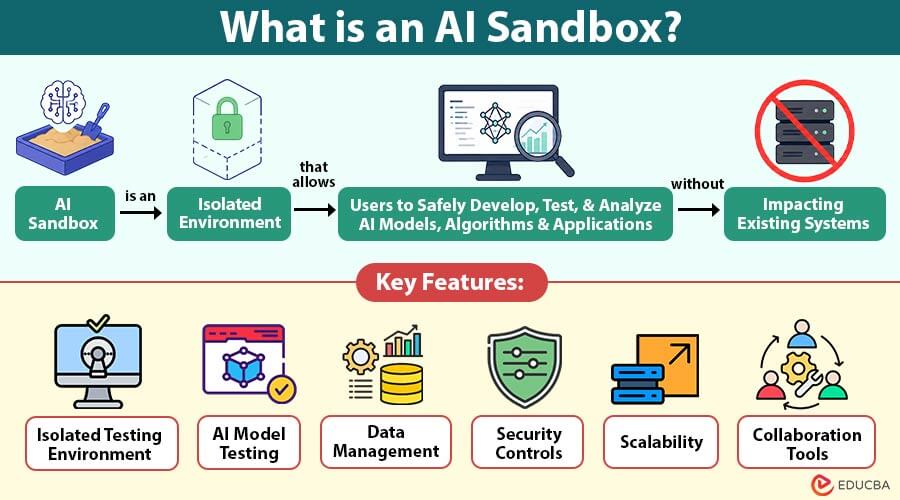
An AI Sandbox is an isolated environment that allows users to safely develop, test, and analyze AI models, algorithms, and applications without impacting existing systems. It provides access to computing resources, datasets, development tools, and security controls required for AI experimentation.
Unlike traditional development environments, AI sandboxes are designed specifically for artificial intelligence workloads. They help organizations test machine learning models, generative AI applications, large language models (LLMs), and automation systems while reducing risks.
For example, a company developing an AI chatbot can use an AI sandbox to test responses, detect errors, evaluate security vulnerabilities, and improve performance before releasing it to customers.
Table of Contents:
Key Takeaways:
- AI Sandboxes provide secure environments for developing, testing, and improving artificial intelligence applications.
- They reduce AI risks by isolating experiments from production systems and sensitive data.
- They accelerate innovation through scalable resources, tools, and controlled testing processes.
- Organizations use AI sandboxes to build reliable, secure, and responsible AI solutions.
Why is AI Sandbox Important?
AI systems often process large amounts of data and make automated decisions. Incorrect predictions, security vulnerabilities, or biased outputs can create serious business and operational risks.
AI sandboxes help organizations overcome these challenges by providing:
1. Safe AI Experimentation
Allows developers to test models and applications securely without affecting production systems or business operations.
2. Improved Security
Reduces risks by providing protected environments with access controls, monitoring, and security policies against threats.
3. Data Protection
Protects sensitive data through controlled access, privacy features, and anonymized datasets during AI testing processes.
4. Faster AI Development
Accelerates development by providing tools, resources, and frameworks to quickly build and evaluate AI solutions.
How Does an AI Sandbox Work?
An AI Sandbox works by creating an isolated environment in which AI applications can operate independently of external systems.
The main steps include:
1. Environment Creation
The organization creates a virtual AI environment with required resources such as:
- Computing power
- Storage capacity
- AI frameworks
- Development tools
- Testing datasets
Cloud platforms often provide scalable infrastructure for AI sandbox environments.
2. Data Integration
Developers add the datasets required to train and test AI models.
The data can include:
- Structured business data
- Images
- Text documents
- Audio files
- Sensor data
Security controls ensure that sensitive information remains protected.
3. Model Development
AI developers use machine learning platforms or frameworks like TensorFlow and PyTorch to create and train machine learning models. They can try out various settings and algorithms.
4. Testing and Evaluation
The AI model is tested for:
- Accuracy
- Performance
- Security
- Bias
- Reliability
- Ethical compliance
Teams analyze results and improve the model before production deployment.
5. Deployment Preparation
After successful testing, the AI solution can be integrated into real-world applications. The sandbox environment ensures that only reliable and secure AI models move into production.
Key Features of AI Sandbox
Below are the key features that help organizations safely develop, test, manage, and efficiently deploy AI solutions.
1. Isolated Testing Environment
Separates experimental projects from business systems, preventing unexpected AI behavior and operational disruptions.
2. AI Model Testing
Organizations evaluate multiple AI models, compare performance, and select the most effective solutions before deployment.
3. Data Management
Helps manage, prepare, organize, and protect datasets required for AI model training.
4. Security Controls
It provides authentication, permissions, encryption, monitoring, and threat detection to secure AI environments.
5. Scalability
Allows organizations to efficiently adjust computing resources to changing AI project requirements.
6. Collaboration Tools
Enables teams to securely share models, datasets, and test results within a single environment.
Types of AI Sandboxes
Below are the different types that support various requirements for AI development, testing, research, and deployment.
1. Cloud-Based AI Sandbox
Cloud AI Sandboxes use cloud platform infrastructure to provide scalable computing resources. They are commonly used by businesses that need flexible AI development environments.
2. Enterprise AI Sandbox
Enterprise AI sandboxes are designed for organizations that require strict security, compliance, and governance controls. They help businesses develop AI solutions while maintaining internal policies.
3. Research AI Sandbox
Research institutions and universities use AI sandboxes to experiment with new AI technologies, algorithms, and models.
4. Generative AI Sandbox
Generative AI sandboxes allow users to safely test large language models, AI assistants, and content-generation applications.
Benefits of AI Sandbox
Below are the key benefits that help organizations reduce risks, improve AI quality, support innovation, and enable responsible AI development.
1. Reduces AI Development Risks
Allows organizations to identify problems early before deploying AI systems. This reduces failures, security issues, and operational risks.
2. Supports Innovation
Developers can experiment with new AI ideas without worrying about damaging existing systems. This encourages creativity and faster innovation.
3. Lowers Development Costs
Reduces infrastructure setup costs by providing ready-to-use development environments. Organizations can test solutions without investing heavily in additional hardware.
4. Improves AI Quality
Continuous testing and evaluation help improve model accuracy, reliability, and performance.
5. Enables Responsible AI Development
Help organizations evaluate fairness, transparency, privacy, and ethical considerations before deploying AI systems.
AI Sandbox Use Cases
Below are the key use cases across different industries, helping organizations safely test, improve, and implement AI solutions.
1. Healthcare
Healthcare organizations use AI sandboxes to test medical AI applications, analyze patient data, and improve diagnostic models while protecting sensitive information.
2. Finance
Banks and financial institutions use sandboxes to test fraud-detection models, risk-analysis systems, and automated financial solutions.
3. Customer Service
Companies test AI chatbots and virtual assistants in sandbox environments to improve customer interactions.
4. Cybersecurity
Security teams use it to evaluate threat detection models and analyze suspicious activities safely.
5. Manufacturing
Manufacturers test AI-powered automation, predictive maintenance systems, and quality control solutions.
6. Education
Educational institutions use it to develop personalized learning systems and evaluate AI-based teaching tools.
Challenges of AI Sandbox
Below are the challenges that organizations must address to ensure secure, efficient, and successful AI development and testing.
1. High Computing Requirements
AI models require powerful hardware and storage resources, thereby increasing infrastructure and operational expenses.
2. Data Management Complexity
Managing, preparing, and maintaining high-quality datasets for AI testing requires significant effort and expertise.
3. Security Maintenance
Organizations must continuously monitor sandbox security, access controls, and potential threats to ensure protection.
4. Integration Challenges
Connecting tested AI models with existing systems may require additional development work and technical adjustments.
5. Governance Issues
Organizations need clear policies for AI use, compliance management, and responsible AI implementation.
Final Thoughts
An AI Sandbox provides a secure and controlled environment for developing, testing, and improving artificial intelligence solutions. It helps organizations reduce risks, protect data, accelerate innovation, and ensure responsible AI deployment. As businesses continue adopting AI and generative AI technologies, AI sandboxes will play a critical role in building secure, efficient, and reliable AI applications for the future.
Frequently Asked Questions (FAQs)
Q1. Who can use an AI Sandbox?
Answer: AI sandboxes can be used by AI developers, researchers, businesses, universities, cybersecurity teams, and organizations that want to safely experiment with artificial intelligence technologies.
Q2. Can AI sandboxes be used for testing generative AI models?
Answer: Yes, AI sandboxes help organizations test generative AI applications such as chatbots, content-generation tools, and large language models while reducing the risk of incorrect or harmful outputs.
Q3. How does an AI sandbox improve AI security?
Answer: An AI Sandbox improves security by isolating AI experiments, controlling user access, monitoring activities, and preventing untested models from affecting critical systems.
Q4. Are AI sandboxes available on cloud platforms?
Answer: Yes, many cloud providers offer AI sandbox environments that provide scalable computing resources, storage, AI frameworks, and development tools for building AI applications.
Recommended Articles
We hope that this EDUCBA information on “AI Sandbox” was beneficial to you. You can view EDUCBA’s recommended articles for more information.


