


Updated November 9, 2026
What is Neuro-Symbolic AI?
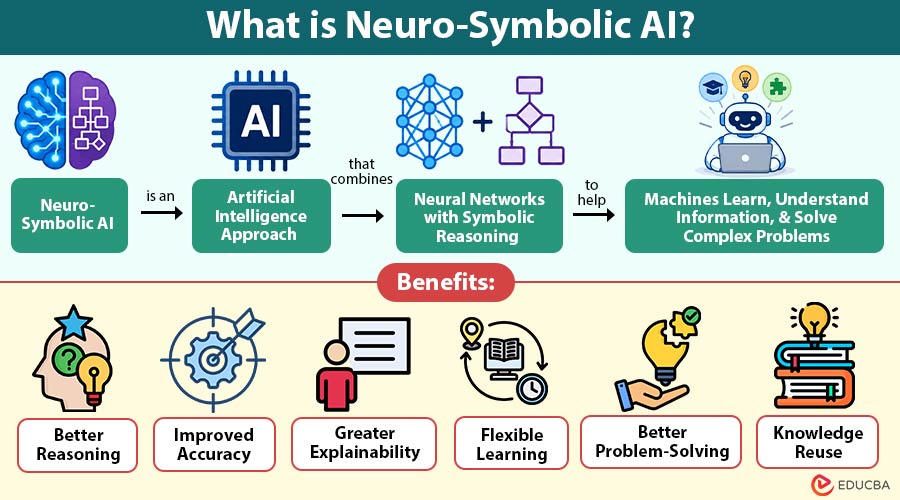
Neuro-Symbolic AI is an artificial intelligence approach that combines neural networks with symbolic reasoning to help machines learn, understand information, and solve complex problems.
Traditional AI systems often follow different approaches to processing information. Neural networks learn patterns from large amounts of data, while symbolic AI uses rules, facts, and logical reasoning to reach conclusions. Neuro-Symbolic AI brings these two methods together.
This combination helps AI systems recognize patterns while also applying logic to understand relationships and make decisions.
For example, imagine an AI system designed to identify objects in photographs. A neural network can recognize objects such as cars, roads, and traffic signals. Symbolic reasoning can then apply traffic rules to understand whether a vehicle is following the correct route or breaking a traffic rule.
By combining learning and reasoning, Neuro-Symbolic AI aims to make artificial intelligence more accurate, explainable, and useful for complex tasks.
Table of Contents:
Key Takeaways:
- Neuro-Symbolic AI combines neural networks and symbolic reasoning to improve machine learning and logical decision-making capabilities.
- It uses learned patterns, existing knowledge, and logical rules to solve problems requiring multiple reasoning steps.
- Healthcare, finance, robotics, and education use Neuro-Symbolic AI to support complex tasks and informed decisions.
- Neuro-Symbolic AI can use existing knowledge and limited training data to support learning in different situations.
Importance of Neuro-Symbolic AI
Neuro-Symbolic AI is gaining attention because it helps overcome some limitations of traditional AI systems. Its importance includes:
1. Combines Learning and Reasoning
It enables machines to learn patterns from available data and apply logical rules to understand information and make informed decisions.
2. Improves Decision-Making
It helps AI systems examine facts, relationships, and logical rules before generating answers or selecting suitable actions for specific situations.
3. Supports Explainability
Symbolic reasoning helps explain certain AI decisions by showing the facts, rules, and logical steps used to reach particular conclusions.
4. Handles Complex Problems
It combines data-based learning with logical reasoning to solve challenging problems that require multiple steps, relationships, and careful evaluation.
5. Reduces Dependence on Large Datasets
Existing knowledge and logical rules support learning when training data is limited, although suitable examples remain important for performance.
How Does Neuro-Symbolic AI Work?
Neuro-Symbolic AI works by connecting neural networks with symbolic reasoning methods. Both components perform different tasks and share information to produce useful results.
The process generally involves the following steps:
1. Collect Input Data
The system receives information such as text, images, numbers, or other data from users, applications, and connected information sources.
2. Recognize Patterns
Neural networks examine the received information to identify important patterns, objects, relationships, and details relevant to the given task.
3. Convert Information
The system converts relevant information into a structured representation that symbolic reasoning components can understand and process effectively.
4. Apply Logical Rules
The symbolic component examines available information using predefined facts, relationships, and logical rules to reach meaningful conclusions.
5. Generate Results
The system combines recognized patterns with logical conclusions to produce useful answers, predictions, recommendations, or appropriate actions.
6. Improve Performance
Feedback, updated information, and additional training help improve the system’s learning capabilities and reasoning performance over time.
The exact process depends on how the system is designed and how its neural and symbolic components communicate.
Components of Neuro-Symbolic AI
Neuro-Symbolic AI uses several important components to combine learning and logical reasoning.
1. Neural Networks
Neural networks learn patterns from training data and help systems recognize objects, understand language, and identify meaningful relationships.
2. Symbolic Representation
It organizes information through symbols, facts, concepts, and relationships, allowing machines to process knowledge using logical methods.
3. Knowledge Base
A knowledge base stores organized information, established facts, and predefined rules that support logical reasoning and informed decision-making.
4. Reasoning Engine
The reasoning engine applies logical rules to available facts and information to draw conclusions and solve specific problems.
5. Integration Mechanism
It connects neural networks with symbolic components, allowing both systems to exchange information and contribute to solving complex tasks.
Types of Neuro-Symbolic AI
Different Neuro-Symbolic AI approaches combine neural learning and symbolic reasoning in different ways.
1. Neural-Symbolic Integration
This approach connects neural networks with symbolic systems. Neural networks identify patterns, while symbolic methods use rules and facts to interpret the results.
2. Symbolic-Guided Neural Networks
In this approach, symbolic rules and existing knowledge guide the learning process of neural networks. This helps systems learn with additional information instead of depending only on training examples.
3. Neural-Guided Symbolic Reasoning
This approach uses neural networks to support symbolic reasoning. Neural models identify relevant information or possible solutions, which symbolic systems examine using logical rules.
4. Hybrid Neuro-Symbolic Systems
These systems combine neural learning and symbolic reasoning within a shared architecture. They allow both components to contribute to tasks such as understanding language, solving problems, and making decisions.
Examples of Neuro-Symbolic AI
The following examples explain how Neuro-Symbolic AI can work in practical situations.
1. Medical Diagnosis
A healthcare AI system can examine medical images and identify possible signs of disease using neural networks. It can then use medical knowledge and diagnostic rules to support its conclusions.
2. Autonomous Vehicles
An autonomous vehicle can use neural networks to recognize pedestrians, traffic signals, and nearby vehicles. Symbolic reasoning can help apply traffic rules and make decisions based on road conditions.
3. Question Answering Systems
An AI system can understand a user’s question using language models and then use facts and logical relationships to produce answers that require multiple reasoning steps.
4. Fraud Detection
A financial system can identify unusual transaction patterns using neural networks. It can also apply business rules and known fraud indicators to examine suspicious activities.
Applications of Neuro-Symbolic AI
Neuro-Symbolic AI has potential applications across different industries where learning and logical reasoning are both important.
1. Healthcare
Helps analyze medical information, identify possible health risks, and support clinical decision-making using learned patterns and medical knowledge.
2. Robotics
Allows robots to recognize their surroundings, understand instructions, and perform tasks by combining visual learning with logical planning.
3. Education
Supports intelligent learning systems that understand student responses, identify knowledge gaps, and provide suitable explanations based on subject rules.
4. Finance
Helps examine financial transactions, identify unusual patterns, and apply business rules to support risk assessment and fraud detection.
5. Scientific Research
Supports researchers in analyzing complex data, identifying relationships, and applying existing scientific knowledge to investigate new findings.
Benefits of Neuro-Symbolic AI
Neuro-Symbolic AI offers several benefits by combining the strengths of two different artificial intelligence approaches.
1. Better Reasoning
It helps AI systems use learned information and logical rules to solve problems that require step-by-step thinking.
2. Improved Accuracy
Combining patterns with logical checks can help reduce certain errors and produce more reliable results.
3. Greater Explainability
Symbolic rules and relationships can provide clearer reasons behind some AI decisions, making results easier to examine.
4. Flexible Learning
It allows systems to use existing knowledge along with new data when handling different tasks.
5. Better Problem-Solving
It supports tasks that require pattern recognition, logical thinking, and understanding relationships between different pieces of information.
6. Knowledge Reuse
Existing facts and rules can be reused across related tasks, reducing the need to develop every solution from the beginning.
Challenges of Neuro-Symbolic AI
Despite its advantages, Neuro-Symbolic AI has certain challenges that organizations must consider before implementing it.
1. Complex Development
Combining neural networks and symbolic systems requires careful design, technical knowledge, and proper coordination between different components.
2. Data Requirements
Neural networks still require suitable training data, and poor-quality information can affect the system’s overall performance.
3. Integration Difficulties
Connecting learned information with symbolic rules can be challenging because both approaches represent and process information differently.
4. Knowledge Representation
Converting real-world information into clear facts, symbols, and logical rules requires time and proper subject knowledge.
5. Scalability Issues
Managing large knowledge bases and complex reasoning processes can increase computing requirements and affect system performance.
6. Maintenance Requirements
Knowledge bases and logical rules need regular updates to remain useful when information, business requirements, or operating conditions change.
Difference Between Neuro-Symbolic AI and Traditional AI
The table below highlights the key differences between the two:
| Basis | Neuro-Symbolic AI | Traditional AI |
| Approach | Combines neural learning and symbolic reasoning. | Often uses individual AI approaches such as machine learning or neural networks. |
| Learning | Learns patterns and uses logical knowledge. | Primarily learns patterns from training data. |
| Reasoning | Supports reasoning through facts and rules. | Reasoning abilities depend on the model and method used. |
| Explainability | Can provide explanations through symbolic rules. | Some models are difficult to interpret. |
| Data Requirements | Can use existing knowledge along with training data. | Often depends heavily on suitable training data. |
Final Thoughts
Neuro-Symbolic AI combines neural networks with symbolic reasoning to help machines recognize patterns, understand relationships, and solve complex problems. Although development and integration remain challenging, it offers valuable applications in healthcare, finance, robotics, and education. Continued research may lead to more reliable, explainable, and capable artificial intelligence systems.
Frequently Asked Questions (FAQs)
Q1. Can Neuro-Symbolic AI work with incomplete information?
Answer: Yes. Neural networks can identify patterns in uncertain or incomplete data, while symbolic reasoning can use available facts and rules to evaluate possible conclusions.
Q2. Does Neuro-Symbolic AI require human supervision?
Answer: Human supervision may be required to develop knowledge bases, define logical rules, review results, and ensure that the system produces appropriate outcomes.
Q3. Can Neuro-Symbolic AI improve the reliability of AI-generated answers?
Answer: It can improve reliability by checking generated information against established facts and logical constraints, although incorrect data or rules can still produce errors.
Q4. Is Neuro-Symbolic AI suitable for small businesses?
Answer: Yes. Small businesses can explore it for specific tasks such as document analysis, customer support, and business rule processing, depending on their technical resources.
Recommended Articles
We hope that this EDUCBA information on “Neuro-Symbolic AI” was beneficial to you. You can view EDUCBA’s recommended articles for more information –


