


What is Pairwise Testing?
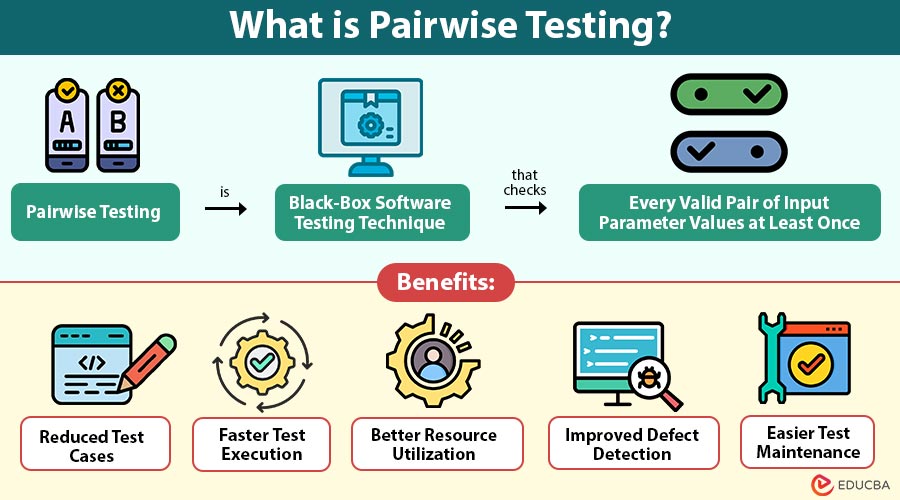
Pairwise testing, also called all-pairs testing, is a black-box software testing technique that checks every valid pair of input parameter values at least once.
Imagine an online shopping application that supports multiple browsers, devices, and payment methods. Testing every possible combination can take considerable time. For example, four browsers, three devices, and three payment methods would require 36 test cases.
Pairwise testing reduces this effort by selecting fewer test cases while ensuring that every possible pair of input values is covered. Since many software defects occur due to interactions between two parameters, this technique helps testers identify potential issues while reducing repetitive testing work.
Table of Contents:
- Meaning
- Importance
- Working
- Key Components
- Process
- Techniques
- Example
- Applications
- Benefits
- Challenges
- Difference
Key Takeaways:
- Pairwise testing examines every valid pair of input values to identify potential software defects efficiently.
- It reduces test cases compared with exhaustive testing, saving time and testing resources.
- Automated tools generate combinations covering interactions between different input parameters while considering application constraints.
- Combining pairwise testing with other testing methods helps improve software coverage, reliability, and quality.
Why is Pairwise Testing Important?
Modern software applications support different devices, operating systems, browsers, languages, and user preferences. Testing every possible combination is not always practical.
For example, a mobile banking application might support several operating systems, authentication methods, account types, and network connections.
Each additional option increases the number of possible testing combinations. Pairwise testing helps organizations manage this complexity by selecting test cases that cover interactions between pairs of input values.
It is particularly useful when testing teams have limited time or resources. However, pairwise testing cannot guarantee that every software defect will be identified. Some problems involve interactions between three or more parameters. Therefore, it is generally used alongside other software testing techniques.
How Does Pairwise Testing Work?
Pairwise testing works by identifying input parameters, defining their possible values, and creating test cases that cover every valid pair.
Consider a mobile application with three input parameters.
| Parameter | Possible Values |
| Operating System | Android, iOS |
| Network Connection | Wi-Fi, Mobile Data |
| Login Method | Password, OTP |
Testing every possible combination requires eight test cases. However, pairwise testing can cover all possible pairs using four carefully selected test cases.
| Test Case | Operating System | Network | Login Method |
| TC01 | Android | Wi-Fi | Password |
| TC02 | Android | Mobile Data | OTP |
| TC03 | iOS | Wi-Fi | OTP |
| TC04 | iOS | Mobile Data | Password |
These test cases ensure that every possible pair of values from different parameters appears at least once.
For example, Android with Wi-Fi appears in TC01, while Android with Mobile Data appears in TC02. Similarly, every combination of network connection and login method is covered. This approach reduces number of test cases from eight to four without losing pairwise coverage.
Key Components of Pairwise Testing
Several components help testers understand how it works.
1. Input Parameters
Input parameters represent different conditions, settings, or features that may influence how a software application behaves during testing.
2. Parameter Values
Parameter values are the available options for each input parameter, such as different browsers, operating systems, or authentication methods.
3. Test Combinations
Test combinations represent selected arrangements of parameter values that testers use to examine software behavior under different conditions.
4. Pairwise Coverage
Pairwise coverage ensures that every valid pair of values belonging to two different input parameters appears in at least one test case.
5. Test Cases
Test cases contain selected input combinations, testing steps, and expected results that help testers verify whether software behaves correctly.
Pairwise Testing Process
It follows a structured process to ensure that important combinations are covered efficiently.
1. Understand the Requirements
Start by reviewing the application’s features, supported environments, and business requirements. Identify areas where different input parameters may interact.
2. Identify Input Parameters
List the parameters that could affect application behavior, such as browsers, devices, operating systems, languages, and payment methods.
3. Define Parameter Values
Identify the possible values for each parameter. Make sure these values reflect actual application requirements and supported configurations.
4. Identify Invalid Combinations
Some combinations may not be supported. For example, certain payment methods might only be available in specific countries. Identify these restrictions before generating test cases.
5. Generate Pairwise Test Cases
Use a pairwise testing tool or suitable algorithm to generate test cases covering every valid pair of parameter values.
6. Execute the Test Cases
Run the generated test cases and compare actual results with expected outcomes. Record any defects discovered during testing.
7. Analyze the Results
Review failed test cases, investigate identified defects, and perform additional testing wherever application requirements or business risks demand greater coverage.
Techniques Used
Different approaches can help testers generate pairwise combinations depending on application complexity.
1. Manual Pairwise Testing
Testers manually create combinations of input values to ensure pairwise coverage. This approach works best when applications contain fewer parameters.
2. Automated Pairwise Testing
Automated tools generate pairwise combinations based on defined parameters and values. This approach is useful for applications with numerous configurations.
3. Orthogonal Array-Based Testing
Orthogonal arrays use mathematical arrangements to organize input combinations systematically. Suitable arrays can provide balanced coverage across different parameter values.
4. Covering Array-Based Testing
Covering arrays generate test cases that cover all required interactions among a specified number of parameters. Pairwise testing uses two-way coverage.
Example of Pairwise Testing
Consider a travel booking website that allows customers to choose a destination, travel class, and payment method.
The available options include:
| Parameter | Values |
| Destination | Domestic, International |
| Travel Class | Economy, Business |
| Payment Method | Card, UPI |
Testing every possible combination would require eight test cases. Using pairwise testing, testers can reduce the number to four.
| Test Case | Destination | Travel Class | Payment Method |
| TC01 | Domestic | Economy | Card |
| TC02 | Domestic | Business | UPI |
| TC03 | International | Economy | UPI |
| TC04 | International | Business | Card |
Each possible pair of parameter values appears in at least one test case.
For example, Domestic with Economy appears in TC01, while International with Business appears in TC04.
This allows testers to examine interactions between input parameters without testing every possible combination.
Applications of Pairwise Testing
It is useful across different industries and software applications.
1. E-Commerce Applications
Online retailers use pairwise testing to examine combinations of browsers, devices, payment methods, and delivery options during customer transactions.
2. Banking Applications
Banking teams apply pairwise testing to verify interactions between account types, transaction methods, authentication options, and supported devices.
3. Mobile Applications
Mobile developers use pairwise testing to examine combinations of operating systems, network connections, screen sizes, and application settings.
4. Web Applications
Web testing teams use pairwise testing to check application compatibility across browsers, operating systems, languages, and different user configurations.
5. Enterprise Software
Organizations use pairwise testing to examine interactions between user roles, system settings, permissions, and business configurations within enterprise applications.
Benefits of Pairwise Testing
It provides several benefits when applications contain multiple input parameters.
1. Reduced Test Cases
Reduces number of test cases by selecting combinations that cover every valid pair of input parameter values.
2. Faster Test Execution
With fewer combinations to execute, testing teams can complete selected testing activities faster while maintaining coverage of two-way parameter interactions.
3. Better Resource Utilization
Organizations can use available testing resources more efficiently by reducing repetitive test execution and focusing on meaningful combinations.
4. Improved Defect Detection
Testing different pairs of input values helps identify software defects caused by unexpected interactions between application settings or conditions.
5. Easier Test Maintenance
A smaller collection of test cases can make reviewing, updating, and maintaining test scenarios easier when application requirements change.
Challenges of Pairwise Testing
Although pairwise testing is useful, it also has certain challenges.
1. Limited Interaction Coverage
Focuses on two-way interactions and may miss defects that occur only when three or more parameters interact.
2. Complex Parameter Selection
Selecting appropriate parameters and values can become difficult when applications contain numerous features, dependencies, and complicated business rules.
3. Invalid Combinations
Some generated combinations may violate application restrictions, requiring testers to define constraints before creating and executing test cases.
4. Additional Testing Requirements
Pairwise testing cannot replace functional, security, performance, or boundary testing because these methods examine different aspects of software quality.
5. Tool Configuration
Automated pairwise testing tools may require additional learning, particularly when defining parameters, configuring restrictions, and reviewing generated test cases.
Difference Between Pairwise Testing and Exhaustive Testing
Pairwise testing and exhaustive testing both examine combinations of input values, but their coverage differs.
| Basis | Pairwise Testing | Exhaustive Testing |
| Meaning | Tests every valid pair of input values | Tests every possible valid combination |
| Test Cases | Generally fewer | Generally more |
| Testing Time | Usually lower | Usually higher |
| Coverage | Two-way parameter interactions | All defined parameter combinations |
| Complexity | More manageable for larger configurations | Increases with additional parameters |
| Best Suited For | Applications with multiple input options | Small input spaces requiring complete coverage |
Final Thoughts
Pairwise testing is a black-box testing technique that examines interactions between input parameters using fewer test cases. It ensures every valid pair of values is tested at least once, helping identify defects, save time, and reduce testing effort. However, combining pairwise testing with other testing methods provides better coverage and improves overall software quality and reliability.
Frequently Asked Questions (FAQs)
Q1. Who performs pairwise testing?
Answer: Software testers and quality assurance professionals usually perform pairwise testing. Developers may also use this technique to examine different application configurations.
Q2. Is pairwise testing easy to learn?
Answer: Yes, the basic concept is relatively simple. However, creating accurate test combinations requires a clear understanding of input parameters and application requirements.
Q3. Can pairwise testing be performed manually?
Answer: Yes, testers can manually create pairwise combinations for applications with fewer parameters. Automated tools are generally preferred for more complicated testing scenarios.
Q4. Is pairwise testing suitable for small applications?
Answer: Yes, pairwise testing can be useful for small applications when multiple input options interact and testing every possible combination becomes unnecessary.
Recommended Articles
We hope that this EDUCBA information on “Pairwise Testing” was beneficial to you. You can view EDUCBA’s recommended articles for more information –

