


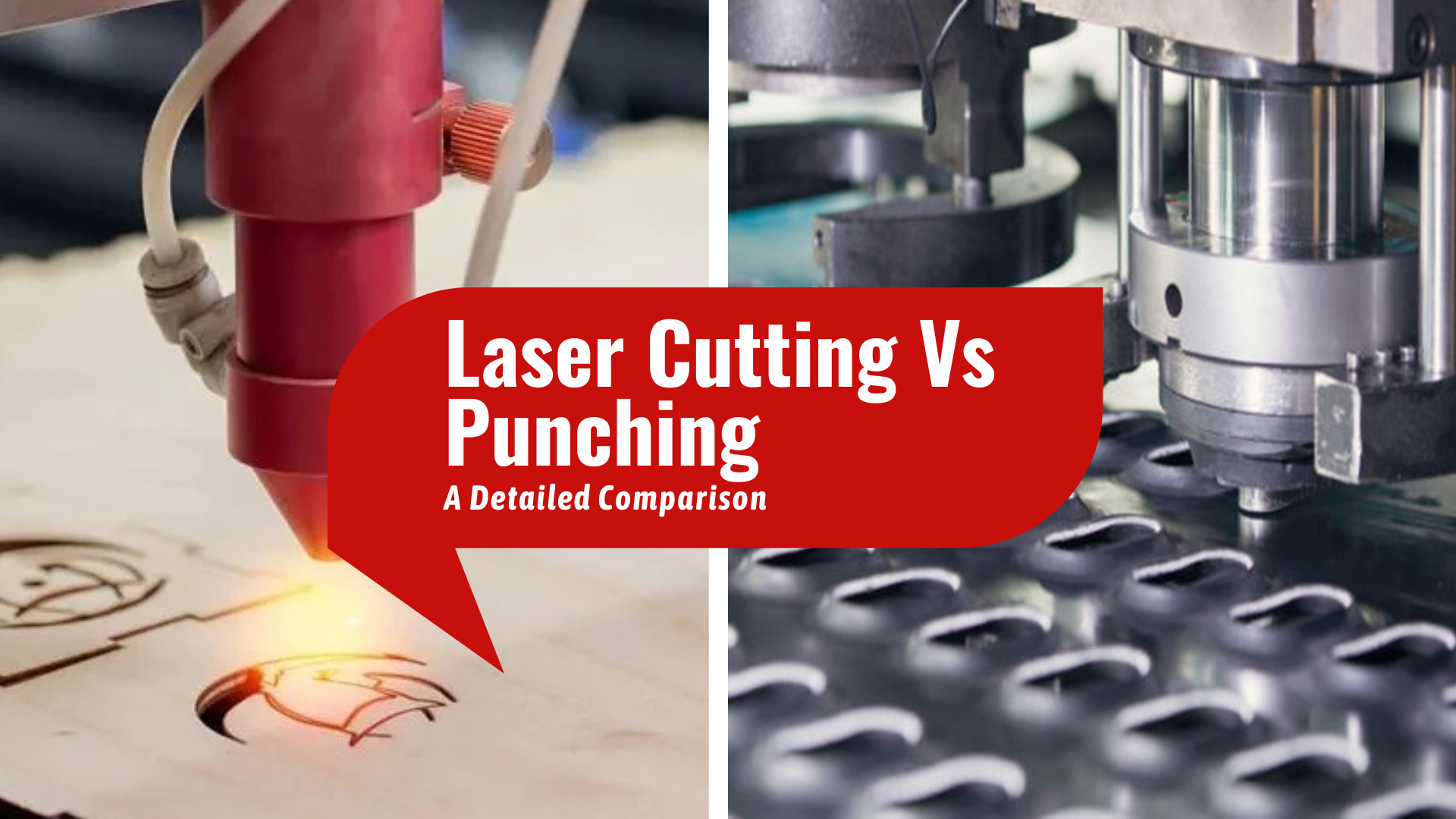
When planning how to manufacture a part, operators often face several cutting options. One of the trickiest decisions is choosing between punching and laser cutting. Both methods can create holes and cut perimeters, but the right choice depends on your specific project needs. Understanding the differences between laser cutting vs punching helps manufacturers select the right process based on factors such as material type, design complexity, production volume, precision, and cost.
This guide explains the differences between punching and laser cutting and highlights which method best suits different part types.
Sheet Metal Laser Cutting Process
Here are the steps involved in the sheet metal laser cutting process;
1. Positioning the Laser
First, place the laser head in a safe location. This prevents heat from damaging the sheet’s edge. It also lets you start the cut at an exact spot.
2. Material Piercing
The laser turns on and pokes through the material. Piercing creates a small hole where the actual cutting will occur. Piercing is very important for both thicker and thinner materials.
3. Following the Cutting Path
The laser follows the part’s design perfectly. The laser adjusts its beam width to match the dimensions of the part being cut. As a result, even complex designs and tight curves can be cut precisely.
4. Exit Safely
When the cut is completed, the laser head moves away from the part. As a result, the laser does not burn or warp the edges of the material. This maintains the material’s quality.
5. Part Separation
The cut piece is released from the material. The operator carefully removes the piece without damaging the surrounding material. This is especially true for parts that nest together closely.
6. Cycle Completion
The laser turns off and resets for the next piece. Each machine calibrates between each cycle to ensure consistency and accuracy. Consistent production is achieved by utilizing machines with calibration capabilities.
Sheet Metal Punching Process
Here are the steps employed in the punching process:
1. Initial Contact
The punch contacts the material in a controlled manner. At that point, the punching process begins. The amount of pressure applied is crucial in preventing cracking or deformation of the material.
2. Material Deformation
The material bends and tears as the punch moves through it. The punch’s shearing action occurs gradually along the length of the shape. If the punch is aligned correctly, the material edges will be clean and sharp.
3. Shear Progression
As the punch progresses through the material’s thickness, it continues to tear apart. As a result, the piece of material is slowly separated from the remainder of the sheet. When the material edges are uniform, it is ready for assembly or welding.
4. Part Release
Once the material has been fully separated from the remaining sheet material, the punch releases the piece. As a result, the punch does not partially cut or damage the material.
5. Final Pressing
The punch extends slightly beyond the material to fully separate it from the remainder of the sheet. In doing so, the edges of the material flatten to prevent it from sticking.
6. Punch Retraction
The punch then retracts back to its original position to prepare for the next punching operation. Retracting the punch minimizes stress on the tool and extends its life.
Laser Cutting vs Punching: Key Comparisons
Here is a detailed comparison of laser cutting vs. punching in terms of setup, cost, geometry, and material suitability.
1. Machine Setup Time
Laser cutting systems require virtually no setup. You place the sheets in frames, and the laser cutting system adjusts parameters such as power, speed, and focus electronically. The laser head automatically aligns itself to the cutting path. Punching presses require loading the punch and die sets, precise positioning, and securing, which increases setup time. For parts with intricate details, adjusting the tooling can take hours.
2. Batch Processing
The time it takes to laser cut directly correlates to the number of parts to be produced. To produce ten times as many parts, it will take about ten times as long. Punch presses are highly efficient for large quantities of parts because they can repeat the same mechanical press cycle multiple times. The time to produce one batch of parts is nearly independent of the total quantity; thus, punching is the most efficient method for repetitive high-volume production runs.
3. Edge Quality
Laser cutting precision produces a smooth edge with virtually no “kerf” (the width of material that is removed by the laser). The kerf of laser cutting can vary in width based on the type and thickness of the material being cut, but is typically in the range of 0.1mm to 0.3mm. The heat-affected zone (HAZ) left behind after cutting is very shallow and therefore minimizes material distortion. Punching produces an edge with a slight burr and some drag marks. Some complex metal parts can develop micro-cracks and/or compressed grain structures adjacent to the hole.
4. Tool Wear
Laser cutting tools do not physically wear because they do not physically cut the material. Punching tools, however, do wear down over time due to repeated impact and shear forces. High-strength metals require hardened steel or tungsten-carbide punches. Punches will eventually wear out, and their punch radius will increase, causing inaccurate holes and requiring tool replacement.
5. Tool Cost (Monetary)
Laser-cutting tools are inexpensive. If special lenses or assist gases are required, additional costs may apply. Punch tooling is expensive to fabricate and maintain. Specialized custom dies require CNC machining and high-strength alloys, making prototyping expensive.
6. Tool Cost (Time)
Laser cutting systems require very little tool preparation time. Punching involves die fabrication, shipping/delivery, and final alignment. Additional delays may occur if tooling must be fabricated and shipped from outside sources or if rework is required.
7. Impact on Surrounding Material
Laser cutting produces a heat-affected zone that depends on the material’s absorption rate at the specified laser wavelength. The HAZ of laser cutting is generally less than 0.5mm deep in mild steel. Punching produces mechanical shock to the material adjacent to the punched hole. Soft metals can experience surface drag, while stainless steel and other hard metals can develop microstructural changes below the surface.
8. Complex Geometry
Laser cutting can produce complex shapes and thin features with minimal distortion. Laser cutting can readily produce internal shapes, small apertures, slots, and “peninsula” features. Punching cannot cut irregular shapes and tight internal cutouts effectively. Punching complex parts may require support structures and/or multiple tool changes.
9. Iterative Design
Laser cutting allows instant design iterations. By modifying the CAD file and sending it to the laser cutter, you avoid retooling. Punching requires new dies for each design iteration, slowing prototyping and increasing costs.
10. Nested Apertures
Laser cutting can remove internal shapes before cutting the part’s outer boundary. This eliminates processing steps and minimizes material waste. Punching internal holes before cutting the outer boundary is difficult and often requires secondary operations or specialized presses.
11. Cost-Effectiveness
Punching is more cost-effective at high, fixed batch sizes due to faster cycle times and lower per-piece cost. Manufacturers can use laser cutting to produce small to medium batches economically and support rapid prototyping and customization when designs require frequent modifications. Additionally, laser cutting offers greater flexibility for creating complex geometric parts without tooling delays.
12. Tolerances
Laser cutting can achieve tight tolerances, typically better than ±0.1mm, depending on the material type and thickness. Punching accuracy depends on tooling wear, mechanical deflection, and vibration. Manufacturers can typically punch holes with diameters equal to the material thickness, while laser cutting can produce holes smaller than half the material thickness.
13. Minimum Aperture Size
Laser cutting can produce excellent features with minimal material weakening. Punching small holes weakens the material and limits accuracy. Vibrations and material spring-back can distort delicate pitch patterns, making laser cutting the preferred method for producing precision components.
Final Thoughts
Choosing between laser cutting vs punching depends on the component’s design, material properties, production volume, precision requirements, and overall manufacturing budget. This guide explored laser cutting and punching and compared them across key factors, including machine setup, batch processing, edge quality, tool wear, tooling costs, material impact, design complexity, iterative design, nested apertures, cost-effectiveness, tolerances, and minimum aperture size.
For projects requiring precise sheet metal components, custom laser cutting services offer a practical way to produce parts with specific dimensions and complex designs. ProleanMFG supports these manufacturing requirements through advanced equipment, quality control processes, and an experienced engineering team, backed by ISO 9001:2015 certification.
Recommended Articles
We hope this guide to laser cutting vs punching helps you choose the right sheet metal cutting method. Explore these recommended articles for more manufacturing insights.

