

Updated October 31, 2026
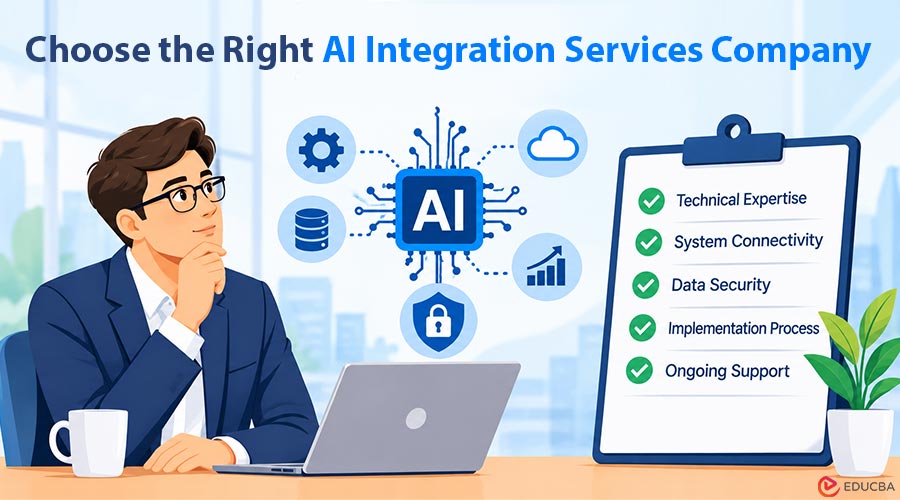
An AI demonstration can classify a customer message in seconds. Connecting that capability to your support platform raises new questions: which account does the message belong to, who can view it, and what happens if the platform rejects the update? Choosing an AI integration services company means evaluating its ability to answer these operational questions.
The right partner should explain how information, permissions, and responsibilities will move through the finished system.
Ask Candidates to Examine a Real Transaction
Give prospective partners one representative task, including an inconvenient exception. For example, ask how they would process a supplier invoice containing an unfamiliar product code and a purchase order that has already closed. Listen to what they investigate before recommending technology.
They should ask about source records, approval rules, existing interfaces, and who currently resolves such cases. This exercise reveals whether the candidate understands integration as a business process. A proposal built entirely around model selection may overlook the systems that determine whether an output is usable.
Compare Evidence Across the Same Criteria
Use a shared scorecard when reviewing candidates. Otherwise, a persuasive presentation can outweigh stronger engineering evidence.
| Evaluation Criterion | Evidence to Request | What a Convincing Answer Includes |
| Comparable Experience | A walkthrough of a completed integration | Responsibilities, constraints, and lessons from operation |
| System Connectivity | A preliminary dependency map | Interfaces, access requirements, and unavailable capabilities |
| Data Handling | A proposed information flow | Storage, permissions, retention, and external processing |
| Failure Recovery | An example of interrupted processing | Retry limits, duplicate prevention, and manual resolution |
| Delivery Ownership | A named team and responsibility outline | Decision makers, assigned specialists, and handover duties |
| Commercial Clarity | An itemized estimate | Assumptions, exclusions, recurring charges, and support terms |
Ask follow-up questions wherever evidence remains vague. Confidentiality may limit what a provider can disclose, but it should still explain its methods without exposing another client’s information.
Discovery Should Produce Decisions
The opening phase should establish the current workflow and its measurable weaknesses. Developers need representative inputs, access to relevant documentation, and conversations with the people who handle exceptions.
Expect a defined scope, a list of dependencies, and acceptance conditions. Each unresolved assumption should have an owner and a method for checking it. Discovery should also identify cases that remain manual. Those boundaries help prevent a small integration from expanding into an undefined attempt to automate an entire department.
How an AI Integration Services Company Should Preserve Business Controls?
The proposed architecture must distinguish generated suggestions from authorized actions. Extracting an invoice amount does not establish that the invoice should be paid. Ask how the team will validate outputs, enforce permissions, and prevent repeated requests from creating duplicate records.
It should explain how the application behaves when a model or connected system becomes unavailable. Development should include operational visibility. Employees need understandable status information, while support teams need enough diagnostic detail to investigate failures.
Acceptance Testing Should Include Disruption
Evaluate more than successful examples. Test incomplete documents, conflicting records, expired access, and delayed responses. Measure the complete task, including employee review and correction. A fast model response offers little benefit if staff must reconstruct every decision before approving it. Agree on who signs off and what evidence supports that decision. Unresolved defects should have explicit consequences for release.
Handover Should Make Continued Operation Possible
Before launch, confirm who monitors the integration, handles incidents, and approves changes. An AI integration services company should provide deployment instructions, configuration records, and documentation of external dependencies.
Support terms should describe response expectations and distinguish maintenance from additional development. Your final selection should reflect the provider’s ability to deliver a maintainable workflow, with clear ownership extending beyond the first successful demonstration.
Recommended Articles
We hope this comprehensive guide to choosing an AI integration services company helps you make informed decisions and build effective AI-powered business solutions. Check out these recommended articles for more insights into AI integration, implementation strategies, and business automation.