
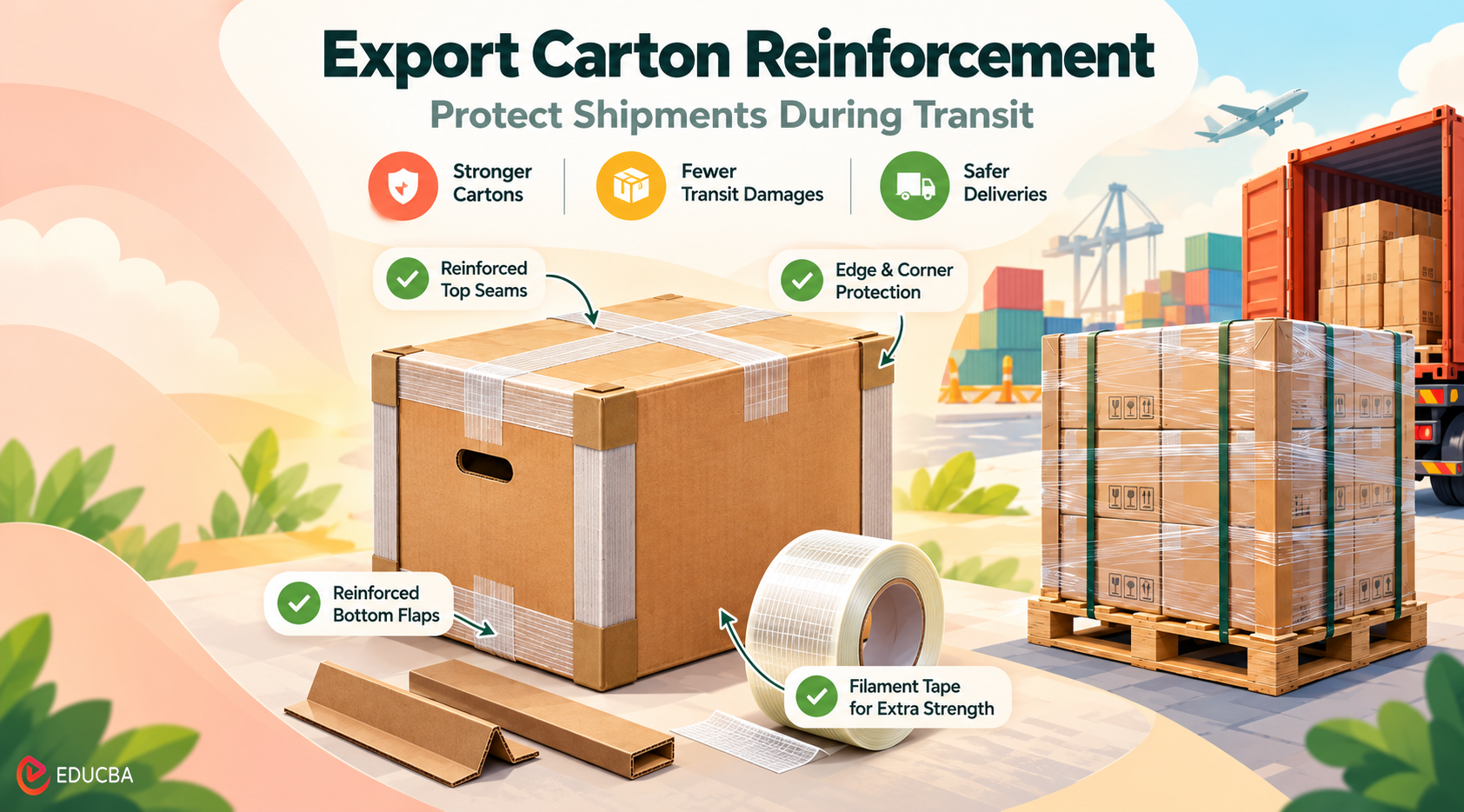
An export carton has more to do than hold a product until the truck arrives. It may be picked up, set down, stacked, moved onto a pallet, loaded again, and exposed to different conditions along the route. A box that looks tidy on the packing bench can reach its destination with an open seam, a torn hand hole, or a pallet load that has shifted out of line. Those failures do not all have the same cause, and they should not all get the same fix.
Effective export carton reinforcement starts with identifying the weak point rather than applying more tape to every damaged area. When damage shows up, inspect where it began. The closure, box wall, corners, and pallet load each perform a different job. Below are six common failure points and the packaging decisions that address them.
What an Export Carton Goes Through?
An export carton can meet impacts, stacking loads, and moisture during one shipment. ISTA’s test-procedure overview describes transport simulation that includes changing conditions and international direct-import shipments. That does not mean a carton prepared according to this article has passed an ISTA procedure.
Inspect the packed carton, then look at how it sits with the rest of the shipment. Check the closure, the walls, and the stability of the stack separately. These checks help determine where export carton reinforcement may be needed before the shipment leaves the facility.
Moisture matters to the carton itself. Research published through Clemson University found that corrugated-box compression strength falls as relative humidity rises under the conditions studied. The practical implication is to look beyond whether the contents are cushioned: the box still needs to support whatever will be stacked on it after its environment changes. If packed boxes wait in a damp staging area, inspect them again before loading. Look for softened corners, panels that have begun to bow, and rows that no longer sit square.
The shipment’s arrangement matters too. In its freight packaging guidance, FedEx says transit damage typically occurs when a shipment has not been properly unitized, bundled, or secured. A sound carton can still become part of a weak pallet load if the rows shift or the stack projects beyond its base. Check that the pallet itself is sound and that the first tier sits squarely on it before building upward; every later tier depends on that base.
Where Export Cartons Usually Fail?
1. A Seam Opens
The first visible warning may be a narrow gap where two panels meet. On a filled carton, that gap can grow as the package is handled and the closure is put under strain. Inspect the entire seam, rather than assuming the top looks secure because its center is covered. A flap that lifts near one edge deserves attention before dispatch.
Watch for: A lifted tape edge, a visible line between panels, or a flap that no longer lies flat.
2. Bottom Flaps Give Way
The bottom closure carries the load while the carton is lifted and moved. With a heavy item inside, a weak box choice or incomplete closure can show up at the bottom before any other part of the carton looks damaged. Turn the packed box over or inspect it from below while it is safely supported. Check the two outer flap edges as well as the center seam; the bottom can begin to open at a corner. A second strip across an already opening flap is not a substitute for selecting a box suited to the contents.
Watch for: Separated bottom flaps, a gap along the closure, or a corner of the bottom panel opening.
3. A Hand Hole Tears
A hand hole can make handling easier, but it also removes material from a corrugated wall. In a study of single-wall corrugated shipping containers, Singh and co-authors found that ventilation and hand holes lowered compression strength. Inspect the opening before the carton goes into a stack. Ask the packer to check both ends of the cutout, where a split can start before the rest of the wall looks damaged. If the opening has begun to tear, review the carton design or choose another box.
Watch for: A split beginning at the edge of the cutout or a distorted opening.
4. Stack Corners Crush
Box corners are easy to overlook because damage can begin as a shallow dent. In a stack, however, a flattened edge is a visible reason to examine how the load is supported and protected. Look down the height of the pallet, not only at the top layer. Protection that stops halfway down leaves part of the stack’s edge exposed.
Watch for: Flattened corners, dented vertical edges, or a stack that no longer has straight sides.
5. Sidewalls Bulge
A panel that bows outward tells you to review the carton and the way the contents are supported inside it. A stronger carton or better internal support may be needed. Check whether the chosen box construction and internal fill match the load before the carton is closed and placed under other freight. Set one packed carton beside an empty one of the same design. The comparison can show whether the contents are pushing the wall out before stacking begins.
Watch for: A side panel that bows, a changed box shape, or a face that will not sit square against its neighbors.
6. A Pallet Load Shifts
On a pallet, the failure may involve several sound cartons moving as one poorly secured load. Look at the rows from more than one side, including the bottom tier where it meets the pallet. A column that leans or a tier that has moved away from the tier below it points to a pallet arrangement problem, not simply to a bad seam on one box.
FedEx’s pallet guidance discusses column stacking, load-protector pads between tiers, stretch wrap, and banding as ways to build and secure unitized freight. Compare the alignment at the top with the alignment at the base; a tidy top does not mean the lower rows have stayed square. Walk around the completed unit once more after securing it. Check for a carton edge peeking beyond the pallet or a gap that appeared as the wrap was applied.
Watch for: Leaning rows, displaced layers, cartons beyond the pallet footprint, or gaps between tiers that were initially aligned.
Matching the Fix to the Failure
Start with hand holes. Effective Export Carton Reinforcement begins by checking whether cutouts are necessary. If a tear has started, change the box design or replace the carton.
For seams and bottom flaps, choose a suitable carton first. FedEx’s small-parcel guidance recommends double-wall boxes for heavier items and an H-pattern tape closure across the flaps and seams on both the top and bottom. Use approved sealing materials, avoiding cellophane, duct, and masking tape.
Where a joint is under strain, reinforcing a carton with filament tape can provide additional support when applied over the seam after the H-pattern closure. Filament tape can also bundle cartons where the shipping method permits. 3M describes glass-yarn filament tape for box closing, bundling, and reinforcing large containers.
For crushed edges, use edge boards along the full height or depth of the pallet stack. These help unitize the load, improve vertical stacking strength, and protect corners. If carton walls bow or cannot support the planned stack, review the box construction and internal fill. Tape cannot replace the compression strength of a suitable carton.
For shifting pallet freight, keep every carton within the pallet edges. FedEx notes that overhanging loads can reduce package compression strength by up to 32%. Column stacking, corrugated pads between tiers, stretch wrap, and banding can improve load stability. Inspect carton alignment before securing the pallet.
Remember that palletized freight and individual parcels have different packaging requirements. FedEx’s small-parcel guidelines prohibit external metal, plastic, or cloth banding and exterior stretch wrap on individual packages. Check the carrier’s requirements for the service booked before dispatch to ensure effective Export Carton Reinforcement throughout transit.
A Pre-Shipment Checklist for Export Carton Reinforcement
- Confirm that any hand holes are appropriate for the carton and load, and replace a carton with an opening that has begun to tear.
- Inspect each seam and bottom flap for gaps before checking the H-pattern closure on both faces.
- Check that the box construction and internal fill support the packed contents without relying on tape to supply missing wall strength.
- Inspect stack corners and make sure edge boards protect the full intended height of the pallet load.
- Look for bowed sidewalls or a carton that will not sit squarely against the next one.
- Keep the pallet rows aligned, the tier sheets in place, and the cartons inside the pallet footprint.
- Secure pallet freight with the planned wrap and banding, or, for an individual parcel, check the carrier’s separate exterior-packaging restrictions.
Final Thoughts
An open seam, torn hand hole, crushed corner, and leaning pallet row call for different fixes. Effective export carton reinforcement begins with inspecting the weak point, choosing a carton and internal support suited to the load, and securing pallet freight as a unit.
If damage keeps appearing in the same place, save one failed carton and note where the failure began before changing the packing method. Before dispatch, confirm that the finishing method fits the carrier service. A targeted approach to export carton reinforcement can help reduce avoidable packaging failures and keep shipments better protected throughout transit.
Recommended Articles
We hope this guide helps you understand how Export Carton Reinforcement can prevent packaging failures and protect shipments during transit. Explore our recommended articles for more insights on corrugated packaging, shipping protection, filament tape, pallet stability, and export packaging solutions.