


Updated October 17, 2026
What is Model Compression?
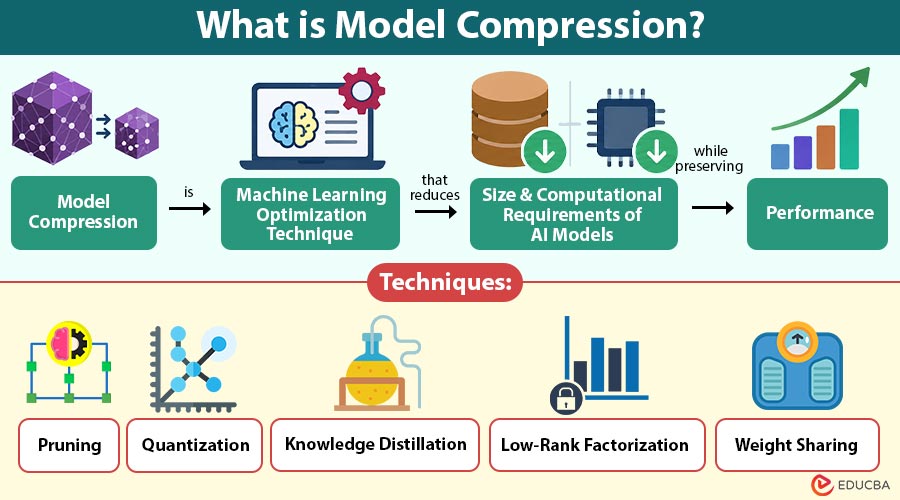
Model compression is machine learning optimization technique that reduces size and computational requirements of AI models while preserving performance.
Modern artificial intelligence (AI) models often contain millions or billions of parameters, requiring substantial memory, processing power, and computational resources. These requirements can make deploying advanced models on smartphones, embedded systems, and resource-constrained devices challenging.
Model compression addresses these limitations by optimizing model architecture, parameters, or numerical representations. It lets developers create smaller, more efficient models without sacrificing significant accuracy or functionality.
For example, a large image recognition model may require hundreds of megabytes of storage. Compression techniques can reduce its memory footprint, allowing it to operate more efficiently on mobile devices.
Table of Contents:
- Meaning
- Working
- Techniques
- Examples
- Benefits
- Challenges
- Difference
- Key Metrics
- How to Implement Model Compression?
- Applications
Key Takeaways:
- Model compression enables organizations to expand AI accessibility across devices with varying technical capabilities.
- Selecting effective compression strategies depends on application requirements, available resources, and acceptable performance trade-offs.
- Combining complementary compression methods can deliver greater efficiency than relying on a single optimization approach.
- Continuous testing helps developers identify potential quality issues and maintain consistent results across deployment environments.
How Does Model Compression Work?
Model compression identifies opportunities to reduce computational complexity, memory usage, or parameter storage while maintaining acceptable model performance.
The process generally involves the following stages.
1. Model Evaluation
Developers examine the original model’s architecture, parameter count, memory requirements, computational demands, and accuracy to identify potential opportunities for effective compression.
2. Compression Technique Selection
Developers select suitable compression techniques based on hardware capabilities, deployment requirements, performance objectives, resource limitations, and acceptable accuracy trade-offs.
3. Model Modification
Developers apply selected compression techniques to remove unnecessary parameters, reduce numerical precision, or transfer learned knowledge into smaller model architectures.
4. Performance Evaluation
Developers test smaller models on suitable devices to check their accuracy, speed, memory use, and how well they work.
5. Model Deployment
Once testing is complete, developers use the smaller models in mobile apps, cloud servers, and other devices while checking how well they work.
Major Model Compression Techniques
Several techniques help developers create efficient machine learning models.
1. Pruning
Pruning removes unnecessary parameters, connections, or components from machine learning models to reduce computational complexity while preserving important information and predictive performance.
2. Quantization
Quantization reduces model memory requirements by representing weights and activations using lower-precision numerical formats while maintaining acceptable accuracy and computational efficiency.
3. Knowledge Distillation
Knowledge distillation transfers learned information from a larger teacher model to smaller student model, enabling efficient predictions with fewer computational resources.
4. Low-Rank Factorization
Low-rank factorization approximates large weight matrices using smaller matrices to reduce parameter storage and computational requirements while maintaining acceptable overall model performance.
5. Weight Sharing
Weight sharing lets multiple connections or operations in machine learning models reuse identical parameter values, reducing storage requirements and model size.
Examples of Model Compression
The following examples illustrate how model compression supports efficient AI deployment.
| Application | Compression Technique | Primary Objective |
| Mobile image recognition | Quantization | Reduce memory consumption |
| Speech recognition | Knowledge distillation | Develop smaller models |
| Object detection | Pruning | Reduce computational complexity |
| Language processing | Low-rank factorization | Reduce parameter requirements |
| Embedded AI systems | Weight sharing | Minimize model storage |
Benefits of Model Compression
Model compression offers several benefits for developing and deploying AI systems.
1. Reduced Storage Requirements
Compressed models require less storage space, making deployment easier on devices with limited memory and storage capacity.
2. Faster Inference
Appropriate compression techniques can reduce computational workloads and improve prediction speed, especially with optimized hardware.
3. Lower Operational Costs
Smaller models may require fewer computing resources, helping organizations reduce infrastructure expenses associated with AI inference.
4. Improved Device Compatibility
Model compression helps AI applications run smoothly on smartphones and other devices with limited memory and computing power.
5. Reduced Energy Consumption
Efficient models can consume less energy during inference, supporting battery-powered devices and potentially reducing computing-related environmental impacts.
Challenges of Model Compression
Despite its advantages, model compression presents several technical challenges.
1. Accuracy Degradation
Excessive compression may remove essential information, reducing predictive accuracy, degrading output quality, and undermining overall reliability across tasks.
2. Hardware Compatibility
Some methods need special hardware, suitable software, or specific systems to help models run faster and work better.
3. Implementation Complexity
Implementing effective model compression requires technical expertise, careful technique selection, extensive experimentation, and a thorough understanding of complex model architectures.
4. Additional Training Requirements
Some methods need extra training, which takes more time, uses more computing power, and increases the overall cost of improving the model.
5. Performance Trade-offs
Reducing model size does not guarantee faster inference, especially when compressed operations lack efficient hardware support or add processing overhead.
Difference Between Model Compression and Model Optimization
The table below highlights the key differences between the two:
| Basis | Model Compression | Model Optimization |
| Meaning | Reduces model size or resource requirements | Improves overall model efficiency or performance |
| Primary Focus | Compact model representation | Broader performance improvements |
| Techniques | Pruning, quantization, distillation | Compilation, kernel optimization, compression |
| Model Size | Frequently reduced | May remain unchanged |
| Objective | Efficient model deployment | Improved execution or predictive efficiency |
Key Metrics for Evaluating Model Compression
Developers measure compression effectiveness using several performance indicators.
1. Compression Ratio
Compares the original model size with the compressed model size to determine the reduction achieved through compression.
2. Model Accuracy
Evaluates whether the compressed model maintains acceptable predictive performance on representative validation or testing datasets.
3. Inference Latency
Measures the time required for a compressed model to process inputs and generate predictions under defined conditions.
4. Memory Consumption
Tracks the memory required to store and execute the model, including parameters, activations, and relevant runtime overhead.
5. Computational Complexity
Estimates the computational operations required for inference, helping developers assess efficiency improvements and potential processing requirements.
6. Energy Consumption
Measures the energy used during model execution to evaluate efficiency improvements, particularly on mobile and embedded devices.
How to Implement Model Compression?
Implementing model compression requires a structured approach to balancing efficiency and performance.
1. Define Performance Objectives
Establish clear targets for model size, predictive accuracy, inference speed, memory consumption, and energy efficiency based on deployment requirements.
2. Analyze the Existing Model
Check which parts of the model use more computing power and memory, and find ways to make it work faster and better.
3. Choose Suitable Techniques
Select appropriate compression techniques, including pruning, quantization, or knowledge distillation, based on model architecture, hardware capabilities, and performance requirements.
4. Apply Compression
Implement the selected techniques using appropriate tools and frameworks, while monitoring changes in model accuracy, computational efficiency, and memory consumption.
5. Fine-Tune When Necessary
Train smaller models again to improve their accuracy, help them work better, and make sure they give reliable results for different tasks.
6. Validate and Deploy
Test smaller models using real-world data and devices to check their speed, accuracy, and compatibility before putting them into use.
Applications of Model Compression
Model compression supports efficient artificial intelligence across several industries and technologies.
1. Mobile Applications
Developers use smaller models to help smartphones recognize images, understand language, and perform other AI tasks with less computing power.
2. Edge Computing
Edge devices use compact models to process information locally, reducing dependence on remote cloud infrastructure and network connectivity.
3. Autonomous Systems
Robotics and autonomous systems benefit from efficient models that support timely perception and decision-making under hardware constraints.
4. Healthcare Technology
Compressed AI models can support medical imaging, wearable monitoring, and diagnostic assistance on suitable resource-constrained devices.
5. Natural Language Processing
Compact language models help chatbots, translate text, sort information, and perform other language tasks while using less computing power.
Final Thoughts
Model compression helps organizations deploy AI more efficiently by reducing model size, memory use, and computational requirements. Techniques such as the pruning, quantization, and knowledge distillation support resource-efficient AI applications. Successful implementation requires balancing compression levels with accuracy, hardware compatibility, and performance objectives to achieve reliable, scalable AI deployment.
Frequently Asked Questions (FAQs)
Q1. Can model compression be applied to pre-trained AI models?
Answer: Yes, model compression can be applied to pre-trained AI models using techniques such as quantization and pruning, often without rebuilding them from scratch.
Q2. Is model compression suitable for large language models (LLMs)?
Answer: Yes, model compression helps reduce memory and computational requirements of large language models, making them more practical for deployment in resource-constrained environments.
Q3. Does model compression always require retraining?
Answer: No, certain techniques, such as post-training quantization, can compress models without retraining. However, other approaches may require fine-tuning to maintain accuracy.
Q4. Can multiple model compression techniques be combined?
Answer: Yes, developers can combine techniques such as pruning, quantization, and knowledge distillation to achieve greater efficiency while managing potential performance trade-offs.
Recommended Articles
We hope that this EDUCBA information on “Model Compression” was beneficial to you. You can view EDUCBA’s recommended articles for more information

