


What is Anchoring Bias?
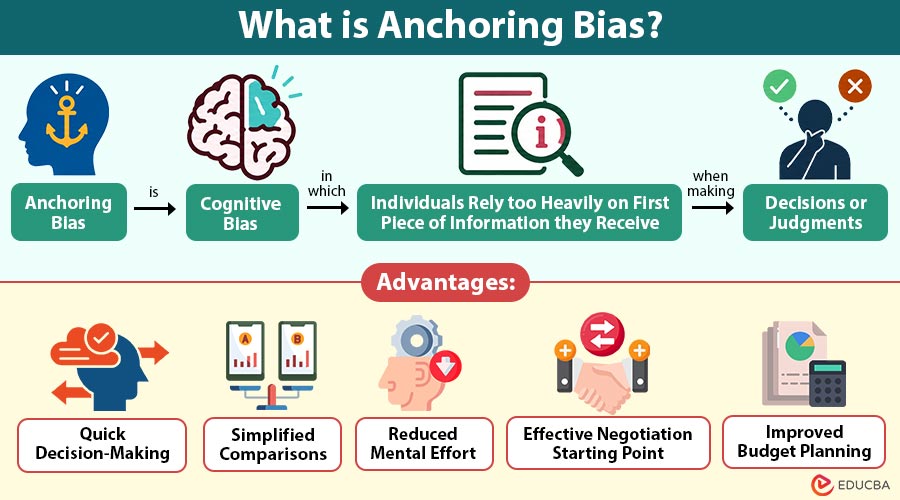
Anchoring bias is cognitive bias in which individuals rely too heavily on first piece of information they receive when making decisions or judgments.
This initial information, known as an anchor, influences how people interpret subsequent information, evaluate alternatives, and reach conclusions. Even when the initial information is inaccurate or irrelevant, it can significantly affect the final decision.
For example, suppose a customer sees a laptop originally priced at ₹80,000 but discounted to ₹60,000. The original price becomes an anchor, making the discounted price appear attractive. However, the customer may overlook whether the laptop is actually worth ₹60,000 compared to similar products.
Anchoring bias commonly occurs in financial decisions, negotiations, marketing, shopping, hiring, investments, and everyday situations. Understanding this bias helps individuals recognize how initial information influences their thinking and make more objective decisions.
Table of Contents:
- Meaning
- Working
- Types
- Examples
- Causes
- Effects
- Applications
- Advantages
- Disadvantages
- How to Avoid Anchoring Bias?
- Difference
Key Takeaways:
- Anchoring bias occurs when initial information disproportionately influences judgments and decisions.
- Anchors can include prices, numbers, estimates, opinions, expectations, and previous experiences.
- The bias affects purchasing decisions, salary negotiations, financial planning, investments, and business strategies.
- Comparing independent information, evaluating alternatives, and questioning initial assumptions can reduce anchoring bias.
How Does Anchoring Bias Work?
Anchoring bias occurs when individuals use initial reference point to evaluate new information. Rather than independently analyzing every available detail, they adjust their judgments around that starting point.
The process generally involves four stages:
1. Exposure to Initial Information
An individual encounters an initial price, number, statement, estimate, or opinion that serves as the starting reference point for evaluating subsequent information.
2. Formation of an Anchor
The initial information establishes a mental reference point, shaping expectations and influencing how individuals interpret, compare, and evaluate additional information they receive.
3. Adjustment Based on New Information
Individuals consider additional information and adjust their judgments accordingly, but these adjustments often fail to overcome the anchor’s influence.
4. Final Decision
The final judgment or decision remains influenced by the original anchor, even when additional evidence suggests that a different conclusion is more appropriate.
For example, during salary negotiations, an employer initially offers ₹50,000 per month. The candidate may negotiate toward ₹55,000 or ₹60,000 instead of independently evaluating whether the position deserves ₹75,000 based on market standards.
Types of Anchoring Bias
Anchoring bias can occur in different types depending on how the initial reference point is established.
1. Numerical Anchoring
Numerical anchoring occurs when an initial number influences subsequent judgments, estimates, or decisions, even when additional information suggests otherwise.
2. Self-Generated Anchoring
Self-generated anchoring occurs when individuals base judgments on reference points from their personal knowledge, past experiences, or existing assumptions.
3. Externally Provided Anchoring
Externally provided anchoring occurs when initial information from advertisements, individuals, or organizations influences subsequent evaluations, expectations, and decision-making processes.
4. Price Anchoring
Price anchoring occurs when an initial price shapes customers’ perceptions of a product’s value, affordability, discounts, and overall purchasing decisions.
Real-Life Examples of Anchoring Bias
The following examples illustrate how anchoring bias influences decisions in various real-life situations.
| Situation | Example of Anchoring Bias |
| Shopping | Customers compare discounted prices with the original listed prices. |
| Salary Negotiation | The first salary offer influences subsequent negotiations |
| Real Estate | Buyers use the initial asking price as a reference for property value. |
| Investing | Investors focus on previous stock prices when making investment decisions. |
| Marketing | Businesses display premium products first to influence perceptions of other products. |
| Project Planning | Teams rely on initial cost estimates despite receiving updated information. |
What Causes Anchoring Bias?
Several psychological and cognitive factors contribute to anchoring bias.
1. Cognitive Shortcuts
The human brain uses mental shortcuts, known as heuristics, to simplify complex decisions. Anchoring provides a convenient starting point but may reduce independent evaluation.
2. Insufficient Adjustment
Individuals often adjust their judgments after receiving new information. However, these adjustments may not move sufficiently away from the initial reference point.
3. Selective Attention
People may focus on information that supports the original anchor while overlooking evidence that suggests a different conclusion.
4. Uncertainty
When individuals lack sufficient knowledge or experience, they may rely more heavily on initial information when making decisions.
5. Time Pressure
Limited decision-making time can push individuals to rely on readily available information instead of making detailed comparisons.
Effects of Anchoring Bias on Decision-Making
Anchoring bias can influence judgment, financial outcomes, and professional decisions.
1. Inaccurate Financial Decisions
Investors may depend on historical prices instead of evaluating current market trends, financial performance, and investment risks.
2. Poor Negotiation Outcomes
Initial offers can shape expectations, leading individuals to accept unfavorable agreements without properly assessing alternatives.
3. Misleading Price Perceptions
Consumers may consider discounts attractive without comparing actual market prices, product quality, or overall value.
4. Biased Business Forecasting
Organizations may rely heavily on initial projections, leading to inaccurate budgets, unrealistic expectations, and ineffective business planning.
5. Reduced Objectivity
Decision-makers may prioritize initial information over relevant evidence, resulting in biased judgments and potentially inaccurate conclusions.
Applications of Anchoring Bias
The following are the key applications of anchoring bias across various business, financial, and professional contexts.
1. Marketing and Advertising
Businesses use reference prices, premium product comparisons, and promotional offers to influence customers’ perceptions of value.
2. Sales and Negotiations
Initial offers can set expectations and shape later discussions about prices, salaries, contracts, and business agreements.
3. Behavioral Finance
Investors may become attached to historical stock prices, purchase prices, or market predictions when evaluating investment opportunities.
4. Human Resource Management
Initial salary expectations, previous compensation, and early interview impressions can influence recruitment and compensation decisions.
5. Business Planning
Initial revenue forecasts, project budgets, and estimated timelines can influence later planning decisions, even when circumstances change.
Advantages of Anchoring Bias
Although anchoring bias can lead to errors, using initial reference points may offer certain practical advantages in decision-making.
1. Quick Decision-Making
Initial reference points help individuals evaluate situations faster, reducing the time required to consider multiple alternatives.
2. Simplified Comparisons
Anchors provide a starting point for comparing prices, products, services, or options without analyzing every detail.
3. Reduced Mental Effort
Relying on familiar information can simplify complex decisions and reduce the cognitive effort involved in processing information.
4. Effective Negotiation Starting Point
Initial offers establish expectations and provide a foundation for discussions about prices, salaries, or business agreements.
5. Improved Budget Planning
Initial financial estimates provide a reference point for developing budgets, allocating resources, and planning future expenses.
Disadvantages of Anchoring Bias
The following are the major disadvantages of anchoring bias:
1. Inaccurate Financial Judgments
Investors may rely on historical prices rather than evaluating current market conditions, financial performance, and potential risks.
2. Unfavorable Negotiation Outcomes
Initial offers can influence expectations, potentially causing individuals to accept agreements that do not reflect fair market value.
3. Misleading Price Evaluations
Consumers may consider discounted products attractive without comparing actual prices, quality, or available alternatives.
4. Unrealistic Business Forecasts
Organizations may rely too heavily on initial estimates, leading to inaccurate budgets, unrealistic targets, and ineffective resource allocation.
5. Limited Objectivity
Decision-makers may prioritize initial information over reliable evidence, leading to biased evaluations and potentially incorrect conclusions.
6. Difficulty Adapting to Changes
Individuals may resist adjusting their judgments when new information, changing circumstances, or updated evidence challenges their initial assumptions.
How to Avoid Anchoring Bias?
Although anchoring bias cannot always be eliminated, individuals and organizations can reduce its influence through structured decision-making.
1. Conduct Independent Research
Gather reliable information from multiple sources before accepting initial estimates, offers, or opinions to develop realistic expectations and informed judgments.
2. Compare Multiple Alternatives
Evaluate different products, prices, proposals, or solutions to identify suitable options without relying too heavily on a single initial reference point.
3. Question the Initial Anchor
Check whether the initial information is accurate, relevant, current, and supported by credible evidence before letting it influence decisions.
4. Use Objective Evaluation Criteria
Establish measurable standards, including market value, product quality, financial performance, and long-term benefits, to support fair, unbiased decision-making.
5. Seek Different Perspectives
Consult people with diverse experiences, expertise, and viewpoints to challenge assumptions and identify biases that may influence important personal decisions.
6. Allow Sufficient Decision-Making Time
Avoid making important decisions under unnecessary pressure; allow enough time to analyze information, compare alternatives, and consider potential long-term consequences.
7. Reevaluate Decisions When New Information Appears
Regularly review initial assumptions and update judgments when reliable new information becomes available, ensuring decisions reflect current facts and circumstances.
Difference Between Anchoring Bias and Confirmation Bias
The table below highlights the key differences between the two:
| Basis | Anchoring Bias | Confirmation Bias |
| Meaning | Overreliance on initial information | Preference for information supporting existing beliefs |
| Primary Influence | First reference point | Preexisting beliefs or expectations |
| Decision Pattern | Adjustments remain influenced by an anchor | Evidence is interpreted selectively |
| Example | Judging a discount using the original price | Reading only reviews supporting a preferred product |
| Prevention | Independent estimates and comparisons | Considering contradictory evidence |
Final Thoughts
Anchoring bias influences how individuals interpret information, evaluate alternatives, and make decisions by relying excessively on initial reference points. It affects financial judgments, negotiations, marketing, and business planning. Recognizing this bias, conducting independent research, questioning assumptions, and comparing alternatives can help individuals make more balanced, informed, and objective decisions consistently.
Frequently Asked Questions (FAQs)
Q1. Can anchoring bias occur without conscious awareness?
Answer: Yes. Anchoring bias often operates unconsciously, influencing judgments even when individuals do not realize that initial information is affecting their decisions.
Q2. Can random numbers influence people’s decisions?
Answer: Yes. Research shows that even arbitrary numbers can influence numerical estimates, particularly when individuals encounter them before making judgments under uncertainty.
Q3. Can artificial intelligence systems exhibit anchoring effects?
Answer: Yes. AI systems can produce responses influenced by initial prompts, examples, or supplied numerical references, although their underlying mechanisms differ from human cognition.
Q4. Is anchoring bias always harmful?
Answer: No. Initial reference points can support efficient evaluations when they are relevant and accurate. Problems arise when individuals rely on them too much.
Recommended Articles
We hope that this EDUCBA information on “Anchoring Bias” was beneficial to you. You can view EDUCBA’s recommended articles for more information.

