


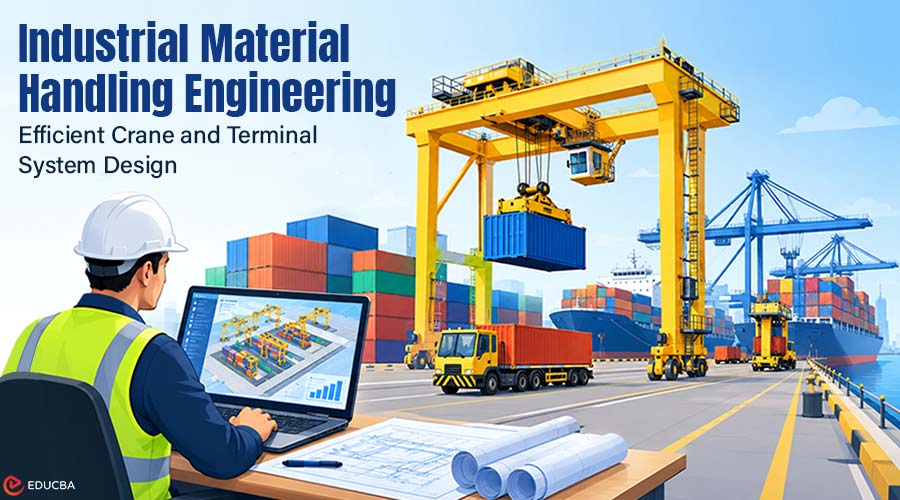
In continuous manufacturing environments and intermodal logistics hubs, lifting and material transport equipment are not ancillary utilities, they are production-critical infrastructure. Selecting the wrong crane type or terminal handling system creates cascading operational inefficiencies: longer cycle times, unplanned structural retrofits, higher maintenance costs, and throughput constraints that limit facility scalability for years after commissioning. Industrial material handling engineering provides a structured approach to selecting, designing, and integrating equipment that meets operational requirements while maintaining structural integrity and cost efficiency.
At the engineering design stage, three primary variables govern equipment selection decisions:
- Civil footprint and structural integration: Whether the facility’s existing structure can bear crane runway loads or whether independent ground-supported legs are required.
- Runway infrastructure and track geometry: Overhead runway beams embedded in building columns versus floor-mounted rail systems that decouple lifting equipment from the building envelope.
- Throughput velocity and duty cycle intensity: The frequency, load weight, and span requirements that determine hoisting class (M3 through M8 under FEM/ISO classifications), motor sizing, and lifecycle replacement intervals.
Understanding how these three variables interact within a given facility type is the foundation of sound crane selection engineering.
Factory & Warehouse Lifting: Overhead vs. Gantry Structural Dynamics
Industrial material handling engineering starts with evaluating a facility’s structural requirements, available floor space, and operational needs. Overhead bridge cranes and gantry cranes offer different advantages depending on these conditions.
Civil Infrastructure vs. Independent Mobility
The fundamental structural distinction between overhead bridge cranes and gantry cranes lies in how they transfer loads. An overhead crane suspends its bridge from runway beams that are either embedded in building columns or attached via tie-backs to the existing structural frame. This means the entire lifted load plus the crane’s dead weight and dynamic impact factors is transferred through the runway into the building’s civil structure. This integration improves floor space utilization.
With no ground-level support legs, the floor beneath an overhead crane stays completely unobstructed, allowing material staging, forklift traffic, and workstation positioning without interference. Gantry cranes, by contrast, are self-supporting structures. Two freestanding A-frame or box-section legs carry their bridge and ride on floor-level rails or, in semi-gantry configurations, on one wall-mounted runway and one floor rail.
This independence from the building frame makes gantry cranes particularly valuable in:
- Outdoor yards and storage areas without overhead structure.
- Facilities whose column spacing, ceiling height, or structural age makes runway beam attachment unfeasible.
- Retrofit situations where adding runway tie-back loads would exceed the building’s original design capacity.
Runway Beam Dynamics and Building Column Load Limits
Runway beam engineering often determines overhead crane selection. When a crane travels along its runway and lifts a load, it imposes vertical wheel loads, horizontal lateral thrust, and longitudinal braking forces on the runway structure. For heavy-duty industrial cranes operating above 20 tonnes, these dynamic forces can be substantial, runway beam deflection limits under CMAA Specification 70 or EN 13001 typically restrict vertical deflection to span/600 or tighter under full load to prevent rail misalignment and premature wheel wear.
The critical engineering question becomes whether existing building columns and their connections can accommodate the cumulative wheel loads from the crane’s end trucks without requiring structural reinforcement. Greenfield facilities can account for these requirements during initial design, while brownfield retrofits require a thorough structural assessment of weld connections, column base plates, and foundation bearing capacity before an overhead system is specified.
In facility design coursework and structural evaluations, engineers often reference a comparative guide on overhead vs gantry cranes to evaluate whether existing runway tie-backs can sustain wheel loadings or if freestanding legs are required. This distinction directly governs the civil engineering scope of a crane installation project and can significantly shift project cost estimates.
Key Selection Criteria for Factory Lifting Systems
- Hook height requirement: Overhead cranes maximize hook height by utilizing full building eave height; gantry legs consume 1.5–3 m of vertical clearance for their leg structure.
- Span and bay geometry: Overhead cranes can span 5–35 m within standard industrial bays; gantry cranes are more practical for spans requiring portability between zones.
- Duty cycle classification: Heavy-duty continuous operations (M6–M8) typically favor fixed overhead systems with engineered runways over portable gantries.
- Maintenance accessibility: Overhead runway systems require walkways or elevated access platforms for periodic inspection of runway joints, end stops, and electrification systems.
Container Terminal & Intermodal Yard Engineering
Container terminals have different operational priorities from enclosed factories. Their equipment must balance storage density, horizontal transportation speed, container retrieval time, and terminal throughput. The following sections compare common equipment types and their operational requirements.
High-Density Stacking vs. Direct Transport Flexibility
Container terminal operations present a fundamentally different material-handling engineering problem than enclosed factory environments. Here, the primary optimization challenge is balancing container stack density, how many TEUs (twenty-foot equivalent units) can be stored per hectare of yard against horizontal transit speed how rapidly individual containers can be retrieved and delivered to quay cranes or truck exchange points.
Two equipment families dominate this trade-off:
- Rubber-Tyred Gantry Cranes (RTGs) operate on pneumatic tires and straddle container rows, stacking containers 4–6 high across typical block widths of 6–8 containers. RTGs offer high stack density and can be repositioned between yard blocks using a drive-off procedure, though this repositioning takes time and reduces operational availability.
- Straddle Carriers are taller, narrower machines that pick and carry individual containers and can stack 2–3 high. Their key advantage is that they serve as both the stacking crane and the horizontal transport vehicle, eliminating the need for separate terminal tractors or automated guided vehicles (AGVs) to deliver containers to the quay apron.
When modeling intermodal yard throughput and container turnover cycles, operations researchers evaluate straddle carriers versus rubber-tired gantry cranes to find the optimal trade-off between horizontal transit speed and vertical stack density. The most suitable option depends on yard layout, annual TEU throughput targets, quay crane productivity, and available capital.
Equipment Duty Cycles and Automation Readiness
From an engineering standpoint, duty cycle intensity in container terminals is extreme. RTGs and straddle carriers in high-throughput ports may execute 300–500 lift cycles per shift, operating across three shifts. This places equipment in FEM M7–M8 duty classifications, requiring reinforced structural members, high-cycle hoist gearboxes, and predictive maintenance based on structural-fatigue monitoring.
Automation readiness is an increasingly critical selection variable. Many greenfield terminal designs have successfully converted RTGs to automated rail-mounted gantries (ARMGs), where the transition from rubber tires to fixed rails provides the precision positioning repeatability automated container handling requires. Straddle carriers, while capable of semi-automation (remote operation), face greater challenges in achieving full automation because their free-roaming navigation in densely trafficked yard environments is complex.
Engineering Evaluation Matrix
The following matrix compares different equipment types across key engineering criteria to support informed selection decisions.
| Evaluation Criterion | Overhead Bridge Crane | Gantry Crane | RTG (Container Terminal) | Straddle Carrier |
| Civil Dependency | High (building structure) | Low (independent) | Medium (paved yard, drainage) | Low (paved yard) |
| Stack Height Utilization | Facility ceiling limited | Leg height limited | 4–6 TEU high | 2–3 TEU high |
| Floor/Yard Obstruction | None (suspended) | Leg footprint | Rail corridors | None (free-roaming) |
| CapEx Range | Moderate–High | Low–Moderate | High | High |
| OpEx & Maintenance Complexity | Moderate (runway inspection) | Low–Moderate | High (tyre wear, gearbox) | High (complex drivetrain) |
| Automation Potential | High | Moderate | High (→ ARMG conversion) | Moderate (semi-auto) |
| Retrofit Feasibility | Structural assessment required | High | Requires yard repaving | High |
| Duty Cycle Suitability | M3–M8 (all classes) | M3–M6 | M7–M8 | M7–M8 |
Pre-Selection Decision Checklist
Use this checklist during the facility programming and pre-FEED (front-end engineering and design) phase:
- Has a structural survey confirmed building column capacity for runway wheel loads? (If no → evaluate gantry)
- Does the application require full floor clearance for concurrent ground operations? (If yes → overhead crane preferred)
- Is the facility sited outdoors or in an unenclosed yard? (If yes → gantry or terminal equipment)
- Is annual TEU throughput above 500,000 TEU/year? (If yes → RTG or ARMG for stack density)
- Is rapid container delivery to the quay a higher priority than stack density? (If yes → evaluate straddle carriers)
- Is full automation a 5-year capital plan objective? (If yes → plan runway infrastructure for ARMG conversion)
- Is the project a brownfield retrofit with constrained civil modification budget? (If yes → gantry or straddle carrier over embedded runway systems)
Best Practices for Industrial Material Handling Engineering
Selecting industrial crane and terminal handling systems is ultimately a structured engineering decision, not a procurement preference. The variables that govern the correct specification—civil load capacity, hook height utilization, duty cycle classification, stack density requirements, and automation roadmap—must be evaluated systematically against one another rather than optimized in isolation.
For facility engineers and operations managers, the following best practices apply across all project types:
- Begin with the civil constraint, not the equipment catalog: Runway infrastructure and structural capacity define the boundary conditions for equipment selection. Inverting this sequence leads to costly post-award redesigns.
- Size for the 10-year throughput forecast, not today’s volume: Crane capacity, runway span, and structural provisions are difficult and expensive to upgrade after installation. Design for anticipated peak demand with appropriate headroom.
- Classify duty cycle rigorously before specifying hoist and drive components: An M4-classified hoist installed in an M7 operating environment will reach its design fatigue life in a fraction of the intended service period, triggering unplanned replacement and production downtime.
- Evaluate total cost of ownership (TCO), not unit CapEx: High-CapEx fixed overhead systems often deliver a lower 20-year TCO than portable alternatives when you fully account for runway maintenance, structural longevity, and automation compatibility.
- Plan the automation migration path at initial design: Whether the near-term plan calls for manual, semi-automated, or fully automated operation, the structural and electrical provisions for future automation upgrades are far less costly to install during initial construction than to retrofit later.
Final Thoughts
Industrial material handling engineering is a structured process that connects equipment selection with structural capacity, operating efficiency, maintenance requirements, and future expansion plans. Overhead cranes can maximize usable floor space when the building structure can support their loads. Gantry cranes provide greater independence from existing buildings.
In container terminals, RTGs support dense stacking, while straddle carriers combine lifting and horizontal transportation. The appropriate solution depends on the facility layout, load characteristics, throughput targets, duty cycle, and automation strategy. By evaluating these factors together and considering total cost of ownership, engineers can design material handling systems that remain safe, efficient, and adaptable throughout their intended service life.
Recommended Articles
We hope this guide to industrial material handling engineering helps you optimize crane selection and terminal operations. Explore these recommended articles for more engineering insights.

