


Updated October 5, 2026
What is Prompt Routing?
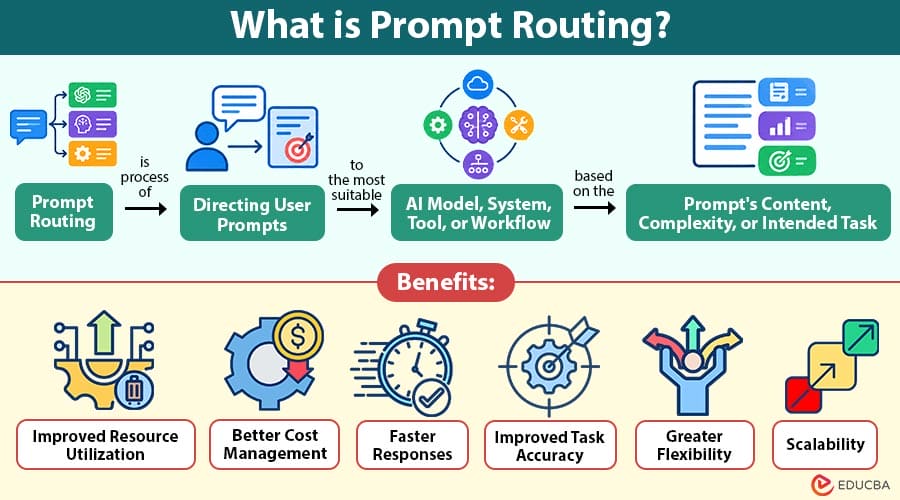
Prompt routing is the process of directing user prompts to the most suitable AI model, system, tool, or workflow based on the prompt’s content, complexity, or intended task. It helps AI applications select an appropriate processing path instead of sending every request to the same model or service.
For example, a simple question may be handled by a lightweight AI model, while a complex coding or reasoning request may be sent to a more capable model. This approach can improve response quality, control costs, reduce unnecessary processing, and support efficient AI system management.
Table of Contents:
Key Takeaways:
- Prompt routing directs user requests to suitable AI models, tools, agents, or workflows.
- It can improve resource utilization, response speed, task accuracy, flexibility, and cost management.
- Prompt routing supports multiple AI systems by matching requests with suitable processing capabilities and requirements.
- Organizations can apply prompt routing across customer service, software development, education, content creation, and data analysis.
How Does Prompt Routing Work?
Prompt routing generally follows a sequence of steps that lets an AI application evaluate a request before selecting a processing path.
1. Receive the Prompt
The system receives a user prompt containing a question, instruction, coding task, document request, or specific business requirement.
2. Analyze the Request
The routing mechanism examines the prompt to understand its purpose, complexity, subject, context, and processing requirements before deciding.
3. Classify the Prompt
The system categorizes the request by purpose, such as coding, customer support, analysis, writing, research, or data processing.
4. Select a Destination
Based on the classification, the router selects a suitable AI model, tool, agent, or workflow to process the request efficiently.
5. Process the Request
The selected model, tool, agent, or workflow processes the prompt and generates the required response or completes the requested action.
6. Return the Result
The completed output is returned to the user through the original AI application, platform, or interface for further use.
Types of Prompt Routing
It can be implemented in different types depending on the design and requirements of an AI system.
1. Rule-Based Routing
Rule-based routing uses predefined conditions, keywords, or rules to decide where a prompt should go, providing simple, predictable routing decisions.
2. Semantic Routing
Semantic routing analyzes the meaning and context of prompts, recognizes similar intentions expressed through different words, and routes them appropriately.
3. Model-Based Routing
Model-based routing uses an AI model or classifier to evaluate incoming prompts, understand their requirements, and select the most suitable destination.
4. Cost-Based Routing
Cost-based routing considers computational and financial costs, directing simple prompts to affordable models while assigning complex requests to advanced models when necessary.
5. Capability-Based Routing
Capability-based routing selects destinations based on required skills, directing specialized tasks such as image analysis to systems with the appropriate capabilities.
Examples of Prompt Routing
Below are some practical examples of how organizations can use prompt routing in AI applications.
1. Customer Support
Identifies whether customer questions involve billing, technical support, account access, or products, directing each request to specialized workflows.
2. Software Development
Development platforms route coding, debugging, documentation, and technical requests to suitable models based on complexity, capabilities, and required reasoning.
3. Financial Services
Financial applications route accounts, educational, document-processing, and business requests to approved systems while applying appropriate controls for sensitive information.
4. Multilingual Applications
Multilingual applications identify the language used in prompts and route requests to suitable language-processing workflows for efficient customer support.
Benefits of Prompt Routing
It can provide several operational and technical benefits.
1. Improved Resource Utilization
Instead of processing every request through the same model, organizations can distribute workloads according to requirements. This can help use available AI resources more efficiently.
2. Better Cost Management
Not every prompt requires a highly capable model. Routing simpler requests to lower-cost systems can help reduce unnecessary AI processing expenses.
3. Faster Responses
Lightweight models and specialized systems can often process suitable requests more quickly. Routing can therefore reduce unnecessary processing for straightforward tasks.
4. Improved Task Accuracy
Matching a prompt with a system designed for the relevant task can improve the likelihood of receiving an appropriate response.
5. Greater Flexibility
Organizations can use multiple AI models, tools, and workflows within one application instead of relying entirely on a single system.
6. Scalability
As AI applications grow, routing can help distribute requests among available models and services. This can support larger workloads without requiring every request to use the most resource-intensive option.
Challenges of Prompt Routing
Although prompt routing can improve AI system management, it also introduces several challenges.
1. Incorrect Classification
A routing system may misunderstand a prompt and send it to an unsuitable destination. This can result in poor responses or unnecessary processing.
2. Routing Complexity
As organizations add more models, agents, and tools, routing logic can become difficult to maintain. Overly complicated routing systems may require regular testing and monitoring.
3. Latency
The routing process itself can add a small amount of processing time. If the system performs several classification steps before reaching the final model, response times may increase.
4. Security Risks
Routing systems may handle sensitive prompts and decide where data goes. Organizations therefore need appropriate access controls, data-handling rules, and monitoring mechanisms.
5. Maintenance Requirements
AI models and business requirements change over time. Routing rules and classification systems may need updates when organizations introduce new models, tools, or workflows.
Difference Between Prompt Routing and Model Routing
The table below highlights the key differences between the two:
| Basis | Prompt Routing | Model Routing |
| Main focus | Directing prompts to suitable processing paths | Selecting an appropriate AI model |
| Destination | Models, tools, agents, or workflows | Primarily AI models |
| Decision factors | Task, intent, complexity, security, and requirements | Model capabilities, performance, cost, or availability |
| Scope | Broader AI workflow management | Model selection |
| Example | Sending a customer query to a support agent or database workflow | Choosing between a lightweight and advanced language model |
Applications of Prompt Routing
It can be applied across many AI-enabled systems, including:
1. Customer Service
Prompt routing directs customer requests to specialized support workflows based on topics such as billing, technical issues, accounts, or products.
2. Enterprise AI
Prompt routing connects employees with approved AI models, enterprise tools, internal systems, and relevant resources based on specific requirements.
3. Software Development
It directs coding, testing, debugging, documentation, and development requests to models or tools with the right technical capabilities.
4. Content Creation
It sends writing, editing, summarization, translation, and content-generation tasks to appropriate AI systems based on their requirements.
5. Healthcare Applications
Directs healthcare information requests to appropriate controlled workflows, helping manage different tasks while supporting privacy and safety requirements.
6. Education
Prompt routing organizes educational questions by subject, difficulty level, learning activity, and appropriate instructional resources or systems.
7. Data Analysis
It sends analytical requests to specialized tools that can process structured datasets, perform calculations, identify patterns, and generate insights.
Final Thoughts
Prompt routing helps AI applications intelligently direct requests to suitable models, tools, agents, or workflows. By considering factors such as task type, complexity, cost, and capabilities, organizations can improve resource utilization and response quality. Effective routing requires accurate classification, security controls, regular monitoring, and ongoing updates as AI systems evolve.
Frequently Asked Questions (FAQs)
Q1. Why is prompt routing important for AI applications?
Answer: Prompt routing helps AI applications choose suitable processing resources based on different user requests and operational requirements.
Q2. Can prompt routing work with multiple AI providers?
Answer: Yes, routing systems can connect different models or AI services and select among them according to predefined requirements.
Q3. How does prompt routing handle ambiguous requests?
Answer: An AI router may examine additional context, request clarification, or use a default processing path when the intended task is unclear.
Q4. What role does context play in prompt routing?
Answer: Context provides additional information about the user’s intent, previous interactions, task requirements, and relevant data, helping the system make routing decisions.
Recommended Articles
We hope that this EDUCBA information on “Prompt Routing” was beneficial to you. You can view EDUCBA’s recommended articles for more information.


