

What is Prompt Injection?
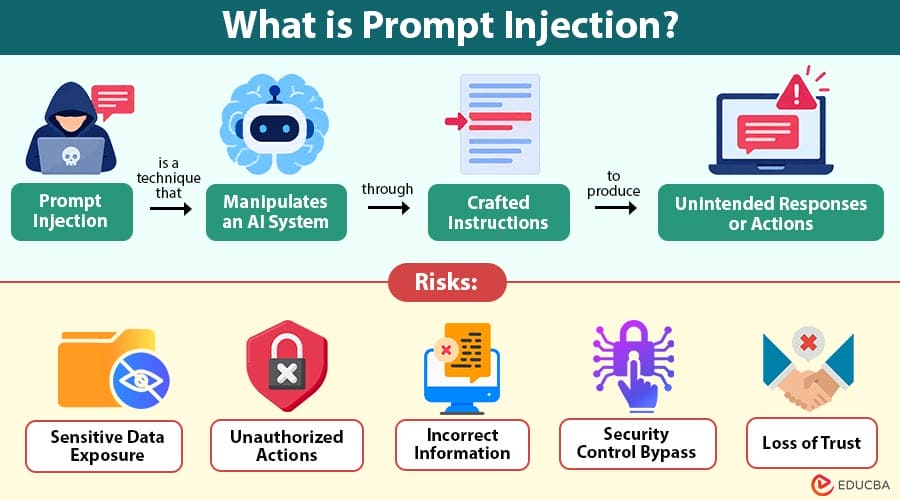
Prompt injection is a technique that manipulates an AI system through crafted instructions to produce unintended responses or actions. It can attempt to bypass rules, expose sensitive information, or influence how the AI processes data.
For example, an attacker may insert hidden instructions into a document or webpage that an AI assistant is asked to analyze.
Table of Contents:
Key Takeaways:
- Prompt injection manipulates an AI model through specially crafted instructions.
- It can affect chatbots, AI assistants, agents, and applications using language models.
- Direct and indirect prompt injection are two common forms.
- Attacks may cause data exposure, unauthorized actions, or incorrect responses.
- Separating trusted instructions from untrusted content helps reduce risk.
How Does Prompt Injection Work?
Prompt injection occurs when an AI application processes attacker-controlled content as part of its input. A typical AI application may receive instructions from several sources:
1. System Instructions
Rules established by developers that define the AI’s behavior, limitations, priorities, and expected responses within an application.
2. User Prompts
Questions or commands entered by users that tell the AI what information to provide or tasks to complete.
3. External Content
Web pages, documents, emails, or database records that provide information but may contain hidden or malicious instructions.
4. Tool Results
Information returned by connected applications or APIs that the AI may process when completing tasks or making decisions.
The security problem arises when the AI model cannot reliably distinguish trusted instructions from untrusted content.
For example, suppose an AI assistant is designed to summarize customer emails. An attacker could insert instructions into an email that attempt to influence the assistant’s behavior. If the application passes the email directly to the model without adequate safeguards, the model may interpret the embedded instructions as commands rather than content to summarize.
The model may then generate an incorrect response or attempt an action the application did not intend.
Types of Prompt Injection
Prompt injection attacks can occur in different ways depending on where the malicious instructions are introduced.
1. Direct Prompt Injection
An attack where malicious instructions are directly entered into an AI prompt to override its intended rules or behavior.
2. Indirect Prompt Injection
An attack where malicious instructions are embedded in external content that an AI processes during its normal operation.
3. Persistent Prompt Injection
An attack where malicious instructions remain stored in data and repeatedly influence an AI system during future interactions.
4. Multimodal Prompt Injection
An attack that embeds malicious instructions within images, audio, documents, or other content processed by multimodal AI systems.
Examples of Prompt Injection
Prompt injection can appear in many AI-enabled applications.
1. AI Customer Support
A customer-support chatbot may be designed to answer questions using an internal knowledge base. A malicious user could attempt to manipulate the chatbot into revealing information that should remain restricted. Without appropriate access controls, the AI could expose information beyond the user’s authorization.
2. AI Email Assistant
An AI assistant may read incoming emails and prepare summaries. An attacker could include instructions within an email designed to influence the assistant. Instead of treating the instructions as email content, an improperly designed system may interpret them as commands.
3. AI Research Agent
An AI research agent may browse websites, collect information, and summarize findings. A malicious web page could contain instructions intended to influence the agent. If the agent has access to additional tools, the impact may extend beyond generating an incorrect response.
4. Document Processing
An organization may use AI to review uploaded documents. A manipulated document could contain instructions that attempt to alter how the AI analyzes or summarizes the file. This demonstrates why uploaded documents should be treated as untrusted input.
Risks of Prompt Injection
Prompt injection can create several security and operational risks.
1. Sensitive Data Exposure
Prompt injection may cause AI systems to reveal confidential information from documents, databases, prompts, or other restricted sources without proper authorization.
2. Unauthorized Actions
Manipulated AI agents may perform unintended actions, such as sending messages, modifying records, accessing services, or creating unauthorized transactions.
3. Incorrect Information
Prompt injection can manipulate AI responses, causing inaccurate, misleading, or incomplete information that affects research, customer service, and business decisions.
4. Security Control Bypass
Attackers may manipulate AI systems to bypass application restrictions, ignore established safeguards, or generate responses that developers intended to prevent.
5. Loss of Trust
Frequent AI manipulation or unreliable behavior can reduce user confidence, especially when organizations depend on AI for important business processes.
How to Prevent Prompt Injection?
Organizations can use multiple layers of protection to reduce prompt injection risks.
1. Treat External Content as Untrusted
Treat information from websites, documents, emails, and users as untrusted, ensuring the AI distinguishes external content from authorized instructions.
2. Apply Strong Access Controls
Use strong access controls to ensure AI systems access only information that users and applications are authorized to retrieve.
3. Limit Tool Permissions
Give AI agents only the permissions necessary for their tasks, preventing unnecessary access to databases, services, transactions, or sensitive operations.
4. Validate Tool Calls
Validate AI-generated tool requests before execution, adding security checks or human approval for sensitive or high-impact actions.
5. Separate Instructions From Data
Keep system instructions, user requests, and external content logically separated to prevent untrusted information from being interpreted as commands.
6. Monitor AI Activity
Monitor AI behavior, tool usage, access attempts, and unusual outputs while maintaining logs to identify suspicious activities and investigate incidents.
7. Test AI Applications
Regularly test AI applications using adversarial prompts and manipulated content to identify vulnerabilities before attackers can exploit them.
Final Thoughts
Prompt injection is a security challenge for AI applications that process instructions and external content. Attackers may manipulate systems through crafted prompts or malicious data. Reducing these risks requires layered protection, including access controls, input handling, permission management, tool validation, monitoring, testing, and human oversight to protect AI systems effectively.
Frequently Asked Questions (FAQs)
Q1. Can prompt injection affect large language models?
Answer: Yes. Large language models can be exposed to prompt injection when applications let them process user input, external content, or information retrieved from other sources.
Q2. Can prompt injection occur without a user directly attacking an AI?
Answer: Yes. Malicious instructions can be placed inside content such as websites, documents, emails, or other data that an AI system later processes.
Q3. Which AI applications are vulnerable to prompt injection?
Answer: Applications that combine language models with external data, browsing capabilities, plugins, APIs, or automated tools can face prompt injection risks, particularly when those systems can take actions.
Q4. Can prompt injection lead to data leakage?
Answer: It can contribute to data leakage if an AI application has access to sensitive information and its surrounding security controls do not properly restrict what the model can retrieve or disclose.
Recommended Articles
We hope that this EDUCBA information on “Prompt Injection” was beneficial to you. You can view EDUCBA’s recommended articles for more information.