


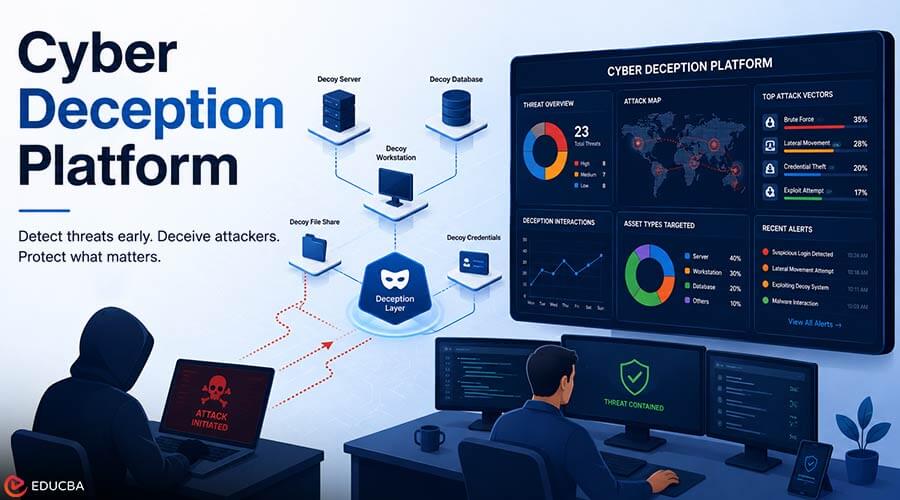
If you are looking for cyber deception platforms, you are probably trying to answer a simple question: Which platform is actually worth considering for an enterprise environment? There are plenty of options. But they take very different approaches. Some focus on honeypots and decoy systems. Others focus on identities, endpoints, cloud environments, OT, or ransomware. A few also bring deception into a larger XDR or security operations platform. So instead of looking at deception as just another security feature, it helps to compare what each platform actually does and where it fits best.
10 Best Cyber Deception Platforms
Here are the best cyber deception platforms worth considering.
1. Fidelis Deception®
Best for: Broad, automated deception across enterprise environments
Fidelis Deception® is a top pick for enterprise security teams because it takes a practical, risk-aware approach to deception. Instead of manually deciding where to place every decoy, Fidelis continuously maps the cyber terrain, assesses asset risk, and helps deploy deception where attackers are most likely to strike. The platform creates realistic decoys from real assets and can emulate operating systems, services, containers, cloud assets, and enterprise IoT devices. It also uses breadcrumbs, lures, deceptive data, and fake Active Directory accounts to make the deception layer convincing.
This helps detect attackers as they move laterally, steal credentials, or search for critical systems. Fidelis Deception® can also work as a standalone solution or integrate with Fidelis Elevate® to correlate deception activity with network, endpoint, Active Directory, and sandbox data.
2. Acalvio ShadowPlex
Best for: Organizations looking for a dedicated deception platform
For years, Acalvio has concentrated on cyber deception, and ShadowPlex is designed with that use case in mind. Its methodology covers identities, endpoints, networks, cloud, and OT/ICS environments. It uses decoys, breadcrumbs, baits, and lures to create environments that attackers are likely to interact with.
One of the platform’s more interesting features is its ability to make real assets appear deceptive and introduce artifacts attackers are likely to investigate. If deception is going to be a dedicated layer in your security architecture, Acalvio is one name worth putting on your shortlist.
3. FortiDeceptor
Best for: IT, OT, and IoT environments
FortiDeceptor comes from Fortinet and is designed to catch attackers by giving them convincing targets to interact with. It supports deception across enterprise IT, OT, and IoT environments. That includes use cases such as stolen credential detection, reconnaissance, lateral movement, and ransomware.
The platform also offers different deployment options, including hardware, virtual, and cloud deployments. For organizations already using Fortinet products, FortiDeceptor can be an especially natural addition to the existing security environment.
4. Zscaler Deception
Best for: Zero-trust environments
Zscaler brings deception into its broader zero-trust ecosystem. Zscaler Deception uses decoys, lures, and breadcrumbs across endpoints, applications, cloud environments, and Active Directory. Since legitimate users should not interact with these deceptive assets, that activity can provide a strong signal of malicious behavior.
The main appeal here is integration. If your organization already relies heavily on Zscaler, adding deception through the same ecosystem can simplify the overall security architecture.
5. Commvault Threatwise
Best for: Ransomware detection and cyber resilience
Commvault Threatwise connects deception with Commvault’s broader focus on data protection and cyber resilience. The platform uses deceptive assets to detect attackers before they can compromise important resources.
This is especially useful for backup protection, since attackers increasingly target backups during ransomware campaigns. If protecting critical data and recovery infrastructure is a major priority, Threatwise is worth considering.
6. Proofpoint Shadow
Best for: Identity attacks and lateral movement
Proofpoint Shadow takes a more identity-focused approach to deception. Instead of relying mainly on separate decoy servers, it can place deceptive files, credentials, sessions, and other artifacts across endpoints. These are designed to look like resources an attacker might actually want.
That makes it particularly interesting for security teams worried about compromised credentials and attackers moving laterally after gaining access.
7. Rapid7 Incident Command
Best for: SOC teams that want deception integrated with security operations
Rapid7 takes a broader platform approach. Its deception capabilities sit alongside security operations functions such as detection, investigation, SIEM, SOAR, and threat intelligence.
The benefit is straightforward: deception alerts can become part of the same workflows your analysts already use for investigation and response. If you are already using Rapid7 across your SOC, this integrated approach may be more appealing than deploying another standalone tool.
8. CounterCraft
Best for: High-interaction deception and threat intelligence
CounterCraft focuses on creating convincing, high-interaction decoy environments. The goal is not simply to trigger an alert when an attacker touches a fake system.
The environment gives attackers something that looks worth exploring, letting defenders observe their behavior and gather intelligence on their techniques and objectives. For organizations that want deception to contribute to threat intelligence and attacker research, CounterCraft is worth a look.
9. Tracebit
Best for: Cloud-native environments and AI agent detection
Tracebit takes a distinctly cloud-focused approach. It deploys canaries across cloud, Kubernetes, CI/CD, identity, and endpoint environments to flag suspicious activity.
Tracebit also focuses on a newer problem: AI agents. Its approach can help identify suspicious activity involving compromised or misbehaving AI agents. That makes it an interesting option for organizations with large cloud environments and growing use of AI agents.
10. Deceptive Bytes
Best for: Endpoint-focused ransomware defense
Deceptive Bytes takes a different route from most platforms on this list. Its Active Endpoint Deception technology works directly on endpoints and uses deceptive information to influence how malware perceives the environment.
The goal is to make an endpoint appear hostile or unappealing to ransomware and other malware, potentially stopping an attack before it executes. If your main concern is endpoint-level deception and ransomware, this specialized approach may be worth considering.
What Should You Look for in a Cyber Deception Platform?
Once you narrow down the vendors, look beyond the feature list and consider how each platform will work in your environment.
- Start with coverage: Can it protect the environments that matter to you, including endpoints, networks, identities, Active Directory, cloud, containers, OT, or IoT?
- Then look at automation: How much manual work is needed to create and maintain deceptive assets? The more your environment changes, the more important automation is.
- Pay attention to alert quality: One of deception’s biggest advantages is that legitimate users generally have no reason to interact with deceptive assets. The platform should take advantage of that and give your analysts meaningful alerts.
- Look at what happens after detection: Can the platform show you what the attacker was trying to do? Can you see reconnaissance, credential abuse, lateral movement, and targeted assets?
- Finally, consider integration: Deception does not have to replace your existing security tools. Check if it integrates with your existing security tools and whether you can use it as a standalone platform.
Which Deception Platform is Right for You?
No single cyber deception platform is ideal for every organization. But for enterprises looking for broad deception capabilities that adapt to their environment, Fidelis stands out as our top choice. Its combination of continuous cyber terrain mapping, risk-aware deception, broad asset coverage, high-fidelity alerts, attacker visibility, and standalone deployment gives security teams a practical way to detect attackers earlier and learn from their activity.
Recommended Articles
We hope this guide to choosing a cyber deception platform helps you strengthen your enterprise security strategy. Check out these recommended articles for more insights and practical strategies to improve your cybersecurity posture.


