


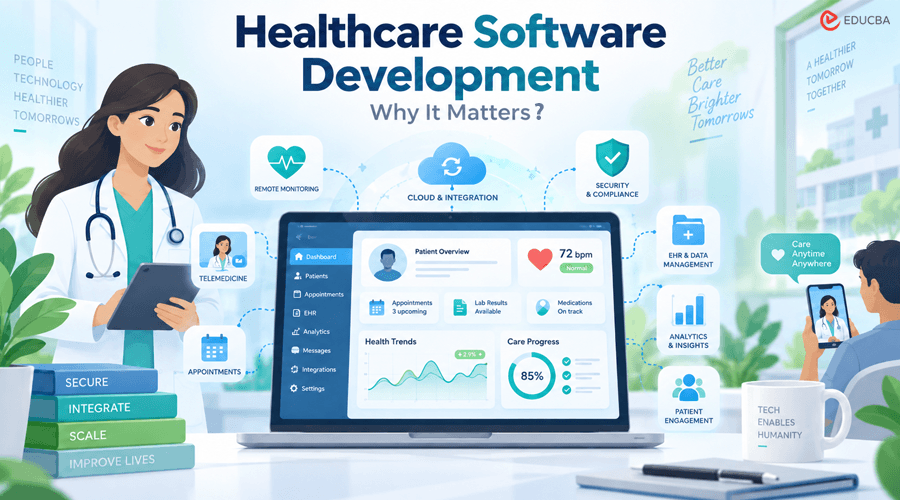
The healthcare industry is rapidly evolving in the digital age. Clinics, hospitals, healthcare startups, diagnostic centers, and wellness providers are adopting software to streamline operations, boost patient experiences, support better decision-making, and manage data. Healthcare software development plays an increasingly important role in helping these organizations address their unique operational and technological needs.
Technology plays a vital role in modern healthcare by enabling telemedicine. With advanced technologies, organizations can schedule appointments, manage hospitals, keep electronic health records, and monitor patients remotely. However, developing full-cycle healthcare software differs greatly from building basic business apps. A healthcare software development company should prioritize security, patient data protection, interoperability, reliability, usability, and regulatory compliance. This guide covers why healthcare businesses need custom Healthcare Software Development and how to choose a suitable partner.
The Growing Need for Custom Software in the Healthcare Industry
Healthcare businesses manage significant complexity, including a never-ending stream of processes, large volumes of data, and multiple systems every day. Off-the-shelf software often does not fit these needs, leading to manual work, disconnected systems, and workflows that are anything but efficient. Healthcare Software Development lets healthcare organizations build solutions that actually fit around how they work and the goals they are trying to achieve.
Improving Operational Efficiency
Custom software can automate routine tasks and make day-to-day workflows much easier across departments. It can help reduce the time spent on manual data entry, appointment management, billing, reporting, and other administrative tasks. This lets staff focus more on patient care and helps the organization run more smoothly.
Better Patient Engagement
Custom software can also make healthcare services easier and more convenient for patients. A custom software development company can help healthcare businesses build features like online appointment booking, patient portals, digital communication, reminders, and telemedicine, all of which can reduce friction in the patient journey. When everything runs smoothly, patient satisfaction increases, patients are more likely to complete their care, and companies get better long-term retention.
Data Security
Healthcare businesses handle highly sensitive patient and business information, making data security a major priority. Custom software can include the security controls you need based on how your organization works, your access requirements, and how you handle data. Role-based access, authentication, audit trails, and other security measures can all help you better control who can access sensitive information. Security should therefore be considered from the beginning of the Healthcare Software Development process rather than added after the product is built.
Better Data Management
Healthcare organizations often use many different systems to manage patient, operational, financial, and clinical information. Custom software can bring these systems together and put the right information in a more centralized, accessible place.
Effective Healthcare Software Development can help connect different data sources and workflows, reducing duplicate work and improving information accessibility. Centralizing your data can reduce errors and give teams much easier access to the information they need.
Reduced Manual Work
Manual administrative tasks can consume a huge amount of time and increase the risk of human error. Custom software can automate processes such as data entry, document management, notifications, scheduling, and routine reporting. By reducing manual work through Healthcare Software Development, staff can spend less time on repetitive tasks and more time on high-value activities.
Scalable Technology
Healthcare businesses often need to adapt as their services, patient base, and operational needs grow, and custom software can be designed with this in mind. This means you can add new features, integrate additional systems, and support growing workloads over time.
A scalable Healthcare Software Development approach makes the technology much easier to adapt as business needs change. Organizations can expand their digital capabilities without replacing their entire technology infrastructure.
Making Better Decisions
Custom software can turn your operational and business data into useful insights through dashboards, reports, and analytics. Healthcare companies can use this information to understand performance, identify bottlenecks, understand patient trends, and make a lot more informed decisions. With relevant information in one place, it is much easier to respond to changing needs and opportunities.
How to Choose the Custom Software Development Company for the Healthcare Industry?
Choosing a healthcare software development partner is more than checking a company’s technical expertise. The right partner should understand healthcare workflows, patient data security, system integrations, and your business’s long-term needs. Before you hire a healthcare app development company for your project, consider these key factors.
Healthcare Experience
Does this company have a track record of working on similar healthcare solutions? Do they understand the specific twists and turns of the industry and the requirements that come with it?
Technical Expertise
Have they worked with the same tech stacks that your project needs, such as Cloud, APIs, mobile, AI, and data analytics?
Security & Compliance
Does the development team know how to keep patient data safe by managing access controls, encryption, and other healthcare compliance requirements?
Integration Capabilities
Can they connect your software to your existing systems, such as EHR/EMRs, billing platforms, laboratories, payment gateways, APIs, and medical devices?
Testing & Quality Assurance
What is their approach to making sure everything works smoothly, securely, and is user-friendly? Do they also test functionality, performance, security, and integrations before and after launch?
Post-Launch Support
Once the project is done, how do they handle maintenance, security updates, bug fixes, monitoring, and future feature improvements?
Communication & Cost Transparency
Choose a partner that clearly communicates about timelines, deliverables, project changes, and costs. Ask for a detailed estimate that includes development, integrations, testing, infrastructure, and ongoing support.
Final Thoughts
Custom software will not automatically solve every problem for every healthcare business. However, it is worth considering when your organization is trying to identify a specific operational bottleneck that existing software cannot handle properly. For any business dealing with disconnected systems, repetitive time-consuming processes, growing data volumes, changing workflows, or integration needs that off-the-shelf software cannot meet, Healthcare Software Development can offer greater control over how technology supports the business.
Before healthcare businesses invest in a software development company, determine where their current systems create bottlenecks, which processes need improvement, and what they need the software to achieve. Then evaluate the required features, integrations, security or compliance requirements, build costs, and long-term maintenance costs. The end goal should not be just building another healthcare software solution. It is about using Healthcare Software Development to create a secure digital solution that scales properly, solves real business problems, and can evolve as the business grows.
Recommended Articles
We hope this guide helps you understand Healthcare Software Development, its benefits, and how to choose the right development partner. Explore our recommended articles for more insights on healthcare technology, custom software development, healthcare app development, data security, and digital transformation.

