


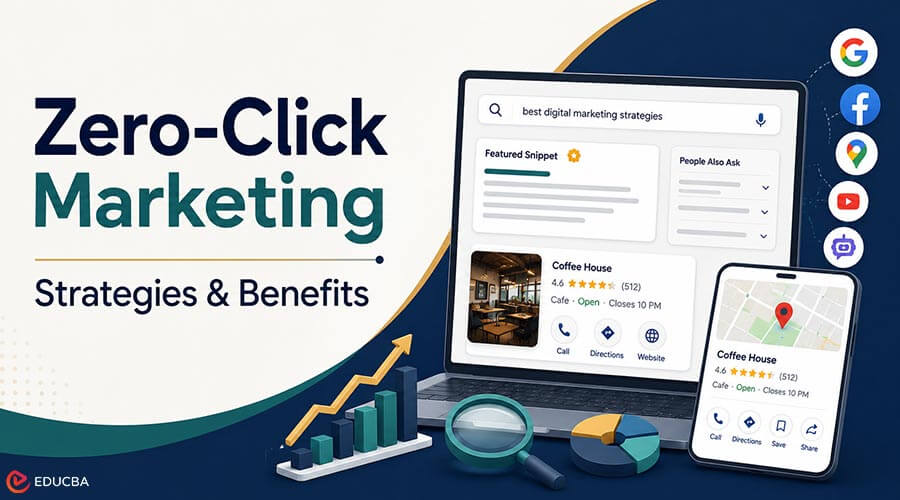
Digital marketing traditionally focuses on attracting users to a website. Marketers create content, optimize webpages, publish social media posts, and run advertising campaigns to encourage people to click and visit a specific destination.
However, customer behavior is changing. Users increasingly expect quick answers and convenient experiences without opening multiple websites or applications. Search engines, social media platforms, maps, marketplaces, and AI-powered tools can now provide information directly where users search.
This shift has created a growing opportunity for zero-click marketing.
Zero-click marketing helps businesses provide useful information, build brand awareness, and influence customer decisions without requiring users to click through to their websites. For example, a user searching for a nearby restaurant can see its rating, location, opening hours, photos, and reviews directly in search results.
The user may visit the restaurant without ever visiting its website.
This approach does not make website traffic irrelevant. Instead, it expands the definition of digital marketing success from simply generating clicks to being visible and useful throughout the customer journey.
Table of Contents
- Meaning
- How Does It Work?
- Importance
- Types
- Strategies
- Examples
- Benefits
- Challenges
- How to Measure?
- Zero-Click Marketing vs. Traditional Digital Marketing
- Best Practices
- Future
Key Takeaways
- Zero-click marketing provides information or opportunities for action without requiring a click to a website.
- Search engines, social media, maps, marketplaces, video platforms, and AI-powered search can support zero-click experiences.
- Featured snippets, People Also Ask results, local listings, reviews, and social content can improve zero-click visibility.
- Businesses should answer customer questions directly and structure content clearly.
- Zero-click marketing complements rather than replaces SEO and website marketing.
- Marketers should measure impressions, engagement, calls, reviews, leads, brand searches, and conversions.
- Local businesses can use zero-click marketing to generate calls, directions, visits, and bookings.
- Strong expertise, accurate information, and consistent brand messaging can improve visibility across digital platforms.
- The goal isn’t to eliminate clicks, but to provide value at every stage of the customer journey.
What is Zero-Click Marketing?
Zero-click marketing is a digital marketing strategy that provides information, answers, brand experiences, or opportunities for action directly on the platform where customers discover a business, without requiring them to visit the company’s website.
Businesses can use search engines, social media platforms, maps, marketplaces, review websites, video platforms, and AI-powered search tools to create zero-click experiences.
For example, suppose a user searches for “What is content marketing?” A search engine may display a direct definition at the top of the results page. If a company’s content provides that definition, it can gain visibility even if the user doesn’t click the webpage.
Similarly, a local business can appear in search results with its:
- Business name
- Rating
- Address
- Phone number
- Opening hours
- Photos
- Reviews
- Directions
The customer can use this information to visit the business without opening its website.
Therefore, zero-click marketing focuses on visibility, usefulness, and customer action rather than clicks alone.
How Does Zero-Click Marketing Work?
Zero-click marketing delivers relevant information at the point where users search or make decisions.
A typical customer journey may look like this:
Traditional Marketing:
Search → Click → Website → Content → Conversion
Zero-Click Marketing:
Search → Direct Answer → Brand Awareness → Action
For example, a customer searching for a nearby gym may see a business profile, review rating, location, photos, and operating hours directly in the search results. The customer can then visit the gym without visiting its website.
Businesses can create this experience by following these steps.
Step 1: Identify Customer Questions
Start by understanding what customers want to know before they buy.
For example, a customer searching for accounting software may ask:
- What is accounting software?
- How does accounting software work?
- How much does accounting software cost?
- What is the best accounting software for small businesses?
These questions provide opportunities to create direct answers.
Step 2: Find Where Customers Search
Customers do not use only traditional search engines. Depending on their needs, they may use:
- Search engines
- Social media platforms
- YouTube
- Online marketplaces
- Review websites
- Maps
- Online communities
- AI-powered search tools
Identify the platforms that matter most to your audience.
Step 3: Create Direct Answers
Provide concise and useful answers to customer questions.
Use:
- Definitions
- Lists
- Tables
- Step-by-step instructions
- FAQs
- Short videos
- Images
- Product information
Give users the answer first, then provide additional details.
Step 4: Optimize Content for Each Platform
Adapt content to the platform where users discover it.
For example, convert a detailed blog post into:
- A LinkedIn carousel
- An Instagram post
- A YouTube video
- A short-form video
- An FAQ
- A checklist
This approach allows customers to consume useful information without leaving the platform.
Step 5: Build Brand Recognition
A customer may encounter your brand several times before making a purchase.
Maintain consistency:
- Brand messaging
- Visual identity
- Expertise
- Tone
- Product positioning
Repeated exposure can make your brand more recognizable and trustworthy.
Why is Zero-Click Marketing Important?
Zero-click marketing has become increasingly relevant as customers change how they discover and evaluate businesses.
1. Users Want Immediate Answers
Customers often want quick answers to simple questions. They may not want to open multiple websites to find basic information.
Zero-click experiences reduce this friction.
2. Search Results Provide More Information
Search engines can display answers, maps, images, reviews, products, videos, and other information directly within search results.
This changes how users interact with search engines.
3. Social Media Supports Product Discovery
Users increasingly discover products and services through social media content.
A customer can watch a product demonstration, read comments, and decide whether to purchase without visiting the company’s website.
4. AI Changes Search Behavior
AI-powered search tools can summarize information and answer conversational questions.
For example, instead of searching for several individual keywords, a user may ask:
“What are the best project management tools for a small marketing team?”
The user can receive a summarized answer without opening multiple websites.
Businesses must therefore focus on becoming useful and trustworthy sources across digital discovery channels.
5. Local Customers Need Quick Information
Local customers often need information such as:
- Location
- Opening hours
- Phone number
- Reviews
- Directions
- Services
They can often access this information directly through search and map results.
Types of Zero-Click Marketing
Businesses can implement zero-click marketing across multiple digital channels.
1. Featured Snippets
Featured snippets provide direct answers to search queries.
For example, a search for “What is email marketing?” may display a short definition at the top of the results.
Businesses can improve their chances of appearing in these results by:
- Answering questions directly
- Using descriptive headings
- Creating concise definitions
- Using numbered lists
- Adding tables
- Structuring content logically
2. People Also Ask
Search engines may display related questions under a People Also Ask section.
Businesses can target these questions by creating clear FAQ sections and dedicated explanations.
For example, an article about digital marketing may answer:
- What is digital marketing?
- What are the types of digital marketing?
- Why is digital marketing important?
- How does digital marketing work?
3. Local Search
Local search provides important opportunities for businesses with physical locations.
A customer searching for “coffee shop near me” can see business information directly in search results.
Businesses should maintain accurate:
- Addresses
- Phone numbers
- Opening hours
- Categories
- Photos
- Reviews
- Services
4. Social Media Content
Businesses can answer questions directly through social media posts.
For example, instead of posting:
“Read our blog to learn five SEO tips.”
A business can provide all five tips in the post itself.
This approach provides value even when users do not click the website link.
5. Video Content
Video platforms can answer questions and demonstrate products directly.
Businesses can create:
- Tutorials
- Product demonstrations
- Explainer videos
- How-to videos
- Expert interviews
- Short educational videos
6. Online Reviews
Reviews can influence customer decisions without requiring website visits.
Customers may compare ratings, read experiences, view photos, and contact a business directly from a search or review platform.
7. AI Search Results
AI-powered search experiences can summarize information from multiple sources.
Businesses can improve their visibility by creating:
- Accurate content
- Original insights
- Well-structured information
- Expert-led content
- Comprehensive topic coverage
Zero-Click Marketing Strategies
Businesses can use the following strategies to strengthen their zero-click marketing efforts.
1. Target Search Intent
Understand why users search for a particular query.
A user searching “what is CRM” has a different intent from someone searching “best CRM software for small businesses.”
Create content that directly matches each intent.
2. Answer Questions Clearly
Do not make users search through long paragraphs for simple answers.
Use the following structure:
Question: What is zero-click marketing?
Answer: Zero-click marketing provides useful information directly on the platform where customers search, without requiring them to visit a website.
Then provide additional explanation.
3. Create FAQ Content
Identify common customer questions and answer them clearly.
FAQs can help businesses address informational searches and improve the usefulness of their content.
4. Optimize Local Business Profiles
Businesses with physical locations should keep their online business information up to date.
Add accurate:
- Business details
- Categories
- Services
- Photos
- Hours
- Contact information
Encourage genuine customers to leave reviews and respond to them professionally.
5. Create Platform-Specific Content
Do not publish the same content everywhere.
Instead, adapt one topic into different formats.
For example:
- Blog: Detailed article
- LinkedIn: Industry insights
- Instagram: Educational carousel
- YouTube: Detailed tutorial
- Short-form video: One practical tip
- FAQ: Concise answer
This approach increases opportunities for customers to discover the brand.
6. Use Structured Content
Use:
- Clear headings
- Short paragraphs
- Lists
- Tables
- Definitions
- FAQs
- Step-by-step instructions
Well-structured content makes information easier for both users and search systems to understand.
7. Build Brand Authority
Publish accurate and useful information consistently.
Support important claims with credible sources and demonstrate subject expertise.
A strong reputation can increase the likelihood that customers trust your brand.
8. Encourage Reviews
Ask genuine customers to share honest experiences.
Monitor reviews and respond professionally to positive and negative feedback.
Reviews can influence customers even when they never visit your website.
9. Optimize for Conversational Queries
Users increasingly ask complete questions.
Instead of targeting only:
“CRM software”
also address:
“What is the best CRM software for a small business?”
This approach helps businesses cover more natural search behavior.
Examples of Zero-Click Marketing
Restaurant
A user searches for “best breakfast restaurants near me.”
The search results display:
- Restaurant names
- Ratings
- Reviews
- Photos
- Opening hours
- Location
- Directions
The user chooses a restaurant and visits it.
The restaurant receives a customer even though the user never visits its website.
This represents a practical zero-click marketing experience.
SaaS Company
A SaaS company creates an article answering common CRM questions.
The content provides clear definitions, comparisons, and examples.
A search engine displays part of the content directly in its results.
Users see the company’s information and associate the brand with CRM expertise, even if they do not click the article.
E-commerce Brand
An e-commerce company creates product videos and social media posts that explain product features.
A customer discovers the product through a social platform, watches the demonstration, reads comments, and decides to purchase.
The customer does not need to visit the company’s blog or homepage before deciding.
Professional Services Firm
A consulting company creates short educational videos that answer common questions related to its services.
A potential customer discovers one of the videos through search or social media.
The video provides enough information to establish the company’s expertise.
The customer may later search for the company directly and become a lead.
Benefits of Zero-Click Marketing
1. Increases Brand Visibility
Zero-click marketing allows businesses to appear in front of potential customers without relying entirely on website visits.
2. Reduces Customer Friction
Customers can find important information immediately instead of navigating through multiple pages.
3. Builds Brand Authority
Helpful answers and educational content can position a company as a knowledgeable source.
4. Supports Local Businesses
Local businesses can attract customers through search listings, reviews, maps, and other direct interactions.
5. Expands Marketing Reach
Zero-click strategies allow businesses to reach users through:
- Search
- Social media
- Video
- Maps
- Marketplaces
- AI-powered platforms
6. Supports Different Customer Journeys
Not every customer follows the same path.
Some users click websites, while others call, visit a physical store, watch a video, or buy directly from a marketplace.
Zero-click marketing supports these different journeys.
Challenges of Zero-Click Marketing
Despite its advantages, zero-click marketing creates several challenges.
Reduced Website Traffic
When users receive answers directly from search results, they may not click through to the website.
This can reduce organic traffic for some informational searches.
Difficult Attribution
A customer may discover a brand through search, interact with its social media content, and later make a direct purchase.
Marketers may struggle to identify which interaction drove the conversion.
High Competition
Businesses compete for visibility across search results, social media feeds, video platforms, marketplaces, and AI-powered search.
Dependence on Third-Party Platforms
Businesses do not control the algorithms or policies of external platforms.
Algorithm changes can affect visibility.
Difficulty Measuring Success
Website clicks provide a relatively clear metric. Zero-click interactions require marketers to consider several metrics together.
How to Measure Zero-Click Marketing?
Businesses should measure zero-click marketing using a combination of visibility, engagement, and conversion metrics.
| Metric | Purpose |
| Search impressions | Measures how often content appears |
| Featured snippet visibility | Tracks direct-answer visibility |
| Local profile views | Measures local discovery |
| Calls | Indicates direct customer interest |
| Direction requests | Indicates potential physical visits |
| Social engagement | Measures audience interaction |
| Video views | Measures video reach |
| Reviews | Indicates customer trust |
| Brand searches | Shows brand awareness |
| Mentions | Measures broader visibility |
| Leads | Measures business interest |
| Conversions | Measures actual results |
Do not judge a zero-click campaign only by website traffic.
For example, website visits may decline while phone calls, store visits, social engagement, or qualified leads increase.
Zero-Click Marketing vs. Traditional Digital Marketing
| Factor | Zero-Click Marketing | Traditional Digital Marketing |
| Primary goal | Provide value and build visibility | Generate clicks and visits |
| Main destination | Search, social, maps, AI, marketplaces, and other platforms | Company website |
| Key action | View, call, message, visit, engage, or purchase | Website visit |
| Content approach | Provide useful information directly | Encourage users to click |
| Measurement | Visibility, engagement, actions, leads, and conversions | Traffic and conversions |
| Customer journey | Distributed across multiple platforms | Often website-focused |
Both approaches remain useful.
Businesses should use zero-click marketing to strengthen discovery while maintaining a strong website for customers who need detailed information or want to complete specific actions.
Best Practices for Zero-Click Marketing
Follow these practices to build an effective zero-click marketing strategy:
- Understand customer search intent.
- Answer important questions directly.
- Use clear and descriptive headings.
- Keep business information accurate.
- Create content for multiple platforms.
- Use short videos and visual content where appropriate.
- Build a strong review profile.
- Use structured formats such as lists and tables.
- Create useful content instead of excessive promotional content.
- Build topical and brand authority.
- Optimize content for conversational searches.
- Track visibility and customer actions.
- Connect zero-click metrics with business outcomes.
- Update content regularly.
- Continue investing in your website and traditional SEO.
Future of Zero-Click Marketing
Zero-click marketing will likely become more important as digital platforms continue to improve how they organize and present information.
Search engines can answer more questions directly. Social media platforms support discovery and product research. Maps connect customers with local businesses. Marketplaces provide product information and reviews. AI-powered search can summarize information and help users compare options.
These developments mean businesses must think beyond website rankings.
The future of digital marketing will increasingly focus on distributed visibility.
A customer may:
- Discover a brand through search.
- Watch its video on social media.
- Read customer reviews.
- Compare products on a marketplace.
- Ask an AI tool for recommendations.
- Visit the website.
- Make a purchase.
The website remains important, but it represents only one part of the customer journey.
Therefore, businesses should focus on becoming visible, useful, credible, and recognizable across the platforms their customers use.
Frequently Asked Questions (FAQs)
Q1. Can small businesses use zero-click marketing?
Answer: Yes. Small businesses can use local listings, customer reviews, social media posts, videos, and direct answers to improve visibility without relying on website visits.
Q2. Can zero-click marketing generate leads?
Answer: Yes. Businesses can generate leads through phone calls, messages, appointment requests, social media inquiries, and lead forms that users can access without visiting a website.
Q3. Does zero-click marketing work for B2B companies?
Answer: Yes. B2B companies can share industry insights, answer technical questions, publish educational content, and demonstrate expertise through search engines, LinkedIn, videos, and AI-powered platforms.
Q4. Is zero-click marketing suitable for e-commerce businesses?
Answer: Yes. E-commerce businesses can use product listings, reviews, social commerce, videos, marketplaces, and search features to help customers discover and evaluate products without visiting their websites.
Q5. What is the biggest mistake businesses make with zero-click marketing?
Answer: A common mistake is focusing only on impressions and views instead of measuring meaningful outcomes such as engagement, inquiries, leads, store visits, and sales.
Final Thoughts
Zero-click marketing changes how businesses think about digital visibility. Instead of focusing exclusively on driving users to a website, marketers can provide useful information wherever customers search, compare, and decide.
Businesses can use featured snippets, local search, social media, video, reviews, marketplaces, and AI-powered search to create valuable customer experiences without depending on website clicks.
However, zero-click marketing should not replace traditional SEO or website marketing. A strong website still provides an important destination for detailed information, product exploration, lead generation, and transactions.
The most effective approach combines both strategies:
Get discovered → Provide value → Build trust → Encourage action.
By following this approach, businesses can stay visible even when customers don’t click immediately.
Recommended Articles
We hope this guide helps you understand how Zero-Click Marketing can improve brand visibility, customer engagement, and conversions without relying only on website clicks. Explore these recommended articles for more insights on SEO strategies, search intent, content marketing, digital marketing, local SEO, brand awareness, and AI-powered marketing.


