


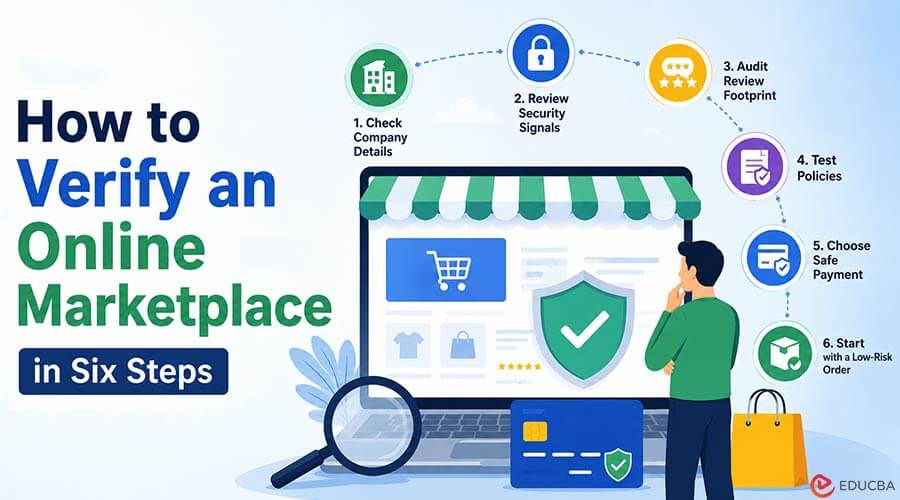
A repeatable six-step check for any online marketplace: identity, security, review footprint, policies, payment protection, and a low-risk first order. Learning how to verify an online marketplace can help you spot potential risks before you buy.
Six Checkpoints on the Path to a Marketplace You Can Trust
Verifying an online marketplace takes six repeatable steps: confirm the operating company exists, read security signals beyond the padlock, audit independent reviews for distribution over time, stress-test the policies, pay through a method with buyer protection, and start with a small order.
Verification is a skill, not a talent, and like any skill, it improves with a procedure. The six checks below run in order of effort: each one is cheap, each one can end the process early, and together they take less time than comparison-shopping for the product itself.
Step 1: Confirm Who Actually Runs the Site
The first step in how to verify an online marketplace is confirming who actually operates the site. Start with the question every scam depends on you skipping: which real-world company operates this marketplace? Scroll to the footer, open the imprint or “about” page, and look for a registered company name, a physical address, and a registration number. Then verify that the company exists outside its own website, in a business register or on a map.
Why this step comes first: it takes two minutes and immediately filters out the worst offenders, before you invest any attention in the catalog. A marketplace that will not say who runs it has answered your question already, and no later signal outweighs that silence.
Pass condition: The operating company is findable outside the site.
Step 2: Judge the Security Signals
Check that the connection uses HTTPS and that the padlock appears on every checkout page, not just the homepage. Look at how the site handles payment forms: consistent design, no redirects to oddly named domains, and no requests for card details over chat or email.
Why this matters less than people think: HTTPS proves the connection is encrypted, not that the people behind it are honest. Treat it as an entry requirement. A site that fails it is disqualified; a site that passes has merely not failed yet.
Pass condition: Encrypted connection and coherent, consistent payment pages.
Step 3: Audit the Review Footprint When Verifying an Online Marketplace
Now leave the marketplace entirely. Reviews hosted on the seller’s own pages are marketing, because the seller decides what stays. The footprint that matters lives on independent platforms where you can browse verified reviews checked before publication and that the business can not edit or remove afterward.
Read the distribution, not the average. Ratings that accumulated steadily over months are evidence; a burst of praise concentrated in one week is a campaign. A few concrete negatives with civil replies from the company are worth more than unbroken enthusiasm.
Pass condition: A steady, independent review history with credible negatives.
Step 4: Test the Policies Before You Need Them
Open the returns and refund policy and read it like you already have a problem. A trustworthy policy names deadlines, a return address, and a refund method. A decorative one speaks warmly and commits to nothing. Consumer rules in many markets, including the EU’s, require sellers to state these terms plainly, so their absence is information in itself.
Check the support channel too: an email address and a phone number beat a contact form that promises a reply “soon.”
Pass condition: Concrete deadlines, addresses, and contacts in writing.
Step 5: Choose Payment With a Safety Net
Prefer the payment method you could reverse: a credit card with chargeback rights or a payment service with dispute resolution. Avoid irreversible transfers on any marketplace you have not used before, no matter the discount offered.
Why this step exists: it is the only protection that still works after every earlier check has been fooled. Buyer protection is the seatbelt of online shopping; you choose it before the ride. Knowing the rules helps too: can a company refuse a chargeback is the question worth answering before you ever need to ask it.
Pass condition: A buyer-protected payment option, actually used.
Step 6: Start With a Low-Risk Order
Finish the verification with an experiment. Order something small and cheap first, and watch the whole pipeline run: confirmation email, shipping updates, delivery time, packaging, and how support answers one simple question. Publishing your own honest review afterward, for instance on WebVouch, closes the loop and leaves the trail you were glad to find in step 3.
A marketplace that handles a fifteen-dollar order well has earned the hundred-and-fifty-dollar one. Repeat the routine on the next unfamiliar storefront, and it compresses to minutes; the checks stay the same even as the shops change.
Pass condition: The small order arrives as promised, and support answers like humans.
Frequently Asked Questions (FAQ’s)
Q1. How to Verify an Online Marketplace?
Answer: To verify an online marketplace, run the six checks in order: confirm the operating company exists, verify security signals, audit independent reviews, read the returns policy for concrete terms, pay through a reversible method, and test with a small first order before committing real money.
Q2. Are reviews on the store’s own site trustworthy?
Answer: Treat them strictly as marketing material. The store controls what appears on its own pages, so weigh independent review platforms instead, and look at how ratings spread out over months rather than the average alone.
Q3. What is the safest way to pay on a new site?
Answer: A method with built-in buyer protection, like a credit card with chargeback rights or a payment provider offering dispute resolution, is generally preferable. Avoid wire transfers and other irreversible methods on any site you have not personally tested end-to-end with a small order.
Final Thoughts
Knowing how to verify an online marketplace can help you shop with greater confidence and avoid unnecessary risks. Start by checking who operates the site, reviewing its security and policies, examining independent reviews, using a payment method with buyer protection, and testing the marketplace with a small order. Following these six steps creates a simple, repeatable process for deciding whether an unfamiliar marketplace is worth trusting.
Recommended Articles
We hope this guide helps you understand how to verify an online marketplace and shop more safely online. Explore these recommended articles for more insights into online shopping safety, payment protection, reviews, chargebacks, and identifying trustworthy websites.

