


What is Intraday Trading?
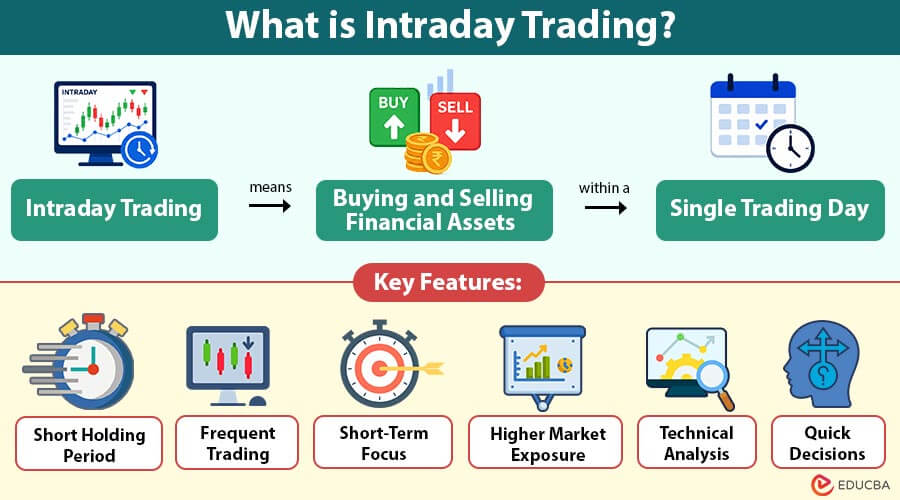
Intraday trading means buying and selling financial assets within a single trading day. Unlike long-term investing, intraday traders do not usually hold their positions overnight. Short-term price changes in stocks, currencies, commodities, or other financial instruments are what they hope to profit from.
For example, a trader may buy a stock at ₹500 in the morning and sell it at ₹510 later that day. The ₹10 price difference, after applicable charges and taxes, represents the potential trading profit. Similarly, traders can sell first and buy later when they expect prices to decline, depending on the market and trading rules.
Intraday trading requires careful market analysis, quick decision-making, risk management, and discipline. Since prices can change rapidly, traders need to understand both potential opportunities and risks before participating.
Table of Contents:
- Meaning
- Working
- Key Features
- Popular Strategies
- Technical Analysis
- Importance of Risk Management
- Benefits
- Risks of Intraday Trading
- Tips
- Common Mistakes
- Who Should Consider Intraday Trading
Key Takeaways:
- Intraday trading involves entering and exiting positions during a single trading session to benefit from short-term price changes.
- Successful intraday trading requires technical analysis, disciplined execution, careful planning, and effective risk management strategies.
- Traders should manage losses through stop-loss orders, proper position sizing, trading plans, and controlled leverage.
- Intraday trading carries significant risks, including market volatility, emotional decisions, transaction costs, and potential financial losses.
How Does Intraday Trading Work?
Intraday trading begins when a trader identifies a potential short-term market opportunity. The trader analyzes price movements, trading volume, market trends, company information, and other factors before entering a position.
Once a trade is placed, the trader monitors the position throughout the trading session. The position is generally closed before the market closes. Traders may use a market order to execute trades immediately or a limit order to trade at a specified price.
A typical intraday trading process includes:
1. Market Analysis
Study market conditions, price movements, trading volume, and trends to identify potential short-term trading opportunities.
2. Stock Selection
Choose securities based on liquidity, volatility, price movements, trading volume, and identifiable market patterns.
3. Entry Planning
Determine the appropriate entry price by analyzing market conditions, technical indicators, and expected short-term price movements.
4. Risk Management
Set stop-loss levels, position sizes, and maximum loss limits before entering each intraday trade.
5. Trade Execution
Buy or sell the selected security using market or limit orders according to your trading plan.
6. Position Monitoring
Continuously track price movements, trading volume, market developments, and relevant news throughout the trading session.
7. Exit
Close the position when the predetermined profit target, stop-loss level, or trading condition is reached.
Key Features of Intraday Trading
Intraday trading has several features that distinguish it from traditional investing.
1. Short Holding Period
In order to avoid being exposed to the market overnight, traders usually open and exit positions inside the same trading day.
2. Frequent Trading
Intraday traders may execute multiple buy and sell transactions within a single trading session to capture opportunities.
3. Short-Term Focus
Trading decisions primarily depend on short-term price movements rather than long-term company performance or business growth.
4. Higher Market Exposure
Frequent price fluctuations create opportunities for profits but can also result in significant losses.
5. Technical Analysis
Traders commonly use charts, indicators, price patterns, support levels, resistance levels, and trading volume to identify opportunities.
6. Quick Decisions
Rapidly changing market conditions require traders to analyze information quickly and execute timely trading decisions.
Popular Intraday Trading Strategies
Traders use different strategies depending on market conditions, risk tolerance, and trading experience.
1. Scalping
Scalping involves making many trades to capture very small price movements. Traders may hold positions for only a few minutes or even seconds. The strategy depends heavily on market liquidity, quick execution, and strict risk management.
2. Momentum Trading
Momentum traders focus on securities showing strong upward or downward price movements. They attempt to enter trades while the momentum continues and exit before the trend weakens.
3. Breakout Trading
Breakout trading involves identifying important support or resistance levels. A trader may enter a position when the price moves decisively beyond such a level, expecting the movement to continue.
4. Reversal Trading
Reversal traders attempt to identify situations where an existing price trend may change direction. This strategy can offer opportunities but carries considerable risk because correctly identifying reversals is difficult.
5. Moving Average Strategy
Moving averages help traders identify market trends and potential entry or exit points. Traders may compare short-term and long-term moving averages to identify changes in momentum.
Technical Analysis in Intraday Trading
Technical analysis plays an vital role in many intraday trading strategies. To determine potential future price fluctuations, it entails examining past price and volume data.
Common technical analysis tools include:
1. Moving Averages
Help identify price trends and potential support or resistance levels by smoothing short-term price fluctuations.
2. Relative Strength Index (RSI)
Measures recent price momentum and helps traders identify potentially overbought or oversold market conditions.
3. Moving Average Convergence Divergence (MACD)
Helps identify changes in momentum, trend direction, and potential trading signals through moving average relationships.
4. Bollinger Bands
Show price volatility and potential overbought or oversold conditions by measuring price movements around moving averages.
5. Support and Resistance Levels
Help traders identify price levels where buying or selling pressure may influence future market movements.
6. Candlestick Patterns
Provide visual information about opening, closing, high, and low prices to identify potential short-term market signals.
7. Trading Volume
Shows the level of market activity and helps confirm the strength behind particular price movements.
8. Trend Lines
Connect significant price points to identify the overall direction and potential continuation or reversal of market trends.
Importance of Risk Management
Risk management is one of the most important aspects of intraday trading. Even a strategy that frequently works can result in losses if individual trades are not properly controlled.
When market moves against the anticipated direction, a trader can minimize possible losses by using a stop-loss order. Position sizing can also help prevent a single trade from creating excessive damage to the trading account.
Traders should determine their acceptable risk before entering a position. They should also avoid making emotional decisions after experiencing losses or profits.
Benefits of Intraday Trading
Intraday trading offers several potential benefits when approached with proper knowledge and discipline.
1. No Overnight Position Risk
Since traders generally close positions before the trading session ends, they can avoid risks associated with overnight price movements caused by unexpected events.
2. Potential for Short-Term Opportunities
Instead of waiting for long-term appreciation, traders can try to profit on market movements inside a single trading session.
3. Flexible Trading Strategies
Traders can choose strategies based on market trends, volatility, trading volume, and their individual objectives.
4. Lower Capital Commitment for Some Trades
Certain brokers and markets may offer leverage or margin facilities, allowing traders to control larger positions with less upfront capital. However, leverage can also increase losses and should be used carefully.
5. Ability to Trade Rising or Falling Markets
Depending on the market and applicable rules, traders may take positions based on expectations of rising or falling prices.
Risks of Intraday Trading
Intraday trading involves substantial risks and is not suitable for everyone.
1. Market Volatility
Prices can move rapidly due to economic announcements, company news, global events, or shifts in investor sentiment.
2. Possibility of Significant Losses
Incorrect market predictions can result in losses. Leverage can further increase potential losses.
3. Emotional Decision-Making
Fear, greed, overconfidence, and the desire to recover losses can lead to poor trading decisions.
4. Transaction Costs
Frequent buying and selling can increase brokerage, taxes, exchange charges, and other transaction costs. These expenses can reduce overall returns.
5. Requires Continuous Monitoring
Intraday trading often requires traders to monitor markets and positions during trading hours, which can be demanding.
Tips for Successful Intraday Trading
Beginners should focus on developing a structured approach rather than trying to make quick profits.
1. Start With Knowledge
Learn market fundamentals, trading terminology, order types, charts, and risk management before trading actively.
2. Create a Trading Plan
Define entry points, exit conditions, stop-loss levels, and maximum acceptable losses before placing trades.
3. Avoid Overtrading
Taking too many positions can increase costs and expose traders to unnecessary risks.
4. Use Stop-Loss Orders
When a transaction moves in the wrong direction, a predetermined exit level might assist manage losses.
5. Maintain Discipline
Follow the trading plan rather than making decisions driven by fear, greed, or short-term emotions.
6. Track Your Trades
Maintaining a trading journal can help identify recurring mistakes and improve future decision-making.
7. Understand Costs
Consider brokerage fees, taxes, spreads, and other charges when evaluating potential returns.
8. Practice Before Scaling
New traders may consider paper trading or simulated trading to understand strategies before committing significant capital.
Common Mistakes in Intraday Trading
Below are some common mistakes traders should avoid while participating in intraday trading.
1. Trading Without Proper Analysis
Entering trades without analyzing market conditions, price movements, trends, or relevant trading indicators.
2. Using Excessive Leverage
Taking larger positions than affordable can increase potential profits but also magnify losses significantly.
3. Ignoring Stop-Loss Levels
Failing to follow predetermined stop-loss levels can allow small losses to become substantially larger.
4. Chasing Price Movements
Entering trades after rapid price increases or decreases can lead to poor entry prices and unexpected losses.
5. Emotional Trading
Trying to recover losses quickly or becoming overconfident after winning trades can encourage unnecessary risks.
Who Should Consider Intraday Trading?
Intraday trading may be considered by individuals who understand market risks, can devote sufficient time to monitoring markets, and have the discipline to follow a defined trading strategy.
It may not be appropriate for individuals seeking predictable returns or those who cannot tolerate short-term losses. Beginners should develop their understanding of financial markets and risk management before committing significant capital.
Final Thoughts
Buying and selling financial products during a single trading session in order to profit from transient price changes is known as intraday trading. It requires market knowledge, technical analysis, discipline, and risk management. Traders should use trading plans, position sizing, and stop-loss strategies while considering their financial situation, risk tolerance, costs, and potential losses.
Frequently Asked Questions (FAQs)
Q1. Is intraday trading suitable for beginners?
Answer: Intraday trading can be challenging for beginners because it requires market knowledge, quick decisions, discipline, and effective risk management.
Q2. How much money is required to start intraday trading?
Answer: The required capital depends on the security, broker, trading strategy, and applicable margin rules. Traders should avoid risking money they cannot afford to lose.
Q3. Can intraday trading generate regular income?
Answer: Intraday trading does not guarantee regular income. Market conditions change constantly, and traders can experience both profits and losses.
Q4. What is the best time to trade intraday?
Answer: There is no universally best time to trade. Market activity and volatility can vary during the session, so traders should choose periods that suit their strategy.
Recommended Articles
We hope that this EDUCBA information on “Intraday Trading” was beneficial to you. You can view EDUCBA’s recommended articles for more information.

