
Updated August 17, 2026
What is Embodied AI?
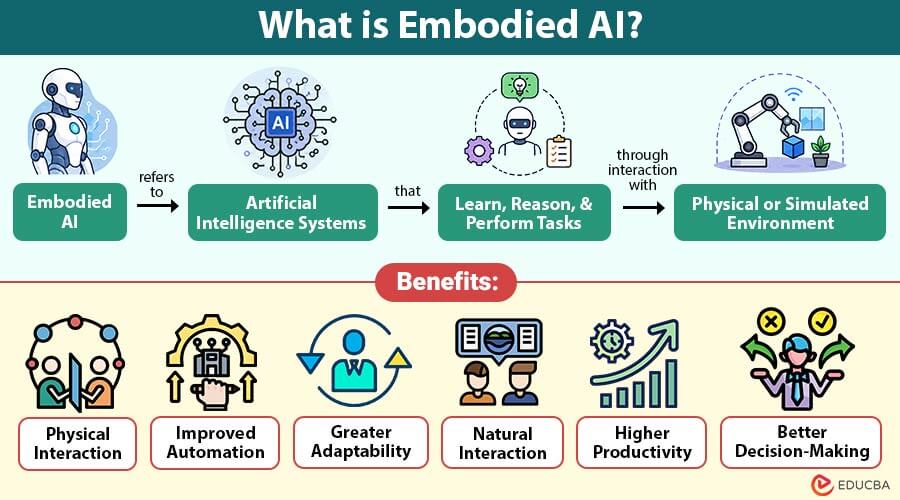
Embodied AI refers to the artificial intelligence systems that learn, reason, and perform tasks through interaction with a physical or simulated environment.
The basic idea is that intelligence becomes more useful when an AI system can not only understand information but also interact with the world. For example, a traditional AI model can identify a cup in an image. An embodied AI system can identify the cup, locate it on a table, plan how to reach it, move its robotic arm, pick it up, and place it somewhere else.
This creates a continuous connection between perception, reasoning, decision-making, and physical action.
Embodied AI is therefore closely connected to robotics, computer vision, machine learning, reinforcement learning, natural language processing, and sensor technologies.
Table of Contents:
Key Takeaways:
- Embodied AI enables intelligent machines to perceive surroundings, reason about situations, and perform physical actions.
- Robots combine sensors, AI models, planning systems, and actuators to interact effectively with changing environments.
- Embodied AI supports automation across manufacturing, healthcare, logistics, agriculture, transportation, and household applications.
- Safety, data requirements, computational costs, and real-world unpredictability remain major barriers to widespread adoption.
How Does Embodied AI Work?
Embodied AI generally works through a continuous cycle of perception, understanding, planning, action, and learning.
1. Perception
The system first collects information about its environment using cameras, microphones, LiDAR, touch sensors, depth sensors, and other devices. These sensors help the AI understand objects, people, distances, sounds, and movement.
For example, a household robot may use cameras to identify furniture and detect obstacles around a room.
2. Understanding
After collecting information, the AI interprets what it sees or senses. Computer vision and multimodal AI models can help identify objects, understand scenes, recognize people, and interpret instructions. The system may understand that a cup is on a table and that the user wants the cup moved to the kitchen.
3. Planning
The AI then determines what actions are necessary to complete the task. Planning may involve selecting a destination, identifying obstacles, determining movement paths, and deciding the order of actions. For complex tasks, the system may divide a large goal into smaller steps.
4. Action
The planned actions are executed through robotic components such as motors, wheels, robotic arms, grippers, or other actuators. The robot continuously compares its intended actions with what is actually happening in the environment.
5. Learning and Feedback
Embodied AI systems can learn from previous interactions and feedback. If robot fails to grasp an object, it can use that experience to improve future attempts. This feedback loop helps machines become more adaptable to changing environments.
Types of Embodied AI
Embodied AI can be implemented across various physical and simulated systems.
1. Humanoid Robots
Humanoid robots are designed with human-like bodies and can perform tasks in environments created for humans. They may be used for manufacturing, logistics, research, healthcare support, and service applications.
2. Autonomous Vehicles
Self-driving cars and autonomous delivery vehicles use cameras, radar, LiDAR, navigation systems, and AI models to understand roads and make driving decisions.
3. Industrial Robots
Industrial robots can perform repetitive or complex manufacturing activities, including assembly, welding, inspection, and material handling.
4. Service Robots
Service robots can assist with cleaning, delivery, hospitality, retail, and other everyday activities.
5. Drones
AI-powered drones can navigate environments, avoid obstacles, inspect infrastructure, monitor locations, and perform delivery or mapping tasks.
6. Simulated Agents
Embodied AI does not always require a physical robot. AI agents can operate inside simulated environments where they learn navigation, object manipulation, planning, and decision-making.
Key Components of Embodied AI
Below are the key components that enable Embodied AI systems to perceive, understand, learn, plan, and interact with their environments.
1. Sensors and Perception
Sensors allow machines to collect information from their surroundings. Cameras provide visual information, microphones capture sound, and LiDAR can help measure distance and construct maps.
2. Computer Vision
Computer vision helps machines recognize and understand objects, people, environments, movement, and spatial relationships.
3. AI Models
Machine learning and deep learning models help systems process information, recognize patterns, understand instructions, and make decisions.
4. Large Language Models
Language models can provide natural-language understanding and help robots interpret instructions such as “pick up the red box and place it on the shelf.”
5. Robotics and Actuators
Motors, robotic arms, wheels, grippers, and other mechanical components allow AI systems to perform physical actions.
6. Planning and Control
Planning systems determine what actions should be taken, while control systems help execute those actions accurately.
7. Learning Systems
Reinforcement learning and other learning approaches can help machines improve their behavior through experience, feedback, and repeated interactions.
Difference Between Embodied AI and Traditional AI
The table below highlights the differences between the two:
| Aspect | Embodied AI | Traditional AI |
| Environment | Operates in physical or interactive environments. | Mainly operates within digital environments. |
| Interaction | Interacts with physical world through sensors and actuators. | Interacts primarily through digital inputs and outputs. |
| Example | A robot identifies, picks up, and moves an object. | A chatbot receives text and generates a text response. |
| Physical Action | Can perform physical actions based on decisions. | Usually does not perform physical actions. |
| Sensors | Uses cameras, microphones, touch sensors, and other sensors. | Primarily relies on digital data and user-provided inputs. |
| Challenges | Must handle real-world uncertainty, movement, and unexpected changes. | Mainly handles challenges within controlled digital environments. |
| Decision-Making | Combines perception, reasoning, planning, and physical action. | Focuses mainly on processing information and generating outputs. |
Applications of Embodied AI
Embodied AI has potential applications across many industries.
1. Manufacturing
Factories can use intelligent robots for assembly, inspection, packaging, material handling, and quality control. Embodied AI can help robots adapt to changing production environments instead of performing only fixed sequences of movements.
2. Healthcare
Robotic systems can support hospitals through transportation, rehabilitation, assistance, and other physical tasks. In the future, more capable robots could assist patients with everyday activities while working under appropriate human supervision.
3. Autonomous Vehicles
Self-driving vehicles are another example of embodied intelligence. They use cameras, sensors, maps, AI models, and control systems to understand roads, identify objects, predict movement, and make driving decisions.
4. Warehousing and Logistics
Autonomous mobile robots can move goods, organize inventory, transport packages, and support warehouse operations. Embodied AI can help these systems navigate dynamic environments and interact with objects.
5. Home Robotics
Household robots could eventually perform tasks such as cleaning, organizing objects, carrying items, and assisting users with everyday activities.
6. Agriculture
Embodied AI can support agricultural robots that monitor crops, identify weeds, harvest produce, inspect plants, and perform other physical tasks.
7. Education and Research
Robotic platforms can provide researchers with environments for studying machine learning, perception, planning, human-robot interaction, and intelligent behavior.
Benefits of Embodied AI
Below are the key benefits of Embodied AI, highlighting how it improves automation, adaptability, interaction, productivity, and decision-making.
1. Physical Interaction
Enables machines to perceive, understand, and interact with physical environments, allowing them to perform meaningful real-world actions.
2. Improved Automation
Automates complex tasks by enabling robots to learn and adapt, reducing dependence on detailed programming for every situation.
3. Greater Adaptability
Uses sensor data to respond intelligently to changing environments, obstacles, unexpected events, and evolving real-world conditions.
4. Natural Interaction
Enables people to communicate with intelligent machines using natural language, making human-machine interaction simpler, easier, and more intuitive.
5. Higher Productivity
Improves productivity across manufacturing, logistics, healthcare, and other industries by enabling efficient, intelligent automation of physical tasks.
6. Better Decision-Making
Combines perception, reasoning, and physical actions to help machines make informed decisions while responding effectively to real-world situations.
Challenges of Embodied AI
Despite its potential, embodied AI faces significant challenges.
1. Real-World Complexity
Physical environments are unpredictable. Objects can move, lighting can change, surfaces can be uneven, and people can behave unexpectedly.
2. Safety
Robots operating around humans must make reliable decisions. A small error in perception or movement can have physical consequences.
3. Data Requirements
Training embodied systems can require large amounts of visual, sensor, and interaction data. Collecting high-quality real-world data can be expensive and time-consuming.
4. Computational Requirements
Processing sensor data, running AI models, and controlling physical systems can require significant computing resources.
5. Sim-to-Real Gap
Robots are often trained in simulations because simulations are safer and cheaper than real-world experimentation. However, behavior learned in a simulation may not always work perfectly in the physical world.
6. Generalization
A robot trained to perform task in one environment may struggle when the environment, objects, or instructions change.
Final Thoughts
Embodied AI connects artificial intelligence with physical perception and action, enabling machines to understand environments, make decisions, and perform tasks. Despite challenges involving safety, cost, data, and uncertainty, advances in AI and robotics could make embodied AI essential for future intelligent robots and autonomous systems.
Frequently Asked Questions (FAQs)
Q1. What is the main goal of Embodied AI?
Answer: The main goal is to enable AI systems to understand environments and perform useful actions autonomously.
Q2. Can embodied AI work without physical robots?
Answer: Yes, AI agents can learn and perform tasks inside simulated environments before being deployed in physical systems.
Q3. How does Embodied AI learn from its environment?
Answer: It collects sensory information, evaluates outcomes, receives feedback, and improves future actions through learning techniques.
Q4. Why does Embodied AI require large amounts of data?
Answer: Systems need diverse sensory and interaction data to learn reliable behaviors across different environments and situations.
Recommended Articles
We hope that this EDUCBA information on “Embodied AI” was beneficial to you. You can view EDUCBA’s recommended articles for more information.


