
Updated August 11, 2026
What is OpenAI API?
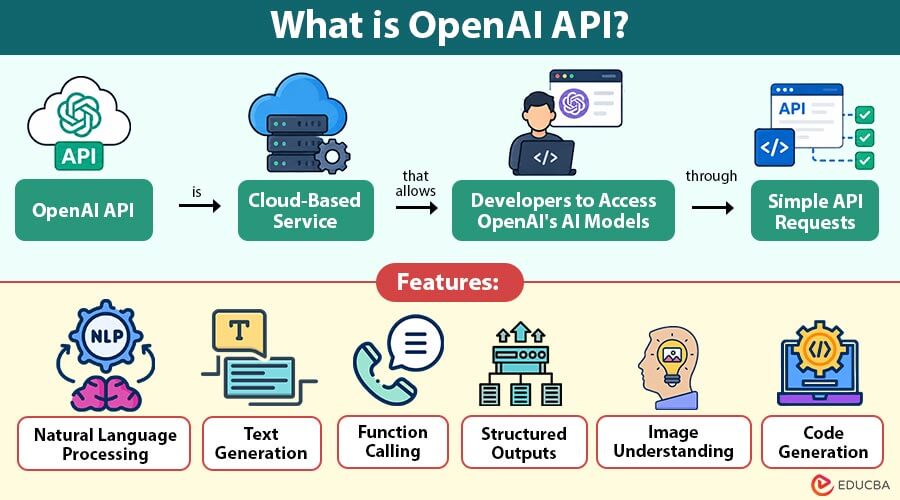
OpenAI API is cloud-based service that allows developers to access OpenAI’s AI models through simple API requests. These models can understand text, generate content, analyze images, write code, summarize documents, perform reasoning, and interact with external tools.
Instead of training complex AI models, developers send API requests with input data, and the AI returns intelligent responses in real time.
In simple terms, the OpenAI API provides applications with access to advanced AI capabilities via secure, internet-based requests.
Table of Contents:
Key Takeaways:
- OpenAI API enables applications to access advanced AI models for text, images, coding, reasoning, and automation.
- Developers can integrate AI capabilities without building or training complex machine learning models from scratch.
- OpenAI API supports chatbots, content creation, customer support, software development, education, healthcare, finance, and legal applications.
- The OpenAI API connects applications to external tools, databases, and APIs via function calling to automate tasks.
How Does OpenAI API Work?
The OpenAI API follows a straightforward request-response process.
Step 1: User Sends a Request
A user asks a question or performs an action within an application.
Step 2: Application Calls the API
The application sends the user’s request to the OpenAI API using an API key.
Step 3: AI Processes the Request
The selected AI model understands the prompt and processes the information.
Step 4: AI Generates a Response
The model creates a relevant and accurate response based on the provided input.
Step 5: Application Displays the Result
The generated response is returned to the application and shown to the user.
Features of OpenAI API
The OpenAI API offers wide range of capabilities that help developers build intelligent, scalable, and AI-powered applications. Below are some of its key features.
1. Natural Language Processing
The API understands human language, interprets user queries, and generates accurate, natural, and conversational responses for various applications.
2. Text Generation
It creates high-quality content such as blogs, emails, product descriptions, marketing copy, reports, summaries, and other written documents.
3. Function Calling
The API can connect with external APIs, databases, and software tools to retrieve live data or perform real-world tasks automatically.
4. Structured Outputs
It facilitates developers’ integration of AI into workflows and apps by producing responses in structured formats like JSON.
5. Image Understanding
The API can analyze images, recognize objects, extract text, understand visual content, and answer questions based on uploaded images.
6. Code Generation
Developers can generate code, explain programming concepts, debug errors, write documentation, and automate software development tasks.
Benefits of OpenAI API
Businesses across industries use the OpenAI API for several benefits.
1. Faster Development
Developers can quickly integrate advanced AI capabilities into applications without building or training complex machine learning models from scratch.
2. Improved Productivity
The API automates repetitive tasks such as content creation, document summarization, coding assistance, and customer support, saving valuable time.
3. High Scalability
Its cloud-based infrastructure can handle applications of all sizes, from small startups to large enterprises with millions of users.
4. Easy Integration
The API easily connects with websites, mobile apps, CRM platforms, ERP systems, databases, and other business software using standard APIs.
5. Better Customer Experience
Businesses can provide faster, more accurate, and personalized responses through AI-powered chatbots, virtual assistants, and support systems.
6. Continuous Improvements
OpenAI regularly updates its AI models, allowing developers to access new features and better performance without maintaining AI infrastructure.
7. Cost Efficiency
Organizations pay only for the API usage they need, eliminating the high costs of training, hosting, and maintaining AI models.
Common OpenAI API Endpoints
Below are the common OpenAI API capabilities and their main purposes for different AI-powered tasks.
| OpenAPI Capability | Purpose |
| Chat Completions / Responses | Generate conversational AI responses |
| Text Generation | Create articles, emails, and documents |
| Image Understanding | Analyze and describe images |
| Function Calling | Connect AI with external tools |
| File Processing | Analyze uploaded files |
| Embeddings | Convert text into vector representations for search and RAG |
| Audio Processing | Speech-to-text and text-to-speech tasks |
Applications of OpenAI API
The OpenAI API is used across many industries to automate tasks, improve productivity, and build intelligent applications. Below are some of its most common applications.
1. AI Chatbots
Businesses build AI-powered chatbots that answer customer questions, provide support, and assist users 24/7 with natural conversations.
2. Content Creation
Marketing teams use the API to generate blogs, articles, product descriptions, emails, advertisements, and social media content quickly.
3. Customer Support
Support teams summarize conversations, draft responses, categorize support tickets, and resolve customer issues more efficiently.
4. Software Development
Developers generate code, debug programs, explain programming concepts, review code, and create technical documentation.
5. Education
Educational platforms develop AI tutors, produce educational resources, respond to inquiries from students, and offer individualized learning opportunities.
6. Healthcare
Healthcare organizations summarize medical records, assist with clinical documentation, retrieve medical information, and support healthcare professionals.
7. Finance
Financial institutions automate report generation, analyze documents, support fraud detection, and improve customer service operations.
8. Legal Services
Law firms analyze contracts, summarize legal documents, extract important clauses, and assist with legal research.
Challenges of OpenAI API
While the OpenAI API offers powerful AI capabilities, developers and organizations should consider several challenges when building and managing AI-powered applications.
1. Usage Costs
High API usage, large prompts, and advanced AI models can increase costs, especially for large-scale or high-traffic applications.
2. Rate Limits
API requests may be restricted based on the selected usage tier, requiring developers to manage request frequency efficiently.
3. Prompt Quality
Poorly written or unclear prompts can lead to inaccurate, incomplete, or irrelevant responses, reducing application performance.
4. Hallucinations
AI models may sometimes generate incorrect or fabricated information, making human verification essential for critical tasks.
5. Data Privacy
When providing data to AI services, organizations must safeguard sensitive information and adhere to data privacy laws.
6. Internet Dependency
Since the API is cloud-based, applications require a stable internet connection for reliable access and consistent performance.
7. Integration Complexity
Connecting the API with existing software, databases, authentication systems, and business workflows may require additional development effort.
Difference Between OpenAI API and Traditional APIs
Below is a clear comparison of the OpenAI API and Traditional APIs:
| Feature | OpenAI API | Traditional APIs |
| Purpose | AI-powered understanding and generation | Fixed business functions |
| Input | Natural language, images, files | Structured parameters |
| Output | Intelligent responses | Predefined data |
| Learning Capability | Uses advanced AI models | Rule-based logic |
| Flexibility | High | Limited |
| Use Cases | Chatbots, automation, content generation | Payments, authentication, databases |
Final Thoughts
The OpenAI API enables developers to integrate advanced AI capabilities into applications for content generation, automation, coding, image analysis, and customer support. With scalable cloud infrastructure, easy integration, and powerful AI models, it helps businesses build intelligent, reliable, and efficient AI-powered solutions across various industries.
Frequently Asked Questions (FAQs)
Q1. Do I need machine learning experience to use the OpenAI API?
Answer: No. You don’t need to build or train AI models. Basic programming knowledge and the ability to make API requests are enough to start integrating AI into your applications.
Q2. Which programming languages support the OpenAI API?
Answer: The OpenAI API can be used with most programming languages, including Python, JavaScript, Java, C#, PHP, Go, Ruby, and others that support HTTP requests.
Q3. How do I authenticate requests to the OpenAI API?
Answer: Authentication is done using an API key generated from your OpenAI account. The key is included in request headers to securely access the API.
Q4. Can the OpenAI API handle multiple users at the same time?
Answer: Yes. The API is designed to support applications ranging from small projects to enterprise-scale systems with many simultaneous users, subject to usage limits and available capacity.
Recommended Articles
We hope that this EDUCBA information on “OpenAI API” was beneficial to you. You can view EDUCBA’s recommended articles for more information.


