


What is an Onchain Economy?
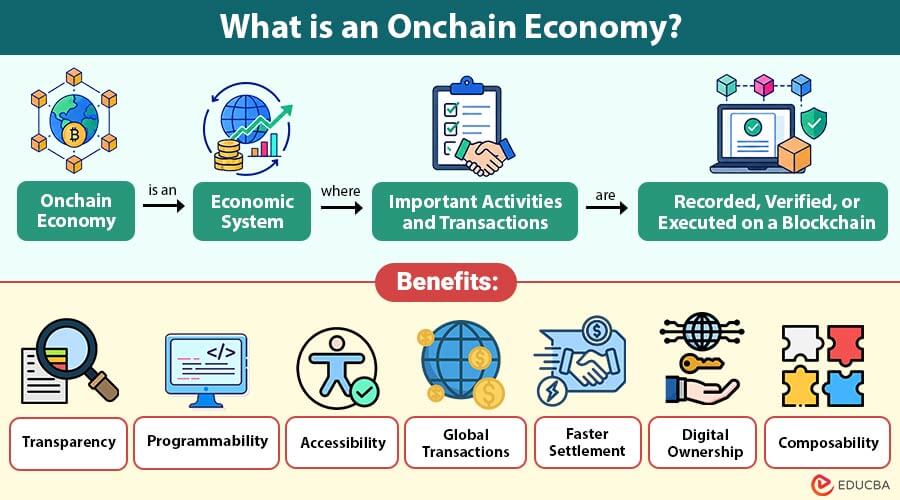
An onchain economy is an economic system where important activities and transactions are recorded, verified, or executed on a blockchain.
In a traditional economy, a bank may maintain account balances, a payment company may process transactions, and a government or institution may maintain ownership records. In an onchain economy, blockchain networks can provide a shared record that participants can independently verify.
For example, when someone transfers a digital asset between two blockchain addresses, the transaction can be recorded on the blockchain. Smart contracts can also automatically execute predefined conditions without requiring a traditional intermediary.
The onchain economy therefore combines blockchain networks, digital assets, smart contracts, decentralized applications, and users to create new forms of economic activity.
Table of Contents:
Key Takeaways:
- Onchain economies use blockchain networks to support transparent, verifiable, and programmable economic activities.
- Smart contracts automate agreements, payments, and asset transfers according to predefined conditions without manual intervention.
- Tokenization enables digital and physical assets to gain blockchain-based representation, transferability, and verifiable ownership.
- Onchain adoption spans finance, payments, gaming, and commerce, despite ongoing technological and regulatory challenges.
How Does the Onchain Economy Work?
The onchain economy is built around blockchain networks that maintain shared records of transactions and activities. Users interact with these networks through digital wallets, decentralized applications, exchanges, and other blockchain-based services.
A typical transaction begins when a user initiates an action through a wallet or application. The transaction is then submitted to the relevant blockchain network. Network participants validate the transaction according to the blockchain’s consensus mechanism. Once confirmed, the transaction becomes part of the blockchain’s permanent record.
Smart contracts play an important role in this process. These programs operate on blockchain networks and can automatically execute predefined instructions.
For example, a smart contract could transfer a digital asset upon receipt of a specific payment. This allows economic activities to be automated, reducing the need for manual processing.
Key Components of an Onchain Economy
Several technologies and participants contribute to the development of an onchain economy.
1. Blockchain Networks
Blockchain networks provide infrastructure for recording, verifying, and securing transactions while maintaining distributed records accessible to participants globally.
2. Digital Wallets
Digital wallets enable users to hold digital assets, manage blockchain addresses, and securely interact directly with decentralized applications and on-chain services.
3. Smart Contracts
Smart contracts automate transactions and enforce business rules through predefined conditions, reducing manual processes and enabling transparent, programmable economic interactions.
4. Digital Assets
Digital assets like cryptocurrencies, stablecoins, and tokenized assets can be traded, transferred, and used in blockchain-based markets worldwide.
5. Decentralized Applications
Decentralized applications, or dApps, provide blockchain-based services including trading, lending, gaming, payments, and digital marketplaces without relying entirely on centralized intermediaries.
6. Users and Developers
Users participate in onchain activities while developers build applications, protocols, and infrastructure that expand functionality, support innovation, and strengthen the ecosystem.
Major Uses of the Onchain Economy
Below are the major areas where the onchain economy is being used
1. Decentralized Finance
DeFi enables users to access lending, borrowing, trading, and asset management services through blockchain protocols without relying entirely on traditional financial institutions.
2. Digital Payments
Blockchain networks support digital payments between users and businesses, while stablecoins can facilitate international transactions, commerce, and automated settlements efficiently across borders.
3. Tokenization
Tokenization represents real-world or digital assets as blockchain-based tokens, enabling easier ownership transfers, automated processes, and new opportunities within digital markets.
4. Digital Ownership
Blockchain provides verifiable digital ownership records for collectibles, gaming assets, memberships, licenses, and other digital property held directly within users’ wallets.
5. Creator Economy
Blockchain enables creators to monetize content through tokens, digital collectibles, memberships, and payments while building communities around digital ownership and audience participation.
6. Gaming
Blockchain games can give players ownership of digital items, which they can own, trade, and manage across supported blockchain networks.
Benefits of an Onchain Economy
The onchain economy offers several potential benefits.
1. Transparency
Blockchain transactions create publicly verifiable records, depending on the network and application, improving visibility into economic activities and transaction histories.
2. Programmability
Smart contracts enable the automation of economic rules, transactions, and processes, reducing manual intervention and supporting efficient, programmable financial services.
3. Accessibility
Blockchain applications can provide access to financial and digital services without requiring users to depend entirely on traditional infrastructure.
4. Global Transactions
Blockchain networks facilitate cross-border transactions among participants, potentially reducing reliance on traditional financial systems and supporting international economic activity.
5. Faster Settlement
6. Digital Ownership
Users can directly hold blockchain-based assets through compatible wallets, providing greater control over digital property, tokens, and other onchain assets.
7. Composability
Blockchain applications can interact with one another, enabling developers to combine existing protocols and services when creating innovative decentralized applications.
Difference Between Onchain Economy and Traditional Economy
The table below highlights the key differences between an onchain economy and a traditional economy:
| Aspect | Onchain Economy | Traditional Economy |
| Infrastructure | Relies on blockchain networks, smart contracts, and decentralized infrastructure. | Relies mainly on centralized institutions, financial systems, and intermediaries. |
| Transactions | Transactions can occur directly through blockchain networks and digital wallets. | Transactions typically pass through banks, payment processors, or other intermediaries. |
| Record Keeping | Blockchain networks maintain distributed and verifiable transaction records. | Banks, companies, governments, and other centralized organizations maintain records. |
| Ownership | Blockchain-based assets can be held and managed directly through compatible wallets. | Ownership records are generally managed by centralized institutions or platforms. |
| Automation | Smart contracts can automatically execute predefined rules and transactions. | Many processes require manual verification and institutional involvement. |
| Accessibility | Blockchain applications can potentially provide broader access to financial and digital services. | Access may depend on financial institutions, geographic location, and traditional infrastructure. |
| Global Transactions | Blockchain networks can facilitate cross-border transactions with fewer traditional intermediaries. | International transactions may involve multiple intermediaries and traditional settlement systems. |
| Interoperability | Onchain applications can interact through composable blockchain protocols and services | Systems may operate separately and require intermediaries for integration. |
| Relationship | Can complement traditional systems by adding blockchain-based infrastructure and services. | Continues to support established financial, commercial, and economic activities. |
Challenges of the Onchain Economy
Despite its potential, the onchain economy faces several challenges.
1. Scalability
Some blockchain networks experience congestion during high demand, potentially increasing transaction costs and reducing processing speed for users across the ecosystem.
2. Security
Smart contract bugs, hacked wallets, phishing scams, and other security problems can cause big money losses for blockchain users and businesses.
3. Regulation
Businesses and consumers are facing uncertainties as governments create regulatory frameworks for digital assets, tokenization, decentralized finance, and blockchain services.
4. User Experience
Blockchain applications can be hard for beginners because they need to learn about wallets, private keys, fees, transactions, and security.
5. Volatility
Many digital assets can change in price quickly, so they may not be good for saving money or making daily payments.
6. Privacy
Blockchain transparency can make transaction information publicly available, raising privacy concerns as wallet activity and transaction histories become traceable over time.
7. Interoperability
Different blockchain networks use varying technical standards, making communication, data sharing, and asset transfers between networks more complex.
Final Thoughts
The onchain economy uses blockchain networks, digital assets, and smart contracts to support transactions, financial services, digital ownership, and applications. Despite challenges involving scalability, security, regulation, volatility, and usability, it offers opportunities across finance, payments, gaming, and commerce. As infrastructure matures, onchain systems may increasingly integrate with traditional economies.
Frequently Asked Questions (FAQs)
Q1. Can businesses use onchain systems?
Answer: Yes. Businesses can use blockchain for payments, asset management, supply chain tracking, loyalty programs, digital ownership, and automated agreements.
Q2. Do onchain transactions always require cryptocurrency?
Answer: No. While many blockchain applications use cryptocurrencies or tokens, some systems can use stablecoins, tokenized assets, or blockchain records for specific purposes.
Q3. Can onchain assets represent physical products?
Answer: Yes. Physical assets such as real estate, commodities, securities, or collectibles can potentially be represented through blockchain-based tokens.
Q4. What role do stablecoins play in the onchain economy?
Answer: Stablecoins can provide blockchain-based digital money designed to maintain a relatively stable value, supporting payments, transfers, trading, and settlement.
Recommended Articles
We hope that this EDUCBA information on “Onchain Economy” was beneficial to you. You can view EDUCBA’s recommended articles for more information.


