
Updated August 13, 2026
What is AI Watermarking?
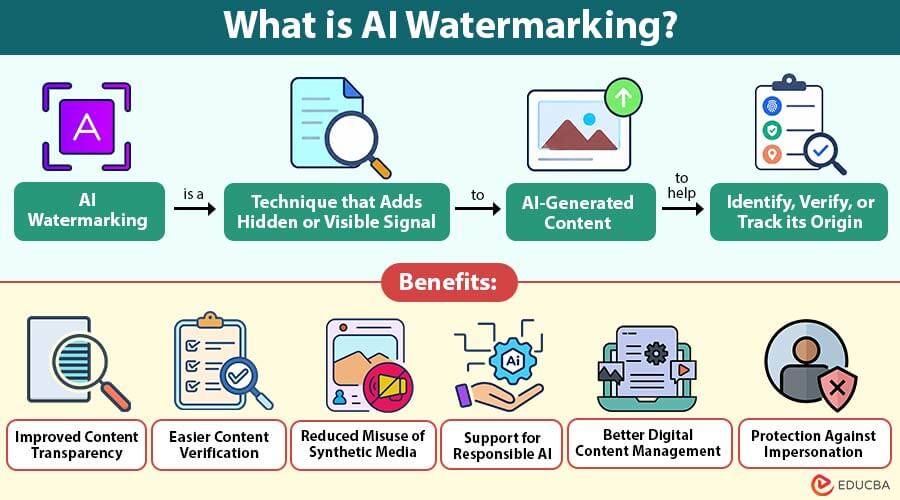
AI watermarking is a technique that adds a hidden or visible signal to AI-generated content to help identify, verify, or track its origin. The watermark can be embedded in text, images, audio, videos, or other digital content without significantly affecting its quality.
As generative AI tools become more common, distinguishing AI-generated content from human-created content has become increasingly important. AI watermarking enables developers, businesses, publishers, and platforms to identify content created or modified by AI systems.
Unlike traditional watermarks, which are often visible logos or text placed over an image, AI watermarks can be designed to remain hidden. A detection system can later analyze the content and determine whether the embedded signal is present.
Table of Contents:
Key Takeaways:
- AI watermarking helps identify AI-generated content by embedding hidden or visible signals into digital media.
- It supports content transparency, provenance, verification, and responsible use of artificial intelligence across industries.
- AI watermarking applies to text, images, audio, video, and multimodal content while preserving overall quality.
- Watermarks can be weakened or removed, making complementary metadata and provenance technologies important for stronger content verification.
Why is AI Watermarking Important?
AI watermarking is important because it helps make AI-generated content easier to identify, verify, and manage. As generative AI produces increasingly realistic text, images, audio, and videos, users may find it difficult to determine how content was created.
It provides an additional signal that can support content provenance and transparency. It can help platforms, businesses, publishers, and other organizations distinguish AI-generated content from other digital media.
Key reasons for using AI watermarking include:
1. Content Identification
Watermarks can help identify content generated or modified by specific AI systems.
2. Greater Transparency
They can help users understand when digital content has been created or altered using AI.
3. Content Provenance
Can support systems that track where digital content originated and how it was produced.
4. Misuse Detection
Watermarks can help identify synthetic media used for impersonation, misinformation, fraud, or other harmful activities.
5. Responsible AI Adoption
Making AI-generated content easier to identify can support more transparent and responsible use of generative AI.
How Does AI Watermarking Work?
AI watermarking works by adding a hidden pattern or signal to AI-generated content. This signal is designed to remain difficult for people to notice but can be identified by specialized detection systems.
The process generally involves the following steps:
1. Content Generation
An AI model creates content such as text, images, videos, or audio using its trained algorithms.
2. Watermark Embedding
A watermarking system adds a unique signal to the generated content. Depending on the technology, the watermark may be added either during content generation or after content creation.
For example, an image-generation system may make small changes to pixels or other image features that are difficult for people to notice but detectable by a watermarking system.
3. Content Distribution
The watermarked content can be published, downloaded, shared, or distributed through websites, social media platforms, and other digital channels.
4. Watermark Detection
A detection system examines the content to check whether the expected watermark signal is present.
5. Content Verification
If the watermark is detected, organizations can use it as an indicator that the content was generated or processed by a particular AI system. This can help with content identification, authenticity checks, and responsible AI use.
Types of AI Watermarking
It can be applied to different types of digital content.
1. Text Watermarking
Text watermarking embeds hidden patterns into AI-generated text, allowing detection systems to identify content based on specific statistical patterns.
2. Image Watermarking
Image watermarking embeds hidden signals within AI-generated images, helping detection systems identify synthetic content without significantly affecting visual quality.
3. Audio Watermarking
Audio watermarking embeds detectable information into AI-generated audio, helping identify synthetic speech, music, podcasts, and other digitally generated recordings.
4. Video Watermarking
Video watermarking adds detectable signals to AI-generated videos, helping platforms recognize synthetic media while maintaining acceptable visual and audio quality.
5. Multimodal Watermarking
Multimodal watermarking applies hidden signals across text, images, audio, or video, enabling broader identification of AI-generated digital content.
Benefits of AI Watermarking
Provides several benefits for organizations and digital platforms.
1. Improved Content Transparency
AI watermarks help users clearly understand whether digital content was created or modified using artificial intelligence technologies.
2. Easier Content Verification
Organizations can use watermark detection to support content verification, authenticity checks, and digital provenance management processes.
3. Reduced Misuse of Synthetic Media
Helps identify AI-generated images, videos, and audio that might otherwise appear authentic to unsuspecting audiences.
4. Support for Responsible AI
Encourages responsible use of generative AI by making artificially generated content easier for users to identify.
5. Better Digital Content Management
Businesses can use watermarking to efficiently organize, track, verify, and manage AI-generated assets across digital workflows.
6. Protection Against Impersonation
Watermarks help identify synthetic voices, images, and videos generated by AI, reducing risks of digital impersonation.
Applications of AI Watermarking
It can be used across several industries and applications.
1. Social Media
Social media platforms can use AI watermarking to identify synthetic images, videos, and other AI-generated content.
2. Education
Educational institutions can use watermarking as one signal when evaluating whether submitted work may have been generated by AI.
3. News and Publishing
Publishers can use watermarking to improve transparency and indicate whether articles, images, or other media were generated using AI.
4. Advertising and Marketing
Marketing teams can identify AI-generated creative assets and maintain better records of how digital content was produced.
5. Entertainment
Film, music, gaming, and media companies can use watermarking to track AI-generated assets and support content management.
6. Cybersecurity
Security teams can use AI-generated content identification to investigate synthetic media used in fraud, impersonation, or social engineering.
Difference Between AI Watermarking and Traditional Watermarking
Below is a comparison table between both:
| Aspect | AI Watermarking | Traditional Watermarking |
| Primary Purpose | Identifies AI-generated content and supports content provenance. | Establishes ownership and discourages unauthorized content use. |
| Main Focus | Focuses on identifying the origin or generation method of content. | Focuses on protecting ownership and copyright. |
| Visibility | Often uses hidden signals that are difficult for users to notice. | Usually uses visible marks, logos, or text on content. |
| Example | Embedding a hidden signal into an AI-generated photograph for detection. | Placing a company logo across a photograph to indicate ownership. |
| Detection | Specialized detection systems can analyze content for embedded AI signals. | Users can often identify the watermark directly on the content. |
| Common Use | Content provenance, AI identification, and responsible AI practices. | Copyright protection, ownership identification, and unauthorized-use prevention. |
Challenges of AI Watermarking
Although it can improve content identification, it is not a perfect solution.
1. Watermark Removal
Attackers may attempt to remove or weaken watermarks through editing, compression, cropping, rewriting, or other content transformations.
2. False Positives
Detection systems may incorrectly classify human-created content as AI-generated, potentially causing confusion and affecting trust in detection results.
3. False Negatives
Detection systems may fail to identify AI-generated content when watermarks become damaged, altered, removed, or difficult to detect.
4. Compatibility Issues
Different AI systems may use different watermarking methods, making universal detection and consistent identification across platforms difficult.
5. Quality Preservation
Watermarking systems must preserve original content quality while embedding signals without noticeably affecting images, audio, video, or text.
6. Privacy Concerns
Organizations must carefully manage information about content origin, creators, and users while implementing AI watermarking systems responsibly.
Final Thoughts
AI watermarking helps identify and verify AI-generated content by embedding visible or invisible signals into text, images, audio, and video. It supports transparency, content verification, responsible AI use, and digital trust. However, watermarking alone is insufficient. Combining it with metadata, provenance technologies, and verification methods provides stronger protection against manipulated digital content.
Frequently Asked Questions (FAQs)
Q1. Can AI watermarking be detected after content is edited?
Answer: Detection depends on the watermarking method. Some watermarks can survive common edits, while others may become weaker or undetectable.
Q2. Does AI watermarking affect the quality of generated content?
Answer: Well-designed watermarking techniques aim to preserve the original quality, although some methods may introduce minor changes.
Q3. Can users remove an AI watermark from digital content?
Answer: Some watermarks can potentially be weakened or removed through extensive editing, compression, cropping, rewriting, or other transformations.
Q4. Is AI watermarking the same as AI content detection?
Answer: No. Watermarking embeds a signal into content, while AI detection analyzes content to estimate whether it was produced by artificial intelligence.
Recommended Articles
We hope that this EDUCBA information on “AI Watermarking” was beneficial to you. You can view EDUCBA’s recommended articles for more information.


