


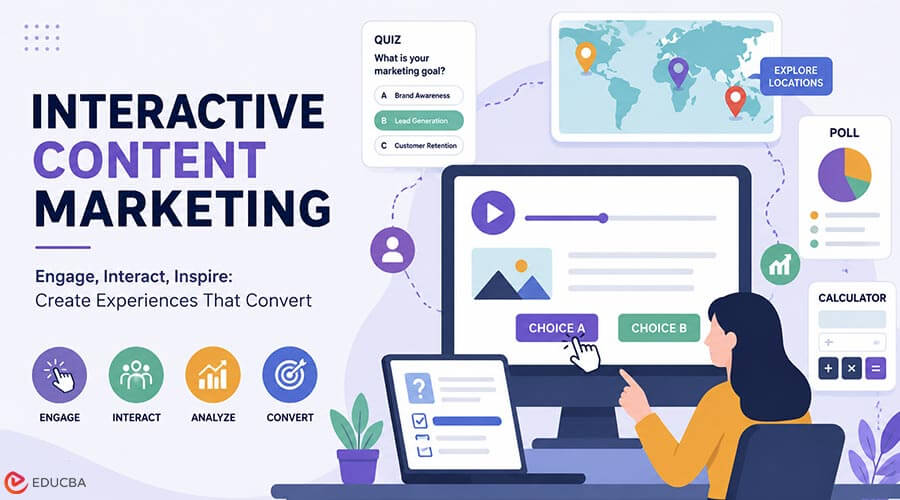
Interactive content marketing is a digital strategy that invites audiences to participate directly in content rather than simply consuming it by reading, watching, or scrolling. It uses elements such as quizzes, polls, calculators, assessments, surveys, interactive infographics, and product recommendations to create two-way communication between brands and audiences.
Traditional content marketing often delivers information in a one-way format. A brand publishes an article, video, ebook, or infographic, and the audience consumes it. Interactive content changes this experience by asking users to make choices, answer questions, enter information, or explore different options.
This approach can help businesses capture attention, increase engagement, collect useful first-party data, and guide users toward relevant products or services. It also gives marketers opportunities to understand audience preferences and create more personalized experiences.
As competition for online attention continues to grow, interactive content marketing has become an important strategy for businesses that want to make their content more engaging and useful.
Table of Contents
- Meaning
- How Does it Work?
- Types
- Benefits
- Interactive Content Marketing vs. Traditional Content Marketing
- Real-World Examples
- How to Create a Strategy?
- Best Practices
- Challenges
- How to Measure Success?
- Common Mistakes
- Future
Key Takeaways
- Interactive content marketing encourages users to participate in content actively.
- Quizzes, calculators, assessments, surveys, interactive infographics, and product finders are common formats.
- Interactive experiences can improve engagement and personalization.
- Businesses can use interactive content to collect useful first-party data.
- Interactive tools can support lead generation and qualification.
- Marketers should create interactive content around genuine audience needs.
- Simple and useful experiences generally work better than unnecessarily complicated ones.
- Businesses should optimize interactive content for mobile devices and accessibility.
- Marketers should measure participation, completion, leads, conversions, and business outcomes.
- Privacy, maintenance, technical performance, and usability require ongoing attention.
What Is Interactive Content Marketing?
Interactive content marketing uses engaging features that invite audiences to interact with and participate in the content rather than passively consume it. Instead of presenting information passively, it allows users to interact with the content and receive an outcome based on their responses or actions.
For example, a financial website can create a retirement calculator that asks users about their age, income, savings, and investment goals. The calculator can then provide an estimated result. Likewise, an e-commerce business can use a personalized quiz to understand customer preferences and recommend products that best match their needs.
The key difference between interactive and traditional content is participation.
A traditional blog may explain how to choose running shoes. An interactive version could ask users about their running frequency, preferred terrain, budget, and experience level and then recommend suitable shoe categories.
Interactive content therefore combines information with user action. When marketers design it well, the audience receives value while the business gains useful engagement and insights.
How Does Interactive Content Marketing Work?
Interactive content marketing usually follows a simple process:
- Identify the audience: Understand the target audience, its needs, interests, and challenges.
- Define the marketing objective: Decide whether the goal is engagement, lead generation, education, product discovery, or conversions.
- Choose the right interactive format: Select a quiz, calculator, assessment, poll, survey, or another suitable format.
- Create useful content: Design questions and interactions that provide genuine value.
- Encourage participation: Use clear calls to action to invite users to interact.
- Deliver a result: Provide personalized recommendations, scores, insights, or other useful outcomes.
- Analyze responses: Study engagement and response data to improve future campaigns.
The strategy works best when the interaction serves a clear purpose. Adding an interactive element simply for novelty may increase complexity without improving the user experience.
Types of Interactive Content Marketing
Businesses can use several types of interactive content depending on their goals and audience.
1. Interactive Quizzes
Quizzes engage users with a set of questions and deliver a tailored result according to the answers they select.
For instance, a skincare company can design a product recommendation quiz that gathers information about a user’s skin type, concerns, habits, and preferences, then recommends relevant product options. The quiz could then recommend suitable product categories.
Quizzes can work well because they combine entertainment with personalization. They can also help marketers understand audience preferences.
2. Calculators
Interactive calculators allow users to enter information and receive a customized result.
Common examples include:
- Mortgage calculators
- ROI calculators
- Salary calculators
- Savings calculators
- BMI calculators
- Pricing calculators
- Advertising budget calculators
- Investment calculators
Calculators work particularly well when a product or service involves numbers. They help users understand potential outcomes while creating an opportunity for businesses to introduce relevant products or services.
3. Interactive Assessments
Assessments evaluate a user’s knowledge, situation, skills, or needs.
For example, a cybersecurity company could create a security assessment that asks businesses questions about password policies, access controls, employee training, and data protection.
At the end, users could receive a score and recommendations for improvement.
This format can support both education and lead generation.
4. Polls and Surveys
Polls and surveys allow marketers to collect opinions directly from their audience.
A company could ask customers which product feature they value most or which topic they want to learn about next.
Marketers can use survey responses to understand customer preferences, improve products, and create future content.
5. Interactive Infographics
Traditional infographics present information visually, while interactive infographics allow users to click, hover, scroll, or explore different sections.
For example, a marketing website could create an interactive infographic showing how customers progress through the stages of the buying journey.
Interactive infographics help users explore detailed information in a more engaging and easy-to-understand way.
6. Interactive Videos
Interactive videos let viewers choose different options that shape their experience of the content.
For example, a training video could allow employees to select different scenarios and see how each decision affects the outcome.
Brands can also use interactive videos for product demonstrations, tutorials, education, and storytelling.
7. Product Recommendation Tools
Product recommendation tools help users identify products that match their requirements.
For example, an e-commerce website selling laptops could ask users about their budget, preferred operating system, gaming requirements, portability needs, and work requirements. It could then recommend suitable models.
This format can simplify product discovery and reduce decision-making difficulty.
8. Interactive Ebooks and Guides
Interactive ebooks combine traditional educational content with elements such as quizzes, videos, clickable graphics, assessments, and calculators.
They offer a more dynamic and engaging way to learn than conventional static materials.
Businesses can use interactive guides for lead generation, product education, employee training, and customer onboarding.
9. Interactive Maps
Interactive maps enable users to discover geographic information by selecting and exploring various locations.
Businesses can use them for store locators, travel content, real estate listings, event information, and market research.
10. Games and Gamified Content
Gamified content uses game-like features such as points, badges, challenges, scores, and rewards.
For example, a language-learning company can create a vocabulary challenge that awards points for correct answers.
Gamification can make repetitive learning or marketing activities more engaging.
Benefits of Interactive Content Marketing
Interactive content can provide several benefits when marketers align it with audience needs and business objectives.
Increased Audience Engagement
Interactive content requires users to take action. Instead of simply scrolling through a page, users answer questions, enter information, click options, or explore different sections.
This active participation can make the content experience more engaging.
Better User Experience
Interactive tools can help users find information that directly relates to their situation.
For example, a large article about personal finance may contain general information. A financial calculator can provide an estimate based on the user’s own inputs.
This personalized experience can make content more useful.
Higher Lead Generation Potential
Interactive content can support lead generation by offering valuable results in exchange for contact information.
For example, a B2B company could provide a free assessment that generates a customized report. The company can ask users for their email address before delivering the full report.
However, marketers should avoid requesting unnecessary information because excessive forms can reduce participation.
First-Party Data Collection
Interactive content can help businesses collect information directly from users.
For example, a quiz can reveal product preferences, while a survey can reveal customer interests.
Businesses can use this first-party data to improve segmentation, personalization, product development, and marketing campaigns. Marketers should collect data transparently and follow applicable privacy requirements.
Improved Personalization
Interactive experiences naturally create opportunities for personalization.
If a user selects a specific need, the brand can show relevant recommendations rather than presenting the same information to everyone.
Personalized experiences can make marketing communication more relevant.
Increased Time Spent With Content
When users actively participate, they may spend more time engaging with the content than they would with a short static page.
However, marketers should focus on meaningful engagement rather than artificially increasing time on page.
Better Understanding of Customers
Interactive content can reveal what users care about.
For example, responses to a product quiz can show which features customers prioritize. Survey responses can reveal common challenges or preferences.
These insights can support content planning, product development, sales conversations, and improvements in customer experience.
Supports Lead Qualification
Interactive assessments can help businesses identify users’ needs.
For example, a software company could ask potential customers about company size, current tools, budget, and requirements. The answers can help the company understand whether a lead fits its target customer profile.
Interactive Content Marketing vs. Traditional Content Marketing
Both interactive and traditional content play important roles in digital marketing.
| Feature | Traditional Content | Interactive Content |
| User participation | Usually low | High |
| Format | Articles, ebooks, videos | Quizzes, calculators, assessments, tools |
| Communication | Mostly one-way | Two-way |
| Personalization | Limited to moderate | Usually higher |
| Data collection | Limited | Often stronger |
| User experience | Primarily consumption | Participation and exploration |
| Development effort | Often simpler | Can require more planning and technology |
Interactive content does not replace traditional content. Instead, marketers can combine both approaches.
For example, a blog can explain a topic and then direct readers to an interactive calculator that helps them apply the information.
Real-World Examples of Interactive Content Marketing
Example 1: HubSpot’s Website Grader
HubSpot uses its Website Grader as an interactive marketing tool. Users enter a website URL and receive an analysis based on different website performance criteria. The tool also provides actionable recommendations based on the results.
This approach demonstrates expertise while giving users personalized information. It also creates an opportunity for HubSpot to introduce its marketing and website solutions to users seeking to improve their online presence.
- Interactive format: Website assessment and personalized report
- Marketing goal: Lead generation, education, and product discovery
Example 2: BuzzFeed’s Interactive Quizzes
BuzzFeed has built a strong presence around interactive quizzes and games. Its current content includes interactive trivia formats such as Trivia Bingo, where users answer questions and try to create a winning line by getting consecutive answers correct.
The format encourages users to participate rather than passively read an article. Users can also share their results or challenge others, which can help increase content reach.
- Interactive format: Quizzes and gamified content
- Marketing goal: Audience engagement, repeat visits, and social sharing
Example 3: Sephora’s Product-Finder Experience
Sephora provides interactive product-discovery experiences that help shoppers identify suitable beauty products. Product-finder experiences can ask users about factors such as preferences, skin characteristics, desired finish, or coverage and then provide relevant product recommendations.
This approach reduces the difficulty of choosing among many products. Instead of asking customers to browse every available option, the interactive experience helps narrow the choices according to their needs.
- Interactive format: Product recommendation quiz
- Marketing goal: Personalization, product discovery, and conversions
Example 4: The New York Times’ Interactive Quizzes and Visual Stories
The New York Times has used interactive formats such as quizzes and data-driven visual experiences to encourage readers to participate in stories. Interactive storytelling can combine maps, charts, visualizations, questions, and other elements to encourage readers to explore information rather than scroll through text. HubSpot also highlights The New York Times’ use of interactive quizzes as an example of interactive content.
This format works particularly well for complex topics because readers can interact with information and discover insights at their own pace.
- Interactive format: Interactive storytelling, quizzes, and visualizations
- Marketing goal: Engagement, education, and audience retention
Example 5: Glass Animals’ Interactive Website
The music group Glass Animals created an interactive website that resembles a computer desktop. Visitors could click different icons, explore sounds and artwork, create memes, and participate in the band’s creative process.
Instead of using the website only to provide information about the band, the experience turned the website itself into an interactive piece of content. This helped create a more memorable connection between the audience and the brand.
- Interactive format: Interactive website and user-generated content
- Marketing goal: Audience engagement, brand connection, and participation
How to Create an Interactive Content Marketing Strategy?
A successful strategy requires more than adding interactive features to existing content.
Step 1: Define Your Goal
Start with one clear objective.
Your objective could be:
- Generate qualified leads
- Increase engagement
- Educate customers
- Recommend products
- Collect customer insights
- Increase conversions
- Improve personalization
A clear goal helps you select the appropriate interactive format.
Step 2: Understand Your Audience
Research your audience before creating the experience.
Identify their:
- Problems
- Questions
- Interests
- Buying motivations
- Knowledge level
- Common objections
Choose an interaction that solves a real problem.
Step 3: Select the Right Format
Match the format to your objective.
For example:
- Use a quiz for personalization.
- Use a calculator for numerical problems.
- Use an assessment for evaluation.
- Use a survey for collecting opinions.
- Use a product finder for product discovery.
- Use gamification for engagement and learning.
Step 4: Keep the Experience Simple
Users should understand what they need to do immediately.
Use clear instructions and avoid unnecessary questions.
A long, complex interactive experience can discourage users from completing it.
Step 5: Provide a Valuable Outcome
Give users something useful after they participate.
Depending on the format, the result could include:
- A personalized recommendation
- A score
- A report
- A calculation
- A checklist
- Educational resources
- Product suggestions
The outcome should justify the user’s effort.
Step 6: Add a Relevant Call to Action
Connect the interactive experience to the next step.
For example, after a product recommendation, you could invite users to explore the recommended products. After an assessment, you could offer a detailed report or consultation.
The CTA should match the user’s intent rather than interrupting the experience.
Step 7: Optimize for Mobile Devices
Many users access content through smartphones. Therefore, interactive experiences must work well on smaller screens.
Use responsive layouts, readable text, large touch targets, and fast-loading elements.
Step 8: Test Before Launch
Test the experience across different devices and browsers.
Check:
- Question flow
- Buttons
- Calculations
- Results
- Forms
- Loading speed
- Mobile usability
- Error messages
- Tracking
A technical issue can quickly damage the user experience.
Step 9: Measure Performance
Track metrics that connect directly to your objective.
Useful metrics include:
- Participation rate
- Completion rate
- Click-through rate
- Lead conversion rate
- Form completion rate
- Conversion rate
- Shares
- Returning users
- Cost per lead
- Revenue generated
Use these insights to improve future campaigns.
Best Practices for Interactive Content Marketing
Make the Interaction Relevant
Do not create interactive content simply because the format looks interesting. Connect it to a real audience need.
Ask Only Necessary Questions
Every question creates additional effort. Remove questions that do not contribute to the final result or marketing objective.
Make Results Easy to Understand
Avoid complicated results that require users to interpret technical information. Present key findings clearly and provide actionable recommendations.
Offer Immediate Value
Users should receive something useful quickly. Long waiting periods can reduce satisfaction.
Use Strong Calls to Action
Tell users what they can do next. Make the next step relevant to the result they received.
Maintain Brand Consistency
Use your brand’s tone, visual identity, and messaging throughout the experience.
Protect User Data
Explain what information you collect and why you collect it. Follow applicable privacy and data-protection requirements.
Integrate With Your Marketing Technology
Where appropriate, connect interactive tools with your analytics, CRM, marketing automation, or customer data systems.
This integration can help teams understand leads and follow up with relevant communication.
Keep Accessibility in Mind
Design interactive experiences so that as many users as possible can access them. Use readable text, sufficient contrast, keyboard-friendly interactions, descriptive labels, and accessible form controls.
Challenges of Interactive Content Marketing
Interactive content offers significant opportunities, but it also presents challenges.
Higher Development Requirements
A simple article may require only writing and editing, while an interactive calculator or assessment may require design, development, testing, and analytics implementation.
Maintenance
Interactive tools may require regular updates when prices, regulations, products, calculations, or other underlying information changes.
Technical Problems
Broken buttons, slow loading, incorrect calculations, and poor mobile performance can negatively affect the experience.
Data Privacy Concerns
Businesses must handle collected information responsibly. They should only collect necessary data and clearly communicate how they use it.
Poorly Designed Interactions
Not every interactive experience creates value. Too many questions, confusing navigation, irrelevant results, or unnecessary animations can frustrate users.
The solution is to prioritize usability and usefulness over complexity.
How to Measure Interactive Content Marketing Success?
Marketers should evaluate performance according to the original objective.
Engagement Metrics
Participation rate shows how many visitors interact with the content.
Completion rate shows how many users finish the experience after starting it.
Lead Generation Metrics
Marketers can track how many users provide contact information and how many of those leads meet qualification criteria.
Conversion Metrics
Businesses can measure whether interactive content contributes to purchases, registrations, consultations, downloads, or other desired actions.
Behavioral Metrics
Marketers can study where users drop off, which questions receive certain responses, and which recommendations receive the most clicks.
Business Metrics
The most important measurement often connects interactive content to business outcomes such as qualified leads, sales, customer acquisition, or revenue.
Common Mistakes to Avoid
Avoid these common mistakes when implementing interactive content marketing:
- Creating interaction without a purpose: Every element should support a user or business objective.
- Making the experience too long: Keep the journey focused.
- Asking unnecessary personal questions: Request only information that serves a clear purpose.
- Ignoring mobile users: Test the experience across screen sizes.
- Providing generic results: Use responses to create meaningful outcomes.
- Forgetting accessibility: Make the experience usable for a broad audience.
- Using weak CTAs: Give users a clear next step.
- Failing to measure results: Track performance and optimize the experience.
- Ignoring technical maintenance: Review calculations, links, recommendations, and content regularly.
Future of Interactive Content Marketing
Interactive content will continue to evolve as marketers gain access to better data, automation, artificial intelligence, and personalization technologies.
AI enables marketers to personalize user experiences by interpreting audience responses and providing recommendations tailored to individual needs. Businesses can also combine interactive tools with customer data platforms and marketing automation systems to create more connected customer journeys.
For example, a visitor could complete an assessment, receive personalized recommendations, access relevant educational content, and later receive marketing communication based on their interests.
However, technology alone will not make interactive content successful. Marketers still need to understand their audiences and provide useful experiences.
The strongest interactive content will combine simplicity, personalization, usefulness, accessibility, and measurable business value.
Frequently Asked Questions (FAQ’s)
Q1. How does interactive content differ from personalized content?
Answer: Interactive content requires users to take action, while personalized content adapts information based on user data or preferences. Interactive content can also deliver personalized experiences based on user responses.
Q2. What industries can benefit from interactive content marketing?
Answer: Industries such as education, finance, healthcare, e-commerce, technology, real estate, travel, and professional services can use interactive content to engage their audiences and deliver more meaningful experiences.
Q3. Can interactive content improve SEO?
Answer: Yes. Interactive content can support SEO by increasing engagement, encouraging sharing, attracting backlinks, and improving the overall user experience. Marketers should also provide relevant text around interactive elements.
Q4. What is the difference between interactive content and gamification?
Answer: Interactive content encourages users to participate, while gamification adds game-like elements such as points, badges, challenges, or rewards. Gamification can be one component of an interactive content strategy.
Q5. Can small businesses use interactive content marketing?
Answer: Yes. Small businesses can start with simple formats such as quizzes, polls, surveys, calculators, and product recommendation tools without requiring complex technology or a large budget.
Final Thoughts
Interactive content marketing transforms content from a one-way communication method into a participatory experience. Instead of simply telling audiences what they need to know, businesses can invite them to answer questions, explore information, calculate outcomes, assess their needs, and receive personalized recommendations.
Quizzes, calculators, assessments, surveys, interactive infographics, and product finders can all help marketers create more useful experiences. However, successful interactive content does not depend on complexity. It depends on whether the experience solves a real problem and gives users meaningful value.
Businesses should start with a clear objective, understand their audience, choose an appropriate format, simplify the user journey, provide useful results, and measure performance. By integrating these principles with valuable content and effective design, marketers can make interactive content marketing a strong component of their overall digital marketing strategy.
Recommended Articles
We hope this guide on Interactive Content Marketing helps you create engaging experiences that drive meaningful audience participation. Explore these recommended articles for additional insights and strategies to strengthen your digital marketing efforts.


