


Finding a truly anonymous, no-logs VPN is hard. Every provider claims it; few prove it. So we sifted through public audits, court records, and police-seizure reports, then ranked each service on an evidence ladder that puts proof ahead of marketing. The work produced a five-provider shortlist, sorted by the privacy win you care about most from audit transparency to power-user port forwarding. Invest five minutes, and you will know who passed, who fell short, and why.
Quick Comparison: Best No-Logs VPN Services
The table below compares the top providers based on privacy evidence, anonymity options, advanced features, pricing, and refund policies.
| Provider | Evidence Score | Latest No-Logs Proof | Account Anonymity | Power-User Features | Promotional Price* | Refund Window |
| TorGuard | 93.0 | Provider privacy policy (no independent audit) | Email; optional cryptocurrency | Port forwarding, SOCKS5, up to 16 devices | US $10.99/month | 7 days |
| Proton VPN | 92.5 | 5th Securitum audit (2026) | Bitcoin or cash payment options | Secure Core, port forwarding | US $2.99/month (2-year plan) | 30 days |
| Mullvad | 89.0 | Police search found no user data (2023) | No email; cash, BTC, Monero | Multihop, DAITA protection | €5 flat (~US $5.50) | 14 days (excluding cash/crypto) |
| NordVPN | 87.1 | 6th Deloitte engagement (2025) | Email required | Double VPN, obfuscation | US $3.49/month (27-month plan) | 30 days |
| Private Internet Access | 85.5 | Deloitte audit + US court record (2026) | Email; cryptocurrency accepted | Port forwarding, SOCKS5 | US $1.33/month (26-month plan) | 30 days |
How the Best No-Logs VPN Services Were Evaluated?
Proof comes first. To even qualify, a service must ban traffic logs, source-IP storage, and timestamp retention, and its apps must include a kill switch plus one modern protocol (WireGuard or OpenVPN). Anything less was rejected. Each no-logs VPN was evaluated using eight important factors:
- Policy & proof: 30 % (public audits, court records, police-seizure outcomes)
- Jurisdiction & legal resilience: 12 %
- Account anonymity: 10 %
- Technical safeguards: 15 %
- Transparency & open source: 13 %
- Performance: 8 %
- Power-user extras: 7 %
- Long-term value: 5 %
Evidence Ladder Used for Ranking No-Logs VPN Providers
To distinguish genuine privacy protection from marketing statements, services were ranked using a six-level evidence ladder.
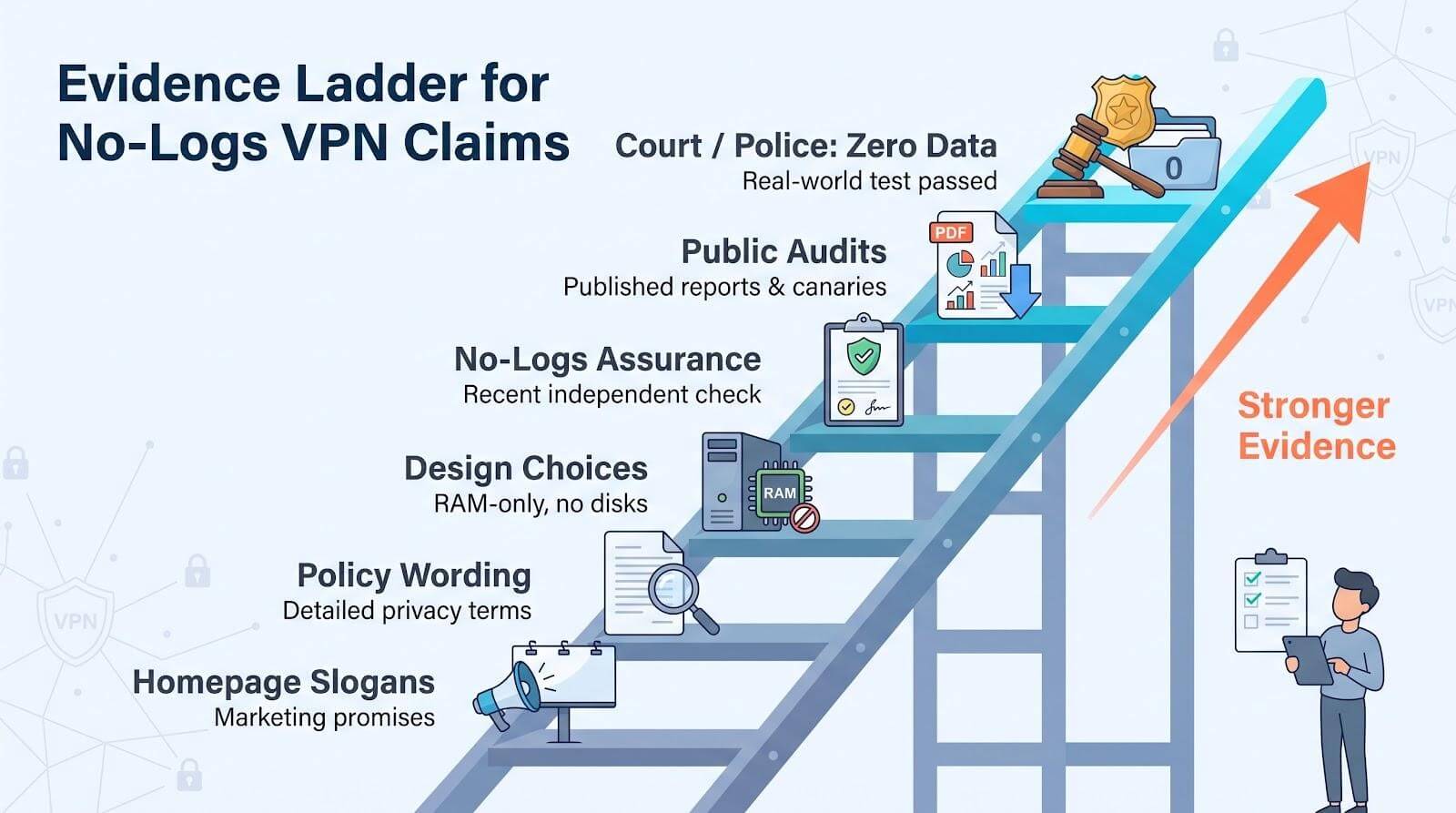
- Homepage slogan
- Detailed policy wording
- Design choices (for example, RAM-only servers)
- Recent independent no-logs assurance
- Public audit reports and transparency pages
- Court order or police action that produced zero user data
Providers with stronger evidence on this ladder receive higher rankings because verified privacy protection is more reliable than simple marketing statements.
What “No Logs” Means in Practice?
The promise “We keep no logs” sounds tidy, yet it covers four separate data sets:
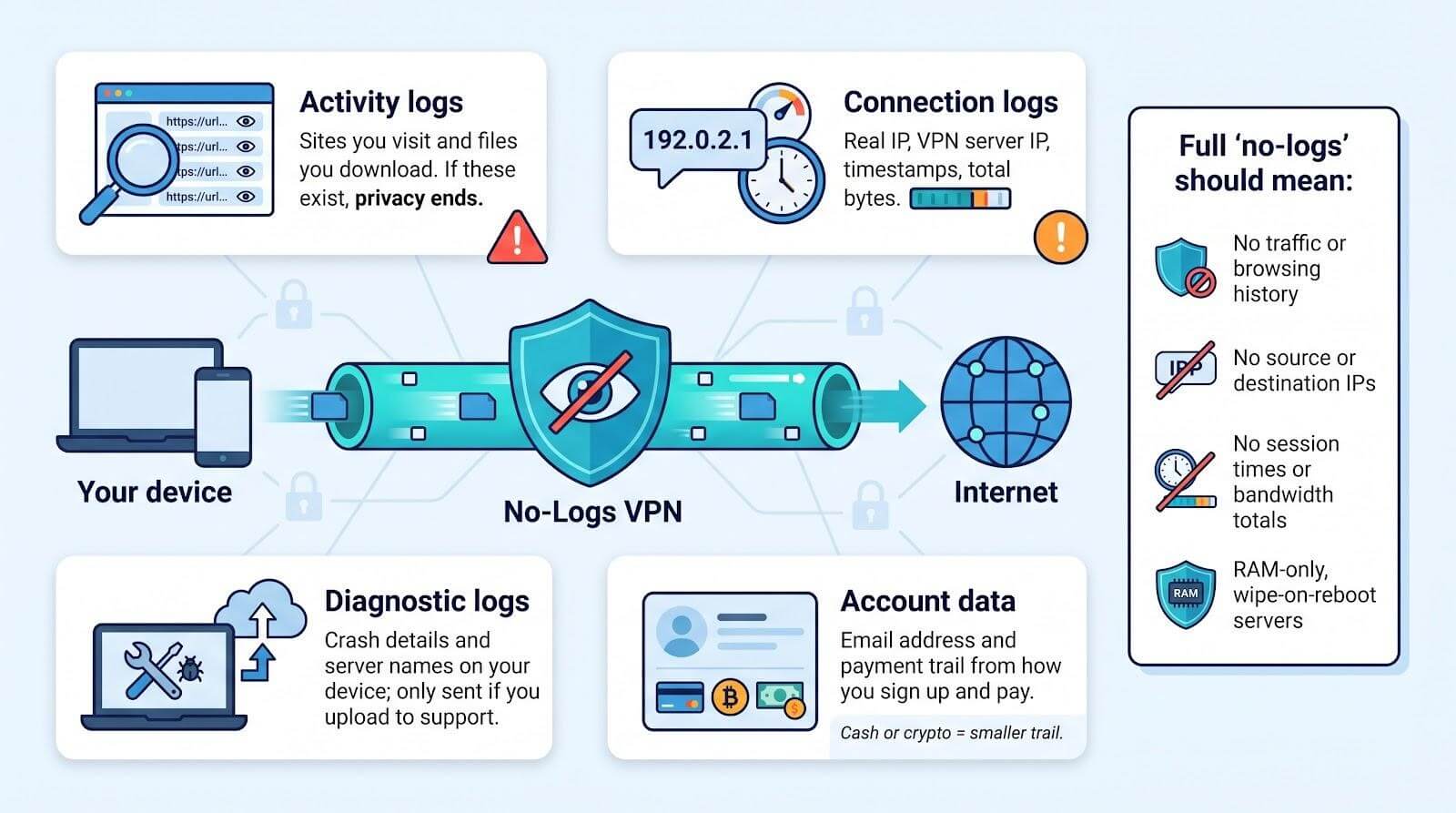
- Activity logs: Activity Logs record the sites you visit or the files you download. If these exist, privacy ends.
- Connection logs: Connection logs capture metadata such as your real IP, the VPN server’s IP, session timestamps, and total bytes. Many providers keep part of this set for troubleshooting; investigators can often connect dots from it alone.
- Diagnostic logs: Diagnostic logs live on your own device. They store crash details and server names and leave the laptop only if you send them to support. A trustworthy provider warns you before you click “submit.”
- Account data: Account details include the email address and payment trail you provide at signup. Paying with cash, Bitcoin, or a number-only account shrinks the paper trail; a recurring credit-card subscription keeps it indefinitely.
A provider that fully claims “no logs” must state in plain language that it does not store traffic, source IPs, destination IPs, session times, or bandwidth totals. It should also outline the technical controls (RAM-only servers, read-only templates, daily redeploys) that make accidental logging difficult. When these details are public and an independent audit confirms them, the slogan moves from marketing to verifiable fact.
Best 5 No-Logs VPN Provider Reviews
The following reviews compare the leading No-Logs VPN services to help users understand their privacy advantages, limitations, and ideal use cases.
1. TorGuard
Image Source: TorGuard
TorGuard targets users who value granular control more than glossy audits.
- Policy: The privacy statement forbids traffic, source IP, and timestamp logs, and assigned IPs are removed at session close (torguard.net/privacy). No independent no-logs audit has been published.
- Jurisdiction and legal history: TorGuard, incorporated in Florida, faces U.S. legal pressure. In 2022, it agreed to block BitTorrent traffic on U.S. servers to settle a copyright lawsuit; no user logs were produced, but the episode shows how policy can change under court heat.
- Key Features:
- WireGuard, OpenVPN, and IKEv2 with custom cipher options
- Stealth modes that wrap packets to evade DPI
- Built-in kill switch
- Port forwarding and SOCKS5 proxy (popular with torrent clients)
- Eight-device base tier; up to 16 on “Ultimate” plans
- Optional dedicated IPs
- Performance: Independent July 2026 testing recorded an average 10 % global speed loss, keeping TorGuard close to the fastest commercial VPNs.
- Transparency gaps: No audit, warrant canary, or recurring transparency report. If third-party proof matters to you, choose one of the higher entries. If protocol control and forwarding outweigh external verification, TorGuard still earns its spot as a specialist.
2. Proton VPN
Image Source: Proton VPN
Proton VPN sits at the top of our evidence ladder because outsiders keep testing its no-logs claim, and they still find nothing to record.
- Audit trail: In June 2026, the Swiss provider completed its fifth consecutive no-logs audit with Securitum. Auditors inspected live servers and confirmed that no traffic, source-IP, or timestamp data is stored (full report on protonvpn.com).
- Legal test: A Swiss court requested VPN records in 2019; Proton replied that none existed, and the case closed without user data changing hands.
- Ongoing transparency: Proton publishes a rolling warrant canary and transparency report, last updated on July 14, 2026, so readers can track every legal request in near real time.
- Technical design: All servers boot from encrypted disks and wipe on power-down. Secure Core routes traffic through hardened data centers, Stealth cloaks packets inside TLS, and optional port forwarding supports self-hosting and seeding.
- Account model: Signup needs an email, but you can pay with Bitcoin or even mail cash to shrink the billing trail.
- Performance: Independent lab tests measured an average 15 % global speed loss, a small trade-off for a five-year audit streak and Swiss jurisdiction.
Choose Proton VPN if you want public proof on the table, open-source apps, and a free tier to try before you pay.
3. Mullvad
Image Source: Mullvad
Mullvad treats identity as risk, so it removes it. You receive a random 16-digit number, no name or email required. Pay with cash, Bitcoin, or Monero and the receipt still shows only that number.
- Policy & proof: The policy forbids logging of traffic, connections, and bandwidth. Swedish police tested the claim in April 2023, seizing office hardware and leaving with zero customer data.
- Transparency: Desktop and mobile apps are open source, builds are reproducible, and recent audits covered the payment back-end code plus the WireGuard-hardening tool GotaTun. Mullvad skips a dedicated no-logs assurance, arguing that point-in-time evidence ages quickly.
- Network design: You get multihop routing, several obfuscation modes, and DAITA traffic-analysis defense. Port forwarding is absent; heavy seeders may prefer PIA, TorGuard, or Proton VPN.
- Performance & price: Independent tests recorded an average 15 % global speed loss, which is competitive. Pricing is flat at €5 (~US$ 5.50) with no renewal surprises.
Choose Mullvad if you want privacy without paperwork and can live without port forwarding or big-name streaming support.
4. NordVPN
Image Source: NordVPN
NordVPN delivers near-top speed backed by a deep audit trail.
- Audit record: On February 3, 2026, the company released its sixth no-logs assurance from Deloitte. Auditors sampled standard, Double VPN, obfuscated, and Onion-over-VPN servers and found no traffic or connection records.
- Infrastructure: Every server is diskless and RAM-based; a reboot wipes configurations, shrinking any forensic window. Panama jurisdiction keeps the company outside mandatory-retention blocs.
- Performance: Independent tests in July 2026 measured an average 14 % global speed loss, only a point behind the fastest service. That headroom lets you stack Double VPN or Onion-over-VPN without noticeable drag.
- Key Features: NordVPN provides several security and privacy features, including:
- NordLynx protocol based on WireGuard technology
- Meshnet for direct device connections
- Kill switch protection
- Threat protection features
- VPN obfuscation for restricted networks
- Account model: Signup requires an email and payment method, so billing metadata lasts longer than with number-only services. Apps are closed source, although binaries undergo separate security audits.
Choose NordVPN if you want fast, no-logs performance backed by recurring Deloitte reviews.
5. Private Internet Access
Image Source: Private Internet Access
Private Internet Access (PIA) has appeared in several U.S. cases, and each time it has produced no user logs.
- Audit & transparency: Deloitte completed a third no-logs audit in early 2026, reviewing server configurations, IT practices, and PIA’s token-based dedicated-IP system. The public summary appears in PIA’s Q4 2025 transparency report, and new reports arrive every quarter, listing every subpoena or law-enforcement request.
- Technical design: The network runs RAM-only servers; open-source clients ship with a kernel-level kill switch. Power-user perks include port forwarding, a SOCKS5 proxy, and unlimited simultaneous devices.
- Jurisdiction: PIA is incorporated in the United States so that a future court could order prospective logging. Until that happens, its RAM-only setup and court record show no leaks.
- Performance & price: Independent tests in July 2026 recorded between 4% (local) and 15% (global) speed loss, keeping PIA near the fastest paid services. A 26-month plan costs US $1.33 per month, with the full feature set intact.
Choose PIA if you want port forwarding, open-source apps, and courtroom-tested privacy without paying premium prices.
How to Read a VPN Audit?
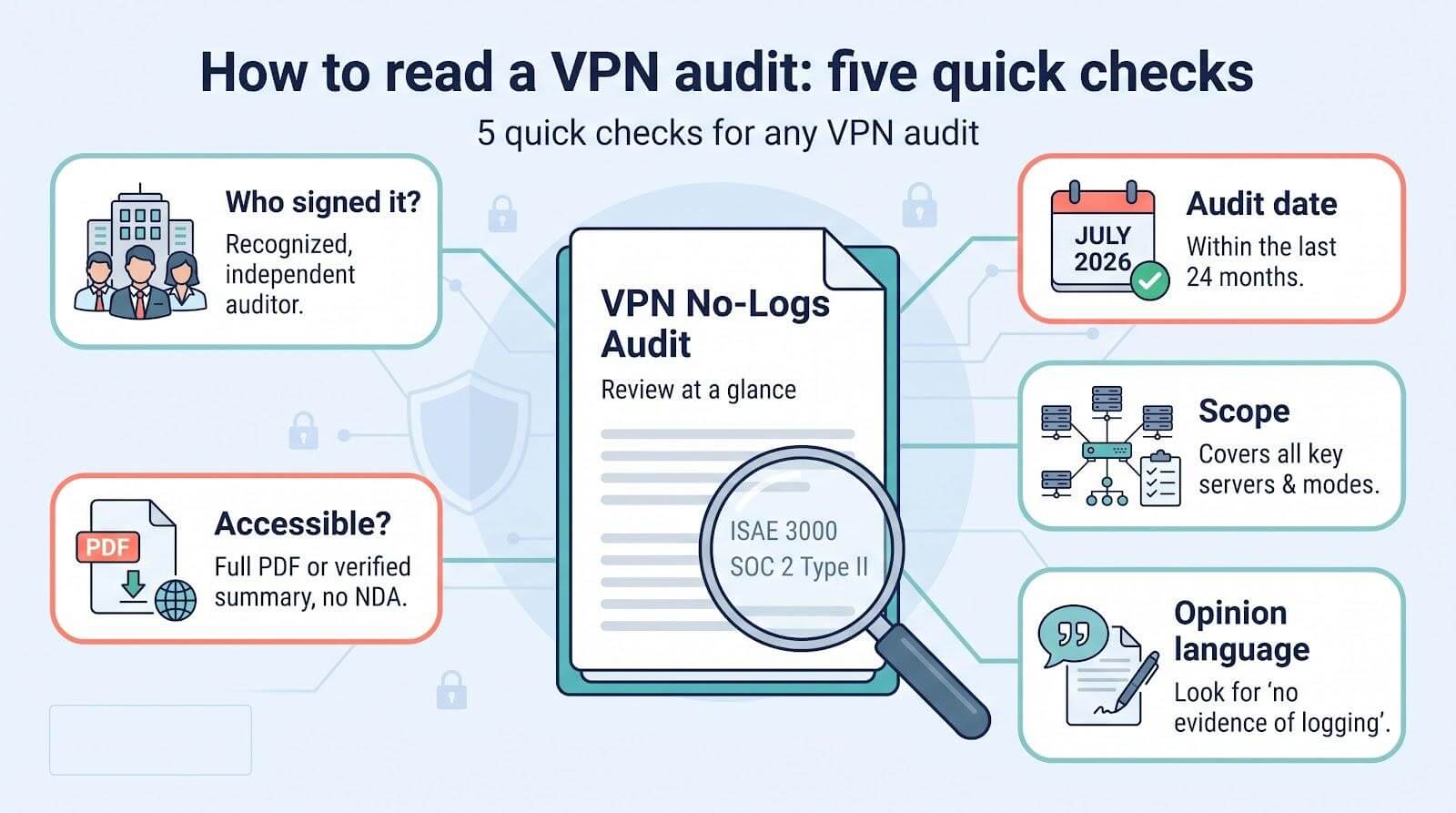
Audits can feel dense, but five signals show whether the PDF is worth trusting:
- Who signed it? Look for a recognized firm such as Deloitte, KPMG, Cure53, or Securitum, not “John’s Cyber Garage.”
- When was it done? Treat anything older than 24 months as stale; cloud networks change quickly.
- What was the scope? Strong reports list every system tested: standard gateways, multihop, obfuscation, dedicated-IP nodes, and control servers. Broader scope equals stronger assurance.
- How is the opinion worded? Phrases like “no evidence of logging” under ISAE 3000 or SOC 2 Type I/II are normal. Sweeping claims that logging “can never occur” are marketing, not audit language.
- Is the report accessible? The best providers publish the full PDF or a hash-verified summary. If you need an NDA or can not download anything the transparency story weakens.
Run through those five checks, and you will separate real assurance from boilerplate badges in seconds.
Why VPN Jurisdiction Matters?
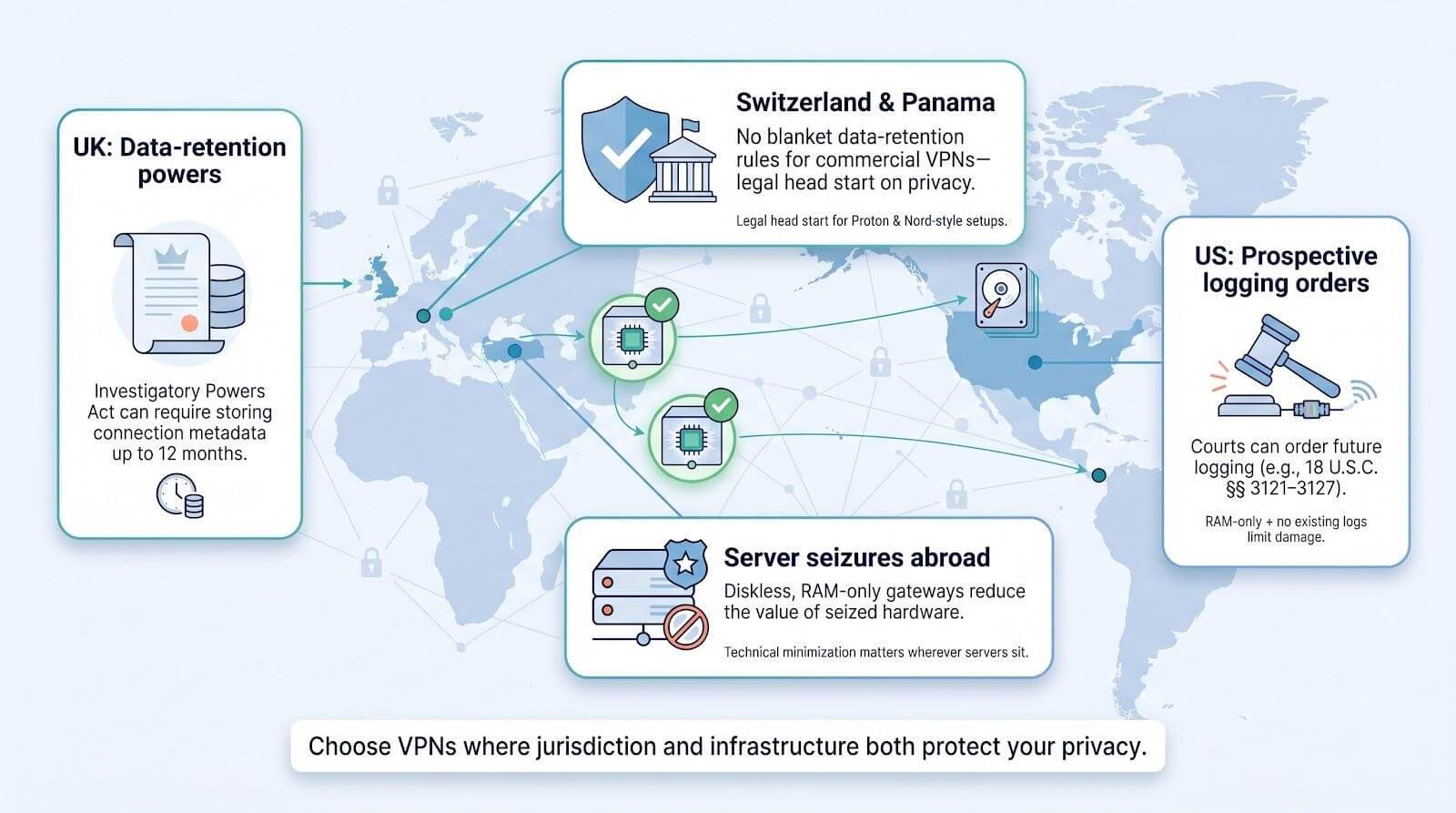
A provider’s address can not guarantee privacy, but it shapes the legal playbook.
- Data-retention laws: The UK’s Investigatory Powers Act can require telecom companies to store connection metadata for up to 12 months; a UK-based VPN could receive the same order. Switzerland and Panama impose no blanket retention on commercial VPNs, giving Proton and Nord a legal head start.
- Compelled future logging: Courts in many democracies, including the United States under 18 U.S.C. §§ 3121–3127, can order a service to begin recording a specific user’s traffic. Whether the provider can fight, disclose, or gag that order depends on local law. PIA’s U.S. court record shows that a RAM-only network can still prevail when no logs exist.
- Server seizures: A diskless gateway in Turkey may be confiscated even if the company is registered in the British Virgin Islands. Technical minimization, RAM-only boot, encrypted control planes reduces the value of that hardware grab.
Pick a VPN where laws and infrastructure reinforce each other. A policy slogan crumbles if courts can demand logs and servers are built to supply them.
Honorable Mentions and Notable Exclusions
Several VPN providers offer strong privacy features but were not included among the top-ranked no-logs VPN services because they did not meet all evaluation criteria.
- ExpressVPN: Polished apps, RAM-only TrustedServer infrastructure, and a February 2025 KPMG no-logs assessment keep ExpressVPN near the top of most privacy lists. We excluded it because NordVPN already fills the mainstream audit slot and ExpressVPN lacks port forwarding.
- IVPN: Offers number-only accounts, open-source clients, frequent security audits, and quarterly canaries. However, its most recent dedicated no-logs audit dates back to 2019. Additional recent verification would strengthen its position among leading no-logs providers.
- Windscribe: Dutch authorities seized one of its RAM-only servers in February 2026 and found no user data, a strong real-world test. A fresh third-party audit could move Windscribe onto next year’s grid.
- PureVPN and IPVanish: Both logged users in the past and later commissioned audits under new ownership. Progress matters, but their history keeps them off our shortlist until more time has passed and fresh audits are completed.
- Emerging watchlist: DuckDuckGo VPN, OVPN, and several hardware-isolation newcomers are testing zero-trust designs. These services may become stronger competitors after achieving public no-logs audits and longer operational records.
Choosing the Right No-Logs VPN Service
The best no-logs VPN depends on individual privacy needs and usage preferences.
- Need dated proof? Proton VPN’s annual Securitum audits provide the most frequent publicly available documentation.
- Want email-free signup? Mullvad’s 16-digit account numbers keep identity off the table.
- Chasing speed plus audits? NordVPN pairs sub-15 % global speed loss with six Deloitte reviews.
- Value port forwarding and a court record? PIA offers both for about $1.33 a month.
- Live in torrent clients and router firmware? TorGuard hands you granular control, but with the least external verification.
Before you trust any service, verify these four points:
- Read the exact policy line that bans traffic, source-IP, and timestamp logging.
- Download the most recent audit or transparency report and check the assessment date.
- Run an IPv4, IPv6, DNS, and WebRTC leak test on your first connection.
- Compare intro and renewal pricing; deep discounts often vanish after the first term.
Final VPN Checklist and Next Steps
Before you click “buy,” confirm these five points:
- Audit date: Choose a provider whose report was issued within the last 24 months.
- Policy wording: Find the sentence that bans traffic, source-IP, and timestamp logging in plain English.
- Leak test: Connect, then visit dnsleaktest.com or ipleak.net to confirm no IPv4, IPv6, DNS, or WebRTC leaks.
- Renewal price: Compare intro and renewal costs in your cart; many discounts vanish after the first term.
- Feature fit: Match port forwarding, multihop, or cash signup to your actual use case; extras you never use do not add privacy.
Frequently Asked Questions (FAQs)
Q1. Can I trust a VPN’s “no-logs” claim?
Answer: Trust the paperwork, not the prose. Look for an audit dated within the past 24 months, a public transparency report, and, ideally, a court or police event where investigators left empty-handed.
Q2. Does a RAM-only server guarantee privacy?
Answer: It wipes data on reboot, but it can not stop live packet capture or a future logging order. Policy wording, audit age, and jurisdiction still matter.
Q3. Which service lets me sign up with zero personal details?
Answer: Mullvad does. You receive a 16-digit account number and can pay with cash, Bitcoin, or Monero, no email needed.
Q4. Why is port forwarding important for torrent users?
Answer: Forwarding opens an inbound path so peers can reach your client directly. Without it, seeding slows or stalls. PIA, TorGuard, and Proton enable forwarding; Nord and Mullvad do not.
Q5. Can a court later force a VPN to start logging me?
Answer: Yes. Many jurisdictions allow prospective orders (for example, 18 U.S.C. §§ 3121–3127 in the United States). Technical minimization, such as RAM-only servers and rapid redeploys, is your fallback if the challenge fails.
Q6. Does a no-log VPN make me anonymous?
Answer: It masks your IP and encrypts traffic, but browser fingerprints, cookies, and logged-in accounts can still identify you. Combine the VPN with tracker-blocking extensions and a privacy-focused browser for stronger cover.
Recommended Articles
We hope this comprehensive guide to no-logs VPN services helps you understand privacy-focused browsing and choose the right VPN solution. Check out these recommended articles for more insights into online security, data protection, and digital privacy.


