


Updated August 5, 2026
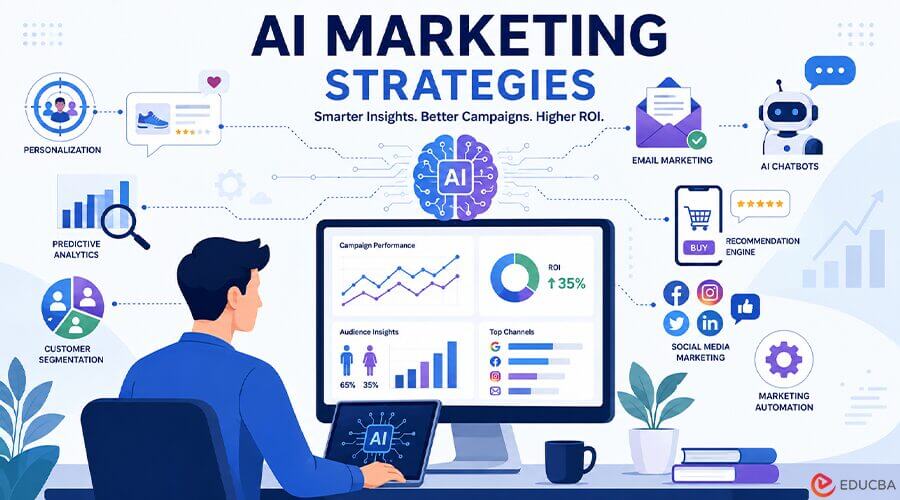
Artificial intelligence (AI) is reshaping how businesses plan, execute, and optimize their marketing efforts. Instead of relying solely on manual processes and broad audience targeting, organizations now use AI to analyze customer data, automate repetitive tasks, and deliver personalized experiences at scale. As customer expectations continue to rise, businesses need smarter strategies to remain competitive, improve engagement, and maximize marketing performance.
AI Marketing Strategies combine artificial intelligence with marketing techniques to help businesses make data-driven decisions, understand customer behavior, and optimize campaigns in real time. From personalized product recommendations and predictive analytics to AI-powered content creation and chatbots, these strategies enable marketers to reach the right audience with the right message at the right time.
In this article, we will explore AI marketing strategies, their importance, key approaches, implementation steps, benefits, challenges, best practices, and future trends that are transforming modern marketing.
Table of Contents
- What Are AI Marketing Strategies?
- Why AI Marketing Strategies Matter
- How AI Supports Marketing Strategies
- Top AI Marketing Strategies
- How to Build an Effective AI Marketing Strategy?
- Best AI Marketing Tools
- Real-World Examples
- Benefits
- Challenges
- Best Practices
- Future Trends
Key Takeaways
- AI marketing strategies use artificial intelligence to improve marketing decisions, automate processes, and deliver personalized customer experiences.
- Businesses can use AI to analyze customer behavior, predict future trends, optimize campaigns, and improve marketing ROI.
- Personalization, predictive analytics, AI-powered content creation, customer segmentation, and conversational marketing are among the most effective AI marketing strategies.
- Successful implementation requires high-quality data, ethical AI practices, continuous monitoring, and human oversight.
- Organizations that combine AI capabilities with creativity and strategic planning can build stronger customer relationships and achieve long-term business growth.
What Are AI Marketing Strategies?
AI Marketing Strategies are structured approaches that use artificial intelligence technologies to improve marketing planning, customer engagement, and campaign performance. These strategies enable businesses to analyze large volumes of customer data, identify behavioral patterns, automate repetitive marketing activities, and deliver personalized experiences across multiple channels.
Unlike conventional marketing approaches that rely on manual analysis and broad customer segmentation, AI-powered strategies leverage real-time data to enable faster, more accurate decision-making. AI can evaluate customer preferences, predict future behavior, recommend relevant products, optimize advertising budgets, and automate communication, enabling marketers to create more effective campaigns more efficiently.
AI marketing strategies incorporate various technologies, including machine learning, predictive analytics, natural language processing (NLP), recommendation engines, and generative AI. Together, these technologies help businesses understand their audiences, improve targeting, and continuously optimize marketing efforts based on performance data.
Rather than replacing marketers, AI serves as a powerful support tool by handling data-intensive tasks, allowing marketing teams to focus on strategic planning, creativity, and relationship-building.
Why AI Marketing Strategies Matter
Modern consumers interact with brands through websites, mobile apps, social media platforms, email, and online marketplaces. They expect personalized experiences, quick responses, and relevant recommendations throughout their customer journey. Meeting these expectations manually has become increasingly challenging as customer data and marketing channels continue to grow.
AI marketing strategies help businesses address these challenges by enabling intelligent automation, providing deeper customer insights, and enabling faster decision-making. Instead of relying on assumptions, marketers can use AI-driven analysis to understand customer behavior, identify emerging trends, and optimize campaigns based on real-time performance.
Some key reasons why AI marketing strategies have become essential include:
1. Growing Customer Expectations
Today’s customers expect businesses to understand their interests and deliver personalized recommendations, offers, and content. AI enables marketers to analyze customer preferences and create experiences that align with individual needs.
2. Increasing Data Volumes
Businesses collect customer information from websites, mobile applications, CRM systems, email campaigns, and social media platforms. AI can process this large volume of data quickly, uncover meaningful insights, and support data-driven marketing decisions.
3. Better Personalization
AI allows businesses to tailor marketing messages, product recommendations, email campaigns, and advertisements for different customer segments. Personalized marketing often leads to higher engagement, improved customer satisfaction, and stronger brand loyalty.
4. Faster Decision-Making
AI analyzes campaign performance and customer interactions in real time, helping marketers respond quickly to changing market conditions and customer preferences. This enables businesses to make timely adjustments that improve campaign effectiveness.
5. Improved Marketing Efficiency
By automating routine tasks such as email scheduling, audience segmentation, social media posting, campaign reporting, and lead nurturing, AI reduces manual effort and allows marketing teams to focus on strategic initiatives.
6. Higher Return on Investment (ROI)
AI continuously evaluates campaign performance and recommends improvements based on real-time insights. Businesses can optimize advertising budgets, improve audience targeting, and allocate marketing resources more effectively, leading to better returns on investment.
7. Stronger Competitive Advantage
Organizations that adopt AI marketing strategies can respond more quickly to customer needs, market changes, and emerging opportunities. This agility helps businesses stay ahead of competitors while delivering more relevant and engaging customer experiences.
How Does AI Support Marketing Strategies?
AI strengthens marketing strategies by helping businesses collect, analyze, and act on data more efficiently. Instead of relying on manual processes, marketers can use AI to identify customer preferences, predict future trends, automate repetitive tasks, and optimize campaigns in real time. This enables organizations to make informed decisions, improve customer engagement, and achieve better marketing outcomes.
The following steps explain how AI supports modern marketing strategies:
1. Data Collection
The process begins with gathering information from various sources, including websites, mobile applications, customer relationship management (CRM) systems, email campaigns, social media platforms, online purchases, and customer support interactions.
AI consolidates this information into a single view, making it easier to analyze customer behavior and marketing performance. The quality and relevance of the collected data directly influence the accuracy of AI-generated insights.
2. Customer Analysis
After collecting data, AI analyzes customer demographics, browsing history, purchasing behavior, interests, and engagement patterns.
This analysis helps businesses answer important questions such as:
- Which products are customers most interested in?
- Which customer segments are most likely to interact with a campaign?
- What type of content generates the highest engagement?
- Which marketing channels deliver the best results?
These insights enable marketers to understand customer needs better and make more informed decisions.
3. Audience Segmentation
AI automatically groups customers based on shared characteristics, behaviors, purchasing habits, interests, and engagement levels.
Unlike traditional segmentation methods, AI continuously updates customer segments as new data becomes available, ensuring that marketing campaigns remain relevant and targeted.
For example, an online retailer can create separate campaigns for:
- First-time visitors
- Repeat customers
- High-value customers
- Customers who abandoned their shopping carts
This level of segmentation improves personalization and campaign effectiveness.
4. Predictive Analytics
AI analyzes historical and current data to identify patterns and forecast future customer behavior.
Predictive analytics helps businesses estimate:
- Which customers are likely to make a purchase
- Which products may become popular during specific seasons
- Which customers are at risk of leaving
- Which campaigns are expected to generate the highest conversions
These predictions allow marketers to take proactive action rather than react after opportunities have been missed.
5. Personalized Content Delivery
AI identifies the most relevant content for each customer by evaluating their preferences, browsing activity, purchase history, and previous interactions.
Instead of showing identical content to every visitor, AI delivers personalized recommendations, product suggestions, promotional offers, and email campaigns tailored to individual customer interests.
This improves customer engagement while increasing the likelihood of conversions.
6. Marketing Automation
AI streamlines repetitive marketing activities, including email scheduling, social media management, campaign execution, lead nurturing, and report creation.
Automation reduces manual effort and improves operational efficiency, allowing marketing teams to dedicate more time to developing strategies, creating innovative campaigns, and strengthening customer relationships.
7. Campaign Optimization
AI continuously monitors campaign performance by analyzing key metrics such as click-through rates, conversion rates, customer engagement, and advertising costs.
Using real-time campaign insights, AI can recommend improvements such as optimizing ad content, refining audience targeting, adjusting budgets, and updating marketing materials to achieve better results.
Continuous optimization helps businesses maximize campaign performance and improve return on investment.
Top AI Marketing Strategies
Organizations use AI in different ways depending on their marketing objectives. The following strategies are among the most effective approaches for improving customer engagement, increasing conversions, and optimizing marketing performance.
1. Personalized Marketing
Personalization is one of the most valuable applications of AI in marketing. Rather than delivering identical messages to every customer, AI enables businesses to create tailored experiences based on individual preferences and behavior.
AI evaluates customer data, including browsing history, purchase records, search activity, location, and engagement patterns, to recommend products, customize website content, and deliver relevant marketing messages.
Benefits
- Improves customer satisfaction
- Increases customer engagement
- Boosts conversion rates
- Strengthens customer loyalty
Example
Amazon uses AI to study customer preferences and suggest products based on individual interests and shopping patterns.
2. Predictive Marketing
Predictive marketing uses AI to anticipate future customer behavior by analyzing historical and current data.
Businesses can forecast purchasing patterns, identify potential high-value customers, estimate customer lifetime value, and predict which campaigns are most likely to succeed.
This proactive approach allows marketers to allocate resources more effectively and improve campaign planning.
Benefits
- Better demand forecasting
- Improved customer retention
- Smarter marketing decisions
- More effective budget allocation
Example
Streaming platforms predict the type of content users are most likely to watch and recommend it to them before they actively search for it.
3. AI-Powered Content Marketing
Creating high-quality content consistently can be time-consuming. AI helps marketers produce content faster while maintaining relevance and consistency.
AI tools assist with generating:
- Blog article ideas
- Product descriptions
- Email campaigns
- Advertisement copy
- Social media captions
- SEO recommendations
It also analyzes audience engagement to determine which content formats perform best.
Benefits
- Faster content production
- Improved content relevance
- Better SEO optimization
- Increased audience engagement
Example
Many businesses use AI writing assistants to generate first drafts of blog posts, marketing emails, and social media content, allowing teams to focus on editing and strategic planning.
4. Customer Segmentation
Customer segmentation helps businesses divide audiences into meaningful groups with similar characteristics.
AI automates this process by evaluating customer demographics, purchasing behavior, browsing activity, and engagement history.
Instead of relying on static customer lists, AI continuously updates audience segments based on new customer interactions.
Benefits
- More accurate audience targeting
- Improved campaign relevance
- Higher customer engagement
- Better marketing efficiency
Example
An e-commerce company may automatically identify frequent buyers, occasional shoppers, and inactive customers, then create customized campaigns for each segment.
5. AI Email Marketing
Email marketing remains one of the highest-performing digital marketing channels, and AI makes it even more effective through automation and personalization.
AI helps businesses:
- Personalize email content
- Recommend suitable products
- Optimize subject lines
- Determine the best time to send emails
- Automate follow-up campaigns
- Segment email audiences
These capabilities improve email engagement while reducing manual effort.
Benefits
- Higher open rates
- Improved click-through rates
- Better customer engagement
- Increased conversions
Example
An online retailer can automatically send personalized product recommendations based on a customer’s recent browsing history, increasing the likelihood of a purchase.
6. Conversational Marketing
Conversational marketing focuses on engaging customers through real-time, personalized interactions. AI-powered chatbots and virtual assistants help businesses answer questions, recommend products, provide support, and guide customers throughout the buying journey.
Unlike traditional customer service, AI-driven conversational tools are available 24/7, enabling businesses to respond quickly and consistently across multiple communication channels.
Benefits
- Provides instant customer support
- Improves customer satisfaction
- Reduces response times
- Increases lead generation opportunities
- Supports continuous customer engagement
Example
Many e-commerce businesses use AI chatbots to answer product-related questions, recommend suitable products, and assist customers during checkout.
7. Recommendation Engines
Recommendation engines use AI to evaluate customer preferences, browsing history, purchase records, and previous interactions to suggest relevant products, services, or content.
By providing personalized recommendations, businesses can improve customer experiences while increasing engagement and sales.
Benefits
- Delivers personalized recommendations
- Increases average order value
- Improves customer retention
- Enhances user experience
Example
Netflix recommends movies and TV shows based on users’ viewing history, while Spotify suggests playlists and songs according to individual listening habits.
8. AI-Powered Advertising
AI has transformed digital advertising by helping businesses deliver advertisements to the most relevant audiences while optimizing campaign performance.
AI analyzes customer behavior, demographics, online activity, and campaign data to improve audience targeting, bidding strategies, budget allocation, and ad placement.
Rather than relying on manual optimization, marketers can use AI to improve advertising performance based on real-time insights continuously.
Benefits
- Improves audience targeting
- Optimizes advertising budgets
- Increases campaign efficiency
- Enhances return on investment (ROI)
Example
Google Ads uses AI-powered Smart Bidding to automatically adjust bids based on the likelihood of achieving campaign objectives, such as conversions or sales.
9. AI for Social Media Marketing
Social media platforms generate large amounts of customer engagement data every day. AI helps businesses analyze this information to improve content planning and audience engagement.
AI supports social media marketing by:
- Scheduling posts
- Generating captions
- Identifying trending topics
- Monitoring customer sentiment
- Recommending optimal posting times
- Measuring campaign performance
These capabilities help businesses maintain a consistent social media presence while improving audience interactions.
Benefits
- Improves content planning
- Enhances customer engagement
- Identifies emerging trends
- Simplifies social media management
Example
Many brands use AI-powered social media management tools to schedule posts automatically and analyze audience engagement across multiple platforms.
10. Predictive Lead Scoring
Not every lead has the same likelihood of becoming a customer. Predictive lead scoring uses AI to identify high-potential prospects by analyzing customer demographics, engagement history, browsing behavior, and purchasing intent.
AI assigns scores to leads based on their probability of conversion, allowing sales and marketing teams to focus on the most promising opportunities.
Benefits
- Improves lead qualification
- Increases conversion rates
- Enhances sales productivity
- Reduces time spent on low-quality leads
Example
A software company can prioritize leads who frequently visit pricing pages, download product guides, and attend webinars, as these actions often indicate stronger purchase intent.
How to Build an Effective AI Marketing Strategy?
Implementing AI successfully requires more than simply adopting new technology. Businesses need a structured strategy that aligns AI capabilities with marketing objectives and customer needs.
The following steps can help organizations develop an effective AI marketing strategy.
Step 1: Define Clear Marketing Objectives
Start by identifying the goals you want to achieve with AI. Common objectives include:
- Increasing website traffic
- Improving customer engagement
- Generating more qualified leads
- Boosting conversion rates
- Enhancing customer retention
- Improving marketing ROI
Clear objectives provide direction and make it easier to measure success.
Step 2: Collect High-Quality Data
AI requires accurate and relevant data to generate dependable insights.
Businesses should gather information from reliable sources such as:
- CRM systems
- Website analytics
- Social media platforms
- Email campaigns
- Customer feedback
- Purchase history
Well-organized and high-quality data improves the effectiveness of AI models and marketing decisions.
Step 3: Choose the Right AI Tools
Different AI tools serve different marketing purposes. Select solutions that align with your business objectives and existing marketing processes.
For example:
- AI writing tools for content creation
- Chatbots for customer support
- Marketing automation platforms for campaign management
- Analytics tools for customer insights
- Advertising platforms with AI optimization features
Choosing the appropriate tools helps maximize the value of AI investments.
Step 4: Start with a Small Pilot Project
Rather than implementing AI across every marketing activity at once, begin with a single campaign or business function.
For example, businesses can first automate email marketing or personalize product recommendations before expanding AI implementation to other areas.
A phased approach reduces risks and allows teams to evaluate performance before scaling.
Step 5: Monitor Performance Metrics
Regularly measure AI performance using key performance indicators (KPIs), such as:
- Conversion rate
- Click-through rate (CTR)
- Customer acquisition cost (CAC)
- Customer lifetime value (CLV)
- Return on investment (ROI)
- Email open rate
- Customer engagement rate
Tracking these metrics helps businesses understand whether AI strategies are delivering the expected results.
Step 6: Continuously Optimize Your Strategy
AI marketing strategies should evolve based on performance data and changing customer behavior.
Regularly review campaign results, identify opportunities for improvement, and update AI models as needed.
Leverage these insights to refine AI systems and strengthen marketing strategies, ensuring they remain effective as customer expectations and market conditions change.
Best AI Marketing Tools
Choosing the right AI marketing tools is essential for improving productivity, enhancing customer experiences, and achieving better campaign results. Different tools specialize in content creation, customer relationship management, advertising, analytics, email marketing, and search engine optimization.
The table below highlights some widely used AI marketing tools and their primary applications.
| Tool | Primary Use |
| ChatGPT | Content creation, brainstorming, and customer support |
| Jasper | AI copywriting and marketing content generation |
| HubSpot AI | CRM, marketing automation, and lead management |
| Salesforce Einstein | Customer insights and predictive analytics |
| Google Ads AI | Smart bidding, audience targeting, and campaign optimization |
| Canva AI | AI-assisted graphic design and visual content creation |
| Mailchimp AI | Email marketing automation and personalization |
| Semrush AI | SEO research, keyword analysis, and content optimization |
Businesses should evaluate their marketing objectives, budget, and existing technology stack before selecting AI tools that best meet their needs.
Real-World Examples of AI Marketing Strategies
Many leading organizations use AI marketing strategies to improve customer experiences, optimize campaigns, and increase business performance. The following examples demonstrate how AI creates value across different industries.
1. Amazon
Amazon leverages AI to study customer preferences and recommend products based on individual interests and shopping patterns.
These personalized recommendations improve customer engagement while increasing sales and average order value.
2. Netflix
Netflix uses AI to analyze viewing history, search behavior, and user preferences to recommend movies and television shows.
Its recommendation engine helps users discover relevant content, increasing viewing time and customer satisfaction.
3. Spotify
Spotify applies AI to understand listening habits and create personalized playlists, such as Discover Weekly and Daily Mix.
These recommendations encourage users to explore new music while keeping them engaged with the platform.
4. Starbucks
Starbucks uses AI to provide personalized offers through its mobile application based on customers’ purchase history, location, and preferences.
This approach helps improve customer loyalty and encourages repeat purchases.
5. Sephora
Sephora incorporates AI-powered virtual assistants and product recommendation systems to help customers discover suitable beauty products.
Its AI solutions provide personalized shopping experiences both online and in stores.
Benefits of AI Marketing Strategies
AI marketing strategies offer numerous advantages, including improved operational efficiency, enhanced customer experiences, and data-driven decision-making.
1. Improves Personalization
AI enables businesses to deliver personalized recommendations, advertisements, emails, and website experiences based on individual customer preferences.
2. Enhances Marketing Efficiency
AI automates repetitive marketing activities, reducing manual effort and allowing teams to focus on strategic planning and creative initiatives.
3. Supports Better Decision-Making
AI analyzes large volumes of customer and market data to identify meaningful insights.
4. Optimizes Campaign Performance
AI continuously evaluates campaign performance and recommends improvements based on real-time insights.
Benefit: Better campaign effectiveness and improved marketing ROI.
5. Strengthens Customer Engagement
Personalized communication and relevant recommendations encourage customers to interact more frequently with brands.
6. Improves Lead Generation
AI identifies high-potential prospects by analyzing customer behavior and purchase intent.
7. Enables Faster Marketing Responses
AI helps businesses analyze market changes and customer behavior in real time.
8. Reduces Operational Costs
Automation minimizes repetitive manual work and improves resource utilization.
Challenges of AI Marketing Strategies
Although AI provides significant advantages, organizations should also address several challenges to achieve successful implementation.
1. Data Privacy and Security
AI relies heavily on customer data, making it essential for organizations to comply with data privacy regulations and protect sensitive information.
2. Poor Data Quality
Low-quality data can result in unreliable predictions and poorly performing marketing campaigns.
Businesses should regularly clean, validate, and update their data to improve AI accuracy.
3. High Implementation Costs
Implementing AI solutions may require investments in software, infrastructure, employee training, and system integration.
Small businesses may initially face budget constraints when adopting advanced AI technologies.
4. Skill Gaps
Marketing teams need expertise in data analysis, AI tools, automation platforms, and digital marketing to maximize AI’s capabilities.
Continuous learning and employee training are essential for successful adoption.
5. AI Bias
AI models learn from historical data. If the training data contains bias, AI-generated recommendations may also become biased, affecting customer experiences and decision-making.
Organizations should regularly evaluate AI outputs to ensure fairness and accuracy.
6. Over-Reliance on Automation
While AI improves efficiency, excessive automation can reduce the human element in customer interactions.
Businesses should combine AI capabilities with human creativity, judgment, and relationship-building to create meaningful customer experiences.
Best Practices for AI Marketing Success
Businesses can maximize the benefits of AI marketing strategies by following proven practices that improve implementation, enhance customer experiences, and support long-term success.
1. Define Clear Marketing Goals
Establish specific objectives before implementing AI solutions. Whether the goal is to improve customer engagement, generate qualified leads, increase conversions, or optimize marketing campaigns, clearly defined objectives help businesses measure performance and achieve better outcomes.
2. Use High-Quality Data
AI requires accurate and relevant data to generate dependable insights. Businesses should regularly update, validate, and organize customer data to improve the accuracy of AI models and marketing decisions.
3. Select the Right AI Tools
Choose AI tools that align with your business objectives, marketing channels, and budget. The right technology can improve productivity, simplify workflows, and deliver measurable business value.
4. Protect Customer Privacy
Securing user consent and complying with relevant data privacy regulations help organizations build trust and promote the responsible use of AI.
Businesses should also implement strong security measures to protect customer information from unauthorized access.
5. Maintain Human Oversight
AI should support marketing teams rather than replace them. Human expertise remains essential for strategic planning, creative decision-making, and the evaluation of AI-generated recommendations.
Keeping people involved helps ensure ethical, accurate, and customer-focused marketing practices.
6. Monitor Performance Regularly
Track key performance indicators (KPIs) such as conversion rates, customer engagement, click-through rates, customer acquisition costs, and return on investment.
Regular performance reviews help identify opportunities for improvement and ensure AI strategies continue to deliver value.
7. Continuously Improve AI Models
Customer behavior, market trends, and business objectives change over time. Businesses should regularly evaluate AI performance, update models with new data, and refine marketing strategies based on performance insights.
Continuous optimization helps maintain the effectiveness of AI marketing initiatives.
Future Trends in AI Marketing Strategies
AI continues to evolve rapidly, creating new opportunities for businesses to improve customer engagement and marketing performance. The following trends are expected to shape the future of AI marketing strategies.
1. Hyper-Personalization
AI will deliver even more personalized experiences by analyzing customer behavior, preferences, location, and real-time interactions. Businesses will be able to create highly relevant content, recommendations, and offers for individual customers.
2. Generative AI for Content Creation
Generative AI will continue to transform content marketing by helping businesses create blog articles, advertising copy, product descriptions, videos, email campaigns, and social media content more efficiently.
Human oversight will remain important to maintain quality, accuracy, and brand consistency.
3. Predictive Customer Journeys
AI will become more effective at predicting customer needs before they arise. Businesses will use predictive insights to engage customers proactively and improve every stage of the customer journey.
4. Voice and Visual Search Optimization
As voice assistants and image-based searches become more common, businesses will increasingly optimize their marketing strategies for voice queries and visual search experiences.
5. AI-Powered Customer Service
AI chatbots and virtual assistants will become more advanced, providing faster, more personalized, and context-aware customer support while handling increasingly complex customer inquiries.
6. Responsible and Ethical AI
Organizations will place greater emphasis on transparency, fairness, data privacy, and responsible AI governance. Ethical AI practices will become an essential part of building customer trust and maintaining regulatory compliance.
Frequently Asked Questions (FAQs)
Q1. What is an AI marketing strategy?
Answer: An AI marketing strategy is a marketing approach that uses artificial intelligence to analyze customer data, automate marketing activities, personalize customer experiences, and improve campaign performance.
Q2. How do AI marketing strategies improve campaign performance?
Answer: AI analyzes customer behavior, identifies trends, optimizes audience targeting, automates repetitive tasks, and provides real-time insights that help marketers make better decisions and improve campaign effectiveness.
Q3. Can small businesses benefit from AI marketing strategies?
Answer: Yes. Small businesses can use AI tools to automate routine marketing tasks, understand customer preferences, improve customer communication, and create effective campaigns without requiring large marketing budgets.
Q4. What skills are important for implementing AI marketing strategies?
Answer: Marketers should develop skills in data analysis, AI tools, customer segmentation, content strategy, digital marketing, and marketing analytics to use AI-powered solutions effectively.
Q5. Will AI replace human marketers?
Answer: No. AI is designed to support marketers by automating repetitive tasks and providing valuable insights. Human creativity, strategic thinking, and decision-making remain essential for developing successful marketing campaigns.
Final Thoughts
AI marketing strategies are transforming the way businesses connect with customers, optimize campaigns, and make marketing decisions. By combining artificial intelligence with data-driven insights, organizations can deliver personalized experiences, automate routine processes, improve audience targeting, and maximize marketing performance.
However, successful implementation requires more than adopting AI tools. Businesses must establish clear objectives, use high-quality data, protect customer privacy, monitor AI performance, and maintain human oversight to ensure responsible and effective AI adoption.
As AI technology continues to advance, organizations that embrace innovation while balancing automation with human creativity will be better equipped to strengthen customer relationships, adapt to changing market conditions, and achieve sustainable business growth.
Recommended Articles
We hope this guide on AI Marketing Strategies has helped you understand how AI can improve modern marketing. Explore these recommended articles to learn more about digital marketing, AI technologies, and effective marketing practices.


