


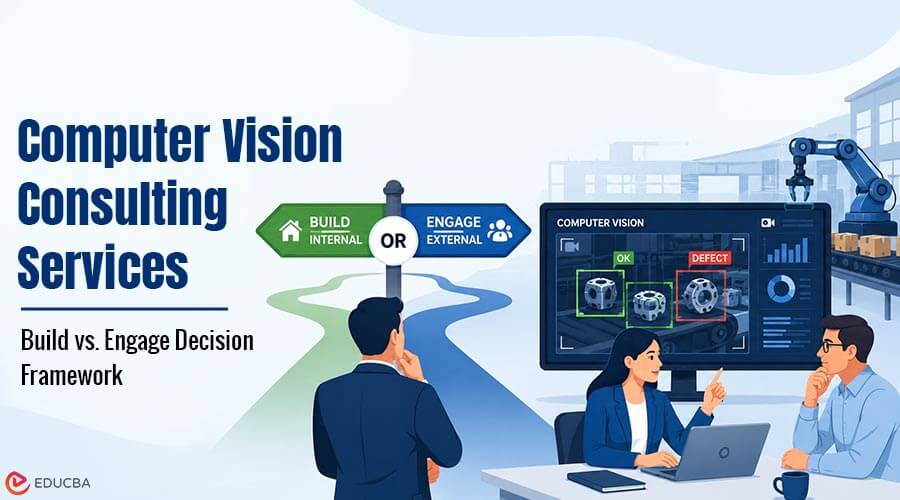
Every organization that gets serious about computer vision faces the same decision: build internal capability or engage external computer vision consulting services.
It sounds like a simple question. It is not. The right answer depends on factors that most organizations do not fully account for when they first start evaluating options, and getting it wrong is expensive in time, money, and organizational credibility.
Here’s a framework for making that decision well.
Why the Decision Is Harder Than It Looks
The surface argument for building internal capability: you own the technology, you control the roadmap, you accumulate knowledge that compounds over time.
Organizations increasingly rely on computer vision consulting services to accelerate AI adoption, reduce implementation risks, and access specialized expertise without spending years building in-house capabilities.
- The surface argument for engaging external computer vision consulting services: faster time to production, immediate access to experience that would take years to build internally, lower upfront cost. Both arguments are partially right. Neither captures the full picture.
- What the build argument misses: Computer vision expertise is genuinely scarce and expensive. The combination of skills required for ML engineering, CV-specific model experience, data pipeline architecture, production deployment, and domain knowledge in your specific application area rarely exists in one person. It takes significant time to assemble as a team. The timeline from “we decided to build internal capability” to “we have a production CV system maintained by people who understand it” typically ranges from 18 to 36 months. That’s a long time to wait for capability that could be deployed in 6-12 months with the right external partner.
- What the engage argument misses: External computer vision consulting services that don’t include meaningful knowledge transfer leave the organization indefinitely dependent. Every update, every new use case, every production issue requires going back to the consulting firm. The economics of ongoing dependency often exceed the cost of building internal capability over a sufficiently long time horizon. The decision is not binary. The right model for most organizations is somewhere between the extremes.
Decision Framework for Computer Vision Consulting Services
Four factors determine where on the spectrum the right answer sits.
Factor 1: How Strategic Is CV to Your Business?
If computer vision is a core capability that will differentiate your product or operations for years to come, investing in internal expertise may make sense. However, many organizations initially partner with computer vision consulting services to validate their strategy before expanding internal teams.
If computer vision solves a specific operational problem that’s important but not differentiating quality control on a standard production line, for example, external consulting services with strong knowledge transfer may be the more efficient path.
Factor 2: How Much Do You Have to Learn About Your Own Problem?
Computer vision applications are domain-specific in ways that are not always obvious upfront. The defect types that matter, the imaging conditions that work, the accuracy thresholds that are actually required, and the unacceptable failure modes emerge through the process of building and deploying the first system.
If you are early in understanding your specific CV problem, external computer vision consulting services that have seen similar problems in similar environments bring a shortcut. They know which questions to ask, where potential challenges are likely to arise, and what training data will be required before the collection process even begins.
Experienced computer vision consulting services also help organizations avoid common implementation mistakes by recommending proven architectures, data collection strategies, and deployment best practices.
If you already understand your problem well, you have done enough research to know the approach, the data requirements, and the performance thresholds; the question is really about execution capacity, not knowledge.
Factor 3: What is Your Current Technical Talent Base?
The following recommendations illustrate how computer vision consulting services fit different organizational maturity levels.
| Existing Capability | Implication |
| No ML/data science team | External consulting is the only realistic path in the near term |
| ML team without CV experience | External consulting with strong knowledge transfer can build CV capability onto your existing team |
| ML team with some CV experience | External consulting for specific expertise gaps, internal team handles the rest |
| Strong internal CV team | Internal with external advisory for novel problems or second opinions |
The hybrid model, external computer vision consulting services that transfer knowledge to internal engineers who participate throughout the engagement, is the fastest path to internal capability for organizations with some existing ML talent.
Factor 4: What is the Timeline Pressure?
If the business need is urgent a quality problem that is causing production losses, a competitive opportunity that requires CV capability- external computer vision consulting services are almost always faster.
If the timeline is flexible and the organization is thinking in 2-3 year horizons, the investment in building internal capability may be worth the longer initial timeline.
The Hybrid Model for Computer Vision Consulting Services
For most mid-market and enterprise organizations with ongoing CV ambitions, the hybrid model produces the best outcomes.
Phase 1 (Months 1–8): External-Led, Internal Participating
External computer vision consulting services lead the engagement. Internal engineers are embedded in the team—not just receiving deliverables, but actively participating in architecture decisions, data strategy, model training, and evaluation. The goal isn’t just to deploy the first system; it’s to ensure internal engineers understand how it works and can support it.
Phase 2 (Months 8–16): Joint Ownership
Internal engineers take increasing ownership of specific components, including:
- Data pipelines
- Monitoring
- Evaluation
Meanwhile, the external team remains available for architectural guidance and complex problem-solving. The external team leads new model development, while the internal team takes responsibility for maintaining and improving the deployed system.
Phase 3 (Month 16+): Internal Ownership with External Advisory
The internal team owns production CV systems and can build new ones independently. External computer vision consulting services transition to an advisory role, providing support for:
- Novel or complex problems
- Second opinions on major architectural decisions
- Periodic audits of production system performance
This phased approach builds internal capability without the 18–36-month delay of starting from scratch and avoids the indefinite dependency on external consulting without knowledge transfer.
What to Look for in External Computer Vision Consulting Services?
Not all computer vision consulting services provide the same level of technical expertise, industry knowledge, or knowledge transfer. Evaluating providers carefully helps ensure long-term project success.
If external engagement is the right path, whether short-term or as part of a hybrid model, the evaluation criteria matter.
1. Domain Experience, Not Just Technical Capability
CV expertise in manufacturing quality control and in medical imaging are different. The data characteristics, accuracy requirements, integration landscape, and regulatory environment differ.
Ask specifically about production deployments in your application domain.
2. Knowledge Transfer as a Designed Deliverable
The consulting firm should be able to describe specifically how knowledge transfer will occur, including:
- What internal engineers will be able to do at the end of the engagement that they couldn’t do at the beginning
- What documentation will be created
- What training sessions are planned
- What the transition period will look like
Vague commitments to “transferring knowledge” are not the same as a designed knowledge transfer program.
3. Production Track Record, Not Just Research Capability
The transition from laboratory testing to real-world production deployment is where many computer vision projects encounter their greatest challenges.
Ask for specific production deployments, including:
- Accuracy in development versus production
- Problems that emerged after launch
- How those issues were resolved
4. Honest Feasibility Assessment
The most valuable thing external computer vision consulting services can tell you early is whether your specific problem is actually solvable with CV at the accuracy you require, with the data you can realistically collect, and in the environment where you plan to deploy it.
Consultants who commit to a project scope without conducting this assessment are either overly optimistic or primarily motivated by securing the engagement.
Computer Vision Consulting Services vs. In-House Teams: Cost Comparison
Most organizations compare the cost of external computer vision consulting services to the cost of hiring.
However, comparing computer vision consulting services with internal hiring requires looking beyond upfront costs and considering deployment speed, business risk, and long-term scalability.
This comparison is incomplete unless you consider the following factors:
| Cost Factor | Build Internal | Engage External | Hybrid |
| Time to first production system | 18-36 months | 6-12 months | 8-16 months |
| Upfront investment | High (hiring, onboarding, tooling) | Medium (engagement fee) | Medium-high |
| Ongoing cost | Salary + benefits + tooling | Advisory retainer or project fees | Reduced internal + advisory |
| Risk | High (talent risk, knowledge concentration) | Medium (dependency, knowledge transfer quality) | Lower (distributed) |
| Long-term economics | Better if CV is strategic and ongoing | Better for one-time or episodic needs | Usually best for sustained CV programs |
The build option wins economically when CV is a sustained, strategic capability and the organization has the patience for an 18-36-month runway. The engage option wins when the need is specific, the timeline is urgent, or the organization doesn’t have the talent base to build from. The hybrid wins most often for organizations with serious CV ambitions and existing ML talent.
The build vs. engage decision for computer vision is not about which is generally better. It is about which fits your specific situation, your timeline, your talent base, your strategic ambition, and your appetite for the ongoing dependency that external consulting without knowledge transfer creates.
Whether you build an internal team, adopt a hybrid approach, or engage computer vision consulting services, making the right decision upfront can save significant time, reduce costs, and improve long-term AI success. Evaluating computer vision consulting services based on domain expertise, production experience, and knowledge transfer capabilities will help ensure lasting business value.
Final Thoughts
Choosing between building an in-house team and engaging computer vision consulting services isn’t about finding a universally better approach; it is about selecting the one that best aligns with your business goals, technical capabilities, timeline, and long-term vision. While building internal expertise offers greater ownership and strategic control, external consultants can accelerate implementation and reduce risk when specialized knowledge is needed. For many organizations, a hybrid approach delivers the best of both worlds by combining faster deployment with sustainable knowledge transfer. By carefully evaluating your needs and choosing the right engagement model, you can build a computer vision capability that delivers lasting business value and supports future innovation.
Recommended Articles
We hope this guide on computer vision consulting services helps you determine whether to build in-house expertise, engage external specialists, or adopt a hybrid approach. Explore these recommended articles for additional insights into computer vision, AI implementation strategies, and building scalable machine learning capabilities.


