


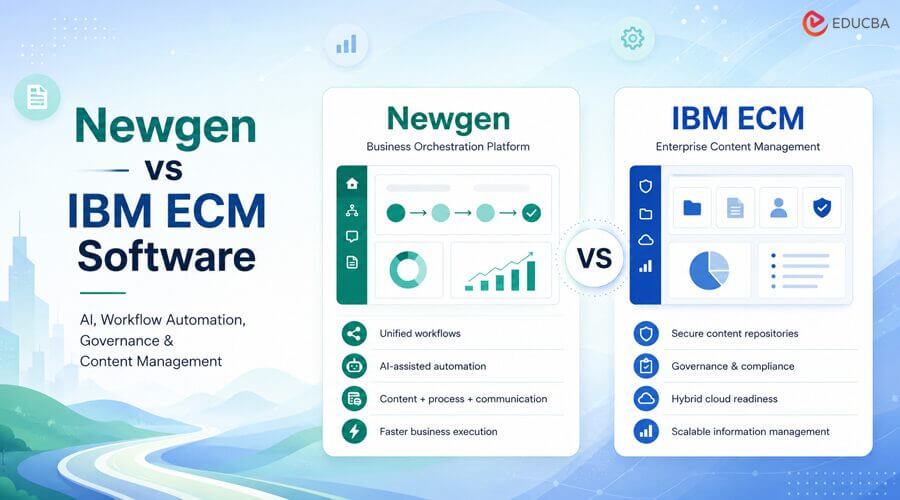
The right enterprise content management software sits at the center of critical operations. As AI becomes more deeply embedded in business operations, organizations need platforms that connect information, workflows, decisions, and communications in a single governed layer. This Newgen vs IBM ECM Software comparison explores how Newgen and IBM approach enterprise content management and business automation. Both established providers in the ECM platform market serve this need in fundamentally different ways.
The core question for any buyer is:
Is your ECM platform helping you manage content or helping you run the business?
What Today’s Enterprises Expect from an ECM Platform?
Organizations now measure ECM success by its business impact, not by its document storage capacity. Modern organizations increasingly expect an enterprise content management platform and solution to deliver across multiple dimensions.
- Intelligent content access and semantic search
- Workflow automation and case management
- AI-driven insights and decision support
- Governance, compliance, and full audit trails
- Seamless integration across departments, systems, and communications
- Faster operational outcomes tied to real business processes.
The best enterprise content management software and systems connect information to the people and processes that need it, making every ECM solution a driver of business outcomes.
Newgen vs IBM ECM Software
| Newgen | IBM | |
| Platform | NewgenONE | IBM Cloud Pak for Business Automation (CP4BA) with FileNet Content Manager |
| Core Focus | Unified orchestration of content, processes, communications, and AI | Enterprise content services, information governance, and content lifecycle management |
| Deployment | Cloud-native SaaS, private cloud, and hybrid | Containerized hybrid cloud (Red Hat OpenShift), self-managed, or managed SaaS |
| Industry Fit | Banking, insurance, healthcare, and government | Large compliance-heavy enterprises in banking, insurance, and government |
| Gartner Standing | MQ Leader, Business Orchestration and Automation Technologies (2025); Forrester Wave Leader, Content Platforms (Q1 2025) | Niche Player, Gartner Magic Quadrant for Document Management (2024) |
| AI Approach | Marvin, Harper, and LumYn agents embedded in live workflows | watsonx ecosystem; Client Managed AI assistant; IBM Workflow Assistant |
Both platforms support enterprise content management, but they differ in how broadly they extend beyond content itself.
Content Intelligence That Turns Information into Action
Modern employees need answers and context, not just access to files. This is where the two enterprise content management systems diverge in practice.
Newgen
NewgenONE Content ORB turns static document repositories into a living context engine. It makes content actionable, not just searchable.
- Semantic search powered by RAG-based vectorization understands business intent, not just keywords.
- Conversational retrieval through the Marvin AI agent turns a 20-minute search into a 30-second interaction.
- AI-powered classification and automatic metadata tagging eliminate manual effort with audit-ready results.
- Knowledge graphs connect documents, customers, transactions, and cases to give every workflow full context instantly.
IBM
IBM FileNet provides enterprise-grade content repositories built for high-volume transactional processing. The platform supports records and information governance, secure content lifecycle management, and content services that integrate with broader IBM and third-party enterprise systems. With CP4BA 25.0.1, IBM introduced the Client Managed Content Assistant.
This allows regulated organizations to run AI summarization and semantic search entirely within their own managed environment, keeping sensitive files under full operational control. Both ECM solutions handle content at scale. In this Newgen vs IBM ECM Software comparison, Newgen makes content contextual and operational, while IBM governs content with depth and infrastructure-level security.
From Automation to Orchestration
This is the clearest point of separation between these two enterprise content management solutions and the core question in any ECM system selection.
Newgen
Newgen orchestrates content, workflows, communications, systems, humans, and AI agents simultaneously within a single governed platform. It is built around the concept of enterprise execution, not just process efficiency.
Real deployments include end-to-end loan origination, insurance claims processing, healthcare prior authorization, and citizen services automation. These are not isolated document workflows. They are complete business operations running inside a single ECM system and enterprise content management platform, making Newgen a true end-to-end ECM solution.
IBM
IBM’s CP4BA supports robust workflow automation and business process management through Business Automation Workflow (BAW). It automates information-driven operational tasks and handles complex transactional volumes with proven scalability.
PNC Financial Services used IBM’s Operational Decision Manager to automate 50 complex business processes and deploy over 5 million active business rules, cutting manual loan review cycles by 80-90 percent. Automation improves individual processes. Orchestration connects entire business operations. In the Newgen vs IBM ECM Software comparison, Newgen is designed specifically for enterprise-wide orchestration.
AI’s Expanding Role in Enterprise Content Management
The next generation of ECM platforms will not simply manage information. They will help organizations act on it. Both Newgen and IBM have invested in AI, but with different scopes.
| Capability | Newgen | IBM |
| AI Agents | Marvin (platform intelligence), Harper (customer conversations) | Client Managed Content Assistant, IBM Workflow Assistant, AI-Assisted Workflow Authoring |
| Document Processing | IDP with 90%+ classification accuracy, self-improving feedback loop | AI-assisted document analysis within CP4BA and watsonx |
| Conversational Search | Marvin agent which is a natural language queries across repositories | Semantic search within a managed environment via Client Managed AI |
| Workflow AI | Embedded across BPM, case management, communications, and decisions | BAW AI-assisted workflow authoring (technical preview); watsonx.ai integration |
| AI Governance | Explainable decisions, full audit trail, policy enforcement at execution | Zero-trust RBAC; HashiCorp Vault for secrets management; namespace-scoped operators |
| Real-time Data | Continuous AI decisions grounded in live enterprise knowledge | Confluent (Apache Kafka) real-time event streaming for live document state monitoring |
Newgen embeds AI directly into operational workflows. IBM governs AI at the infrastructure level with deep enterprise security controls.
Governance, Compliance, and Enterprise Trust
As automation and AI influence more business decisions, trust and traceability become primary evaluation criteria for any enterprise content management (ECM) solution.
Newgen
Newgen’s governance model is embedded across content, workflows, communications, and AI execution. The system enforces policies at the point of execution before it completes actions. The system explains every AI decision, generates a full audit trail for every workflow step, and integrates human oversight into every critical process. Developers designed this specifically for the zero-tolerance compliance environment of banking, insurance, healthcare, and government.
IBM
IBM’s governance framework is built on decades of enterprise security expertise. CP4BA 25.0.1 introduced namespace-scoped RBAC to eliminate broad cluster-level permissions and HashiCorp Vault integration to centralize credentials and secrets management. IBM holds a Gartner Leader standing in Data and Analytics Governance (2026) and AI Governance Solutions (Forrester, Q3 2025).
These recognitions reflect the depth of IBM’s compliance and governance infrastructure for large regulated enterprises. Both platforms govern content with rigor. Newgen governs across the full operational lifecycle. IBM governs at the infrastructure and information management layer.
Newgen vs IBM ECM Software: Which Platform Fits Your Transformation Goals?
Newgen is Best Suited For:
- Organizations pursuing digital transformation across banking, insurance, healthcare, and government.
- Enterprises that need unified ECM, BPM, communications, and AI on a single enterprise content management platform.
- Regulated industries requiring governed AI with explainability, audit trails, and human oversight.
- Businesses looking to eliminate operational silos and connect content directly to business execution.
IBM is Best Suited For:
- Organizations with significant existing IBM investments and infrastructure.
- Enterprises focused primarily on secure content services, records management, and compliance lifecycle controls.
- Large-scale deployments requiring containerized private cloud architecture and deep transactional scalability.
- Businesses prioritizing information management modernization within a mature governance framework.
Final Thoughts
Both Newgen and IBM deliver enterprise content management capabilities built for regulated industries at scale. IBM remains a trusted ECM software choice for organizations focused on deep content services, information governance, and hybrid cloud infrastructure. Newgen takes a broader position. It integrates ECM, process automation, AI agents, and communications into a single orchestration layer, delivering a verified 371% ROI with payback in under six months.
In this Newgen vs IBM ECM Software comparison, organizations looking for the best enterprise content management software to do more than manage files will find that NewgenONE is built for intelligent enterprise execution. As organizations move toward connected, governed, and AI-driven operations, the distinction between managing content and orchestrating the enterprise becomes the defining question in any ECM software selection.
Recommended Articles
We hope this guide helps you compare Newgen vs IBM ECM Software for enterprise content management, workflow automation, AI capabilities, and governance. Explore these recommended articles for more insights into ECM platforms, business process automation, intelligent document processing, and digital transformation.

