
What is Carbon Accounting?
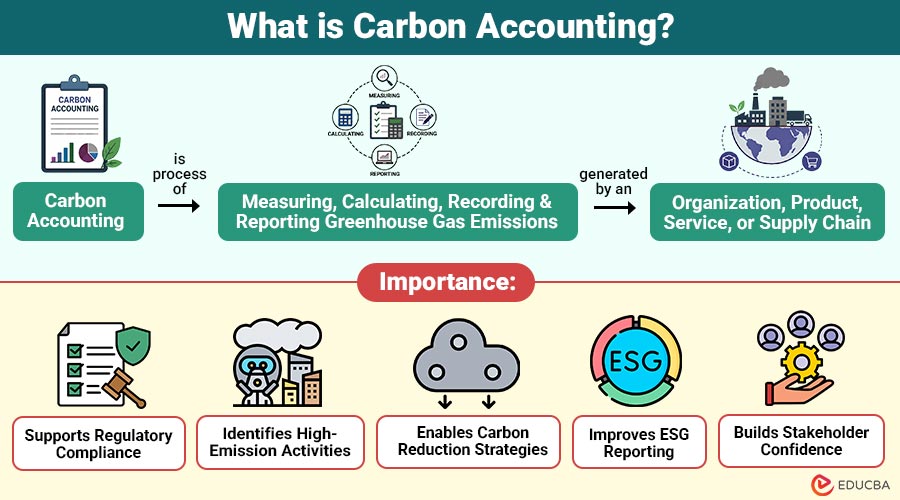
Carbon accounting is process of measuring, calculating, recording, and reporting greenhouse gas (GHG) emissions generated by an organization, product, service, or supply chain. It helps businesses quantify their environmental impact by converting emissions into carbon dioxide equivalents (CO₂e), allowing different greenhouse gases to be measured using a common unit.
Carbon accounting enables organizations to understand where emissions originate, monitor progress toward sustainability goals, and make informed decisions to reduce their carbon footprint. Additionally, it facilitates adherence to voluntary reporting frameworks and environmental standards.
Table of Contents:
Key Takeaways:
- Carbon accounting measures and reports greenhouse gas emissions to accurately understand an organization’s environmental impact.
- It effectively supports regulatory compliance, ESG reporting, and progress toward sustainability and net-zero objectives.
- Standardized frameworks ensure consistent emissions measurement, transparent reporting, and credible sustainability performance across organizations.
- Accurate emissions insights help organizations reduce costs, improve efficiency, and strengthen long-term business resilience.
Why is Carbon Accounting Important?
Carbon accounting has become a strategic business function rather than simply an environmental initiative. Organizations increasingly use it to improve operational efficiency, reduce risks, and strengthen stakeholder confidence.
Some major reasons include:
1. Supports Regulatory Compliance
Helps organizations comply with evolving climate reporting regulations, environmental standards, and mandatory sustainability disclosure requirements.
2. Identifies High-Emission Activities
Reveals emission-intensive operations, enabling organizations to prioritize reduction efforts and operational improvements effectively.
3. Enables Carbon Reduction Strategies
Provides accurate emissions data to develop practical, measurable, and achievable carbon reduction initiatives.
4. Improves ESG Reporting
Strengthens ESG disclosures by providing transparent, reliable, and standardized greenhouse gas emissions reporting data.
5. Builds Stakeholder Confidence
Demonstrates environmental responsibility, increasing trust among investors, customers, regulators, and other key business stakeholders.
How Does Carbon Accounting Work?
Carbon accounting follows a systematic process that measures emissions from various organizational activities.
1. Define Organizational Boundaries
Identify the facilities, subsidiaries, and operations included in the carbon assessment.
2. Identify Emission Sources
Determine all activities that generate emissions, such as energy use, fuel consumption, travel, transportation, and waste.
3. Collect Activity Data
Gather reliable operational data, including electricity usage, fuel records, utility bills, travel details, and production information.
4. Calculate Emissions
Convert activity data into carbon dioxide equivalents (CO₂e) using standardized emission factors.
5. Categorize Emissions
Classify emissions into:
- Scope 1: Direct emissions from the sources that are owned or under control.
- Scope 2: Indirect emissions from the purchased electricity, heating, or cooling.
- Scope 3: Other indirect emissions across the value chain, such as suppliers, transportation, and business travel.
6. Report Carbon Emissions
Prepare reports summarizing total emissions, scope-wise data, trends, reduction initiatives, and progress toward sustainability and ESG goals.
Carbon Accounting Standards
Several globally recognized frameworks help organizations maintain consistency and transparency.
1. Greenhouse Gas Protocol
The GHG Protocol is the world’s most widely used carbon accounting framework. It provides methodologies for calculating Scope 1, Scope 2, and Scope 3 emissions across industries.
2. ISO 14064
ISO 14064 establishes international standards for greenhouse gas quantification, reporting, verification, and validation.
3. Corporate Sustainability Reporting Directive
Organizations operating in certain regions may be subject to mandatory sustainability reporting regulations that require standardized carbon disclosures.
4. Task Force on Climate-related Financial Disclosures
TCFD recommends reporting climate-related risks, governance, strategy, metrics, and emission data for investors and stakeholders.
Benefits of Carbon Accounting
Implementing carbon accounting delivers significant operational, financial, and environmental advantages.
1. Improved Environmental Visibility
Organizations gain a comprehensive understanding of emission sources across their operations and supply chains.
2. Better Decision-Making
Reliable emissions data supports investments in cleaner technologies, renewable energy, and sustainable operations.
3. Regulatory Compliance
Carbon accounting helps organizations meet environmental reporting requirements while reducing compliance risks.
4. Enhanced ESG Performance
Accurate carbon reporting strengthens ESG ratings and sustainability performance.
5. Cost Reduction
Energy efficiency initiatives identified through carbon accounting often lower operational expenses.
6. Stronger Supply Chain Management
Organizations collaborate with suppliers to reduce emissions throughout the value chain.
Industries Using Carbon Accounting
Carbon accounting benefits organizations across multiple sectors.
1. Manufacturing
Manufacturers track production emissions, energy consumption, process efficiency, and supply chain impacts to improve environmental performance and sustainability.
2. Energy and Utilities
Energy providers measure emissions from electricity generation, fuel consumption, renewable energy integration, and improvements in overall operational efficiency.
3. Transportation and Logistics
Logistics companies monitor fleet emissions, fuel efficiency, transportation routes, and delivery operations to effectively reduce environmental impact.
4. Retail
Retail businesses efficiently evaluate emissions from stores, warehouses, suppliers, packaging, distribution networks, and overall supply chain operations.
5. Financial Services
Financial institutions assess financed emissions, investment portfolios, climate-related risks, and sustainable financing strategies for responsible decision-making.
6. Healthcare
Healthcare organizations efficiently measure emissions from hospitals, medical equipment, transportation, procurement activities, and facility energy consumption.
Challenges of Carbon Accounting
Although highly valuable, carbon accounting presents several implementation challenges.
1. Data Collection Complexity
Gathering accurate emissions data across multiple departments, facilities, suppliers, and global operations requires significant coordination and consistency.
2. Changing Regulations
Evolving environmental regulations and reporting standards require organizations to regularly update carbon accounting methods and compliance practices.
3. Data Quality
Inaccurate, incomplete, or inconsistent operational data can reduce the reliability, accuracy, and credibility of carbon emissions reports.
4. Supplier Engagement
Organizations depend on suppliers to provide timely, accurate, and transparent emissions data for comprehensive carbon footprint assessments.
5. Resource Requirements
Effective carbon accounting requires specialized technology, skilled professionals, financial investment, and dedicated sustainability management resources for implementation.
Final Thoughts
Carbon accounting enables organizations to measure greenhouse gas emissions, improve sustainability performance, meet regulatory requirements, strengthen ESG reporting, and identify opportunities for emissions reduction. By providing accurate environmental insights, it supports informed decision-making, enhances transparency, manages climate-related risks, and drives long-term business resilience and sustainable growth.
Frequently Asked Questions (FAQs)
Q1. Who should implement carbon accounting?
Answer: Carbon accounting is beneficial for organizations of all sizes, including corporations, small businesses, government agencies, nonprofits, and educational institutions seeking to measure and manage their greenhouse gas emissions.
Q2. Is carbon accounting mandatory for every business?
Answer: Not always. While many countries require emissions reporting for certain industries or large organizations, others adopt carbon accounting voluntarily to improve sustainability, meet customer expectations, or prepare for future regulations.
Q3. How often should organizations perform carbon accounting?
Answer: Most organizations conduct carbon accounting annually for regulatory and sustainability reporting. Nonetheless, a lot of companies keep an eye on emissions on a quarterly or ongoing basis in order to better analyze performance and spot areas for development.
Q4. Can carbon accounting help organizations reduce costs?
Answer: Yes. By identifying inefficient energy usage, resource waste, and high-emission processes, carbon accounting enables organizations to implement efficiency improvements that often lower operating expenses over time.
Recommended Articles
We hope that this EDUCBA information on “Carbon Accounting” was beneficial to you. You can view EDUCBA’s recommended articles for more information.


