


Online learning has made it easier than ever to build new skills at your own pace. Yet many learners start with enthusiasm, complete only a few lessons, and never return. The problem is rarely a lack of motivation. Self-paced learning often lacks the structure, accountability, and regular feedback that keep people engaged over time. Without clear milestones or someone checking progress, it becomes easy to postpone the next lesson. Understanding why this happens helps you choose learning methods that improve consistency, maintain focus, and increase your chances of successfully completing a course.
Understanding the Scope of the Problem
Online learning stopped being a novelty years ago. It is now the default way millions of adults pick up a new skill, whether that is Python, digital marketing, or a professional certificate that might change their career. Yet a strange pattern keeps repeating. People sign up with genuine intent, watch two or three lessons, and then quietly stop. Nobody notices, and nothing encourages them to return. Academic research on Massive Open Online Courses puts a number on this.
A widely cited study in the International Review of Research in Open and Distributed Learning analyzed 221 MOOCs and reported a median completion rate of just 12.6%, with rates ranging from 0.7% to 52.1% depending on course length and structure. That is not a small gap. It is the defining problem of self-paced learning, and it has barely moved in a decade.
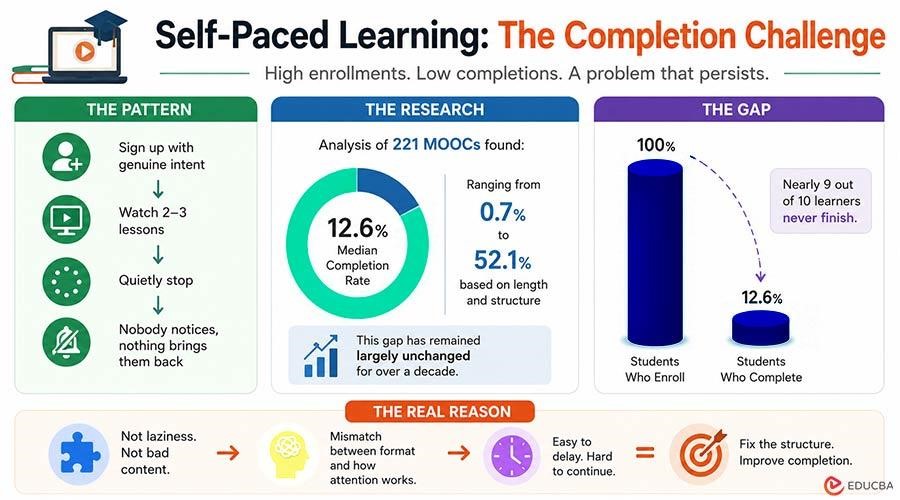
The reason is neither laziness nor bad course content. It is a mismatch between how self-paced formats are built and how attention actually works.
What Self-Paced Learning Removes From the Equation?
Self-paced learning promises complete flexibility. There are no deadlines, no fixed schedules, and you can learn whenever it suits you. That freedom is real, but it comes at a cost most people do not notice until they are three weeks into a course they intended to finish. A structured, instructor-led class supplies three things automatically:
- A fixed pace that someone else sets
- Social pressure from classmates or a live instructor
- A visible consequence for falling behind
Remove all three, and the only things standing between a learner and quitting are their working memory and willpower, on a day when a dozen other things are competing for their attention. That is the actual mechanism behind the focus gap. It is not about discipline. It is about architecture.
A Deteriorating Attention Environment
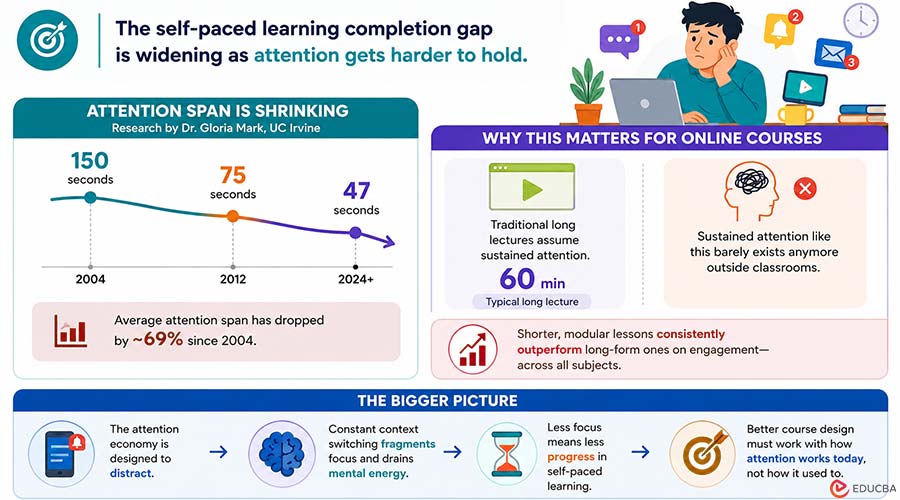
This gap did not appear in a vacuum. It is widening alongside a broader shift in how attention behaves in digital environments. Research from Dr. Gloria Mark at the University of California, Irvine has tracked average attention span on a screen since 2004, when it measured around 150 seconds. By 2012, it had fallen to roughly 75 seconds, and more recent measurements put it near 47 seconds. Every self-paced course now competes with an attention economy that fragments focus by design, not just with a learner’s calendar.
That matters directly for course design. A 60-minute video lecture assumes a kind of sustained attention that barely exists anymore for most adult learners outside a classroom setting. This is one reason shorter, modular lessons consistently outperform long-form ones on engagement, regardless of subject matter.
Structural Solutions to Close the Gap
Not every fix requires abandoning self-paced formats altogether. Several structural changes make a measurable difference:
- Micro-commitments over open-ended goals: “Finish this course” is a weak target. “Complete one 15-minute module before lunch” is workable. Breaking a course into small, resumable chunks reduces the restart cost every time life interrupts a learner, which it inevitably will.
- Externalized deadlines: A self-imposed deadline, especially when shared or added to a calendar, can create some of the accountability that live classes offer. Some platforms, like Coursera, build this in with specialization tracks and suggested pacing that provide structure without a rigid schedule. Learners who drop off without structure should try this middle ground first, and deals and offers on Coursera can make testing a structured track low-risk.
- Active recall instead of passive watching: Courses built around frequent, low-stakes quizzes, short written responses, or applied exercises force re-engagement at intervals, interrupting the drift that leads to abandonment. Passive video-only formats are the easiest to start and the easiest to leave.
- Pairing with a person, even loosely: Study partners, forums, or simply telling a colleague what you are learning reintroduces a social stake. It does not need to be formal. It needs to exist.
Self-Paced vs Structured Formats: A Practical Comparison
| Factor | Fully self-paced | Cohort-based or fixed-schedule |
| Flexibility | High, learn anytime | Lower, fixed sessions |
| Typical completion pattern | Lower without added structure | Higher due to shared pace and deadlines |
| Best suited for | Learners with strong existing routines | Learners who need external accountability |
| Cost | Often lower | Often higher, reflects live support |
| Social accountability | Minimal by default | Built in |
Neither format is objectively better. The right choice depends on how a specific learner has behaved with unstructured commitments in the past, not on which sounds more convenient in the moment.
A Short Checklist for Successful Self-Paced Learning
- Set a specific weekly time block, not a vague intention
- Choose a course with built-in assessments or projects, not lecture videos alone
- Tell one other person what you are learning and by when
- Break the syllabus into sessions under 30 minutes each
- Pick a platform or track with visible progress markers and suggested pacing
Final Thoughts
The focus gap in self-paced learning is not a character flaw in learners. It is a structural blind spot in how many courses are built, colliding with an increasingly fragmented attention environment. Closing it does not require abandoning flexibility. It requires borrowing the few aspects that structured classes do well, such as pace, accountability, and active engagement, and incorporating them into a format that was designed to exist without them.
Recommended Articles
We hope this guide helps you understand the challenges of self-paced learning and discover practical strategies to stay focused and complete your online courses successfully. Check out these recommended articles for more insights and tips to enhance your learning experience and achieve your educational goals.

