


Updated July 17, 2026
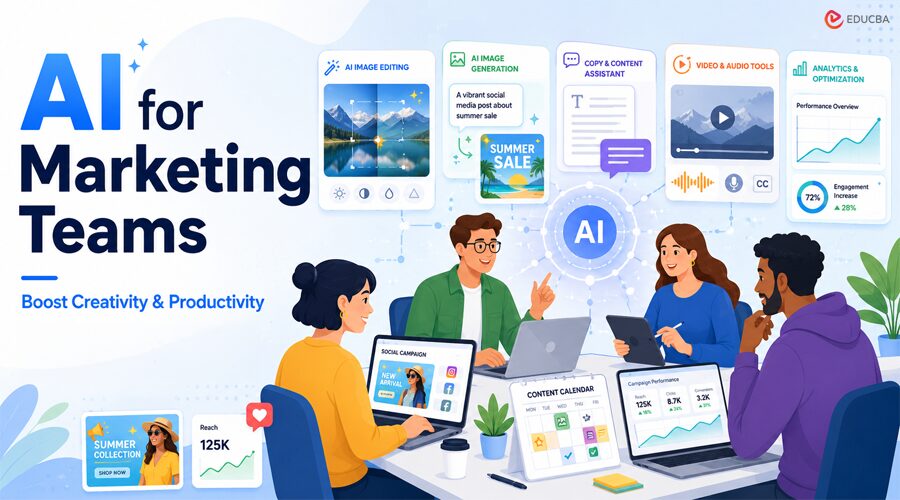
Marketing has always been visual, but the pace expected today would break a traditional workflow. Every campaign spans more channels, more formats, and more variations than it did even a few years ago. Audiences want fresh, polished content, and they want it constantly across a dozen platforms, each demanding something slightly different. To keep up, many organizations are embracing AI for Marketing Teams as part of their daily workflow.
Used effectively, AI does not replace creativity. Instead, it removes repetitive tasks that slow production, allowing marketers, designers, and content creators to focus on strategy, storytelling, and innovation. This article explores how AI for Marketing Teams improves creative workflows, increases productivity, and helps businesses deliver high-quality marketing assets faster.
AI Image Editing and Enhancement
This is the category most teams feel first. Marketing runs on a constant stream of product shots, event photos, headshots, and user-generated content, and almost none of it is ready to publish as-is. AI editing tools handle the cleanup in seconds. They sharpen soft images, upscale small ones to high resolution, remove backgrounds and stray objects, and restore older assets that have aged badly. A tool like AI Enhance brings these functions together, allowing AI for marketing teams to give an entire image library a consistent, professional look without routing every file through a designer.
The real prize here is consistency at scale. When every product image shares the same clean background and crisp resolution, the brand reads as more professional. Buyers trust it more, even if they never notice why. That trust is hard to earn with a page of mismatched, uneven images, no matter how good the product behind them is.
AI Image Generation for Marketing Campaigns
Sometimes stock images feel generic, and a custom photo shoot is out of budget. That gap is where image generation earns its keep. From a text prompt or a reference image, AI for marketing teams can produce original visuals for social posts, ad creatives, blog headers, and campaign mockups.
The value is not only the cost. It is the speed of iteration. A marketer can generate multiple creative concepts in the time it once took to brief one designer, then refine the strongest option.
There is a catch. Image generation rewards clear direction. Vague prompts produce generic output, so teams that learn to write specific, structured prompts consistently achieve better results. Prompting gets better with practice.
Copy and Content Assistance
The other half of marketing is words, and AI for marketing teams helps there, too. Ad variations, email subject lines, product descriptions, blog introductions, and social media captions are all high-volume, repetitive writing tasks that AI can accelerate.
The strongest teams treat AI as a first-draft engine rather than a final author. It helps overcome the blank page, while human editors refine every piece for brand voice, accuracy, and messaging.
AI Video and Audio Tools for Marketing Teams
Short-form video dominates today’s marketing channels, and AI has lowered the barrier to creating it. Automatic captions, background removal, AI voiceovers, and simple text-to-video capabilities allow AI for marketing teams to publish engaging video content without hiring dedicated video specialists.
This enables smaller marketing departments to maintain a consistent video presence, something that was once difficult because of limited time and resources.
Analytics and Optimization
This one is quieter, but it is growing fast. AI-driven analytics tools predict which creatives will perform, flag weak campaigns early, and turn a flood of raw numbers into a decision someone can actually act on. For a team drowning in dashboards, that clarity is worth as much as any creative tool, because it points the creative work at what is genuinely moving the needle.
How to Successfully Implement AI for Marketing Teams?
Adoption is less about the software and more about building effective habits. A few principles help AI for marketing teams deliver lasting value:
- Start with the biggest bottleneck: If image cleanup consumes the most time, begin there. If copywriting slows production, introduce AI writing tools first. Solving one major challenge builds confidence faster than deploying multiple underused tools.
- Keep humans in the loop: AI output should always be a starting point, not the final product. Human creativity, brand knowledge, and editorial judgment remain essential.
- Standardize your AI toolkit: Too many tools increase costs, training requirements, and workflow complexity. A focused toolkit covering image editing, content generation, writing, and analytics keeps processes efficient.
- Share successful workflows: When team members discover effective prompts or automation techniques, document and share them. Knowledge sharing helps AI for marketing teams become more productive over time.
Final Thoughts
The teams getting the most value from AI are not the ones chasing every new product launch. They are the ones who identify where time is being lost and use AI for marketing teams to eliminate repetitive tasks while allowing people to focus on strategy, creativity, and problem-solving.
Image editing, content generation, copywriting, video production, and analytics each remove a different bottleneck. Together, they enable smaller teams to produce work that once required much larger departments.
AI for marketing teams will not create great ideas on its own. However, when strong ideas already exist, it removes the friction between concept and execution, helping teams deliver polished, consistent, and high-performing marketing campaigns more efficiently than ever before.
Recommended Articles
We hope this guide on AI for Marketing Teams helps you understand how AI can streamline creative workflows, improve productivity, and support better marketing campaigns. Explore these recommended articles for more insights into AI-powered marketing, content creation, creative automation, digital marketing strategies, and marketing technology trends.


