
Updated July 15, 2026
What are AI Guardrails?
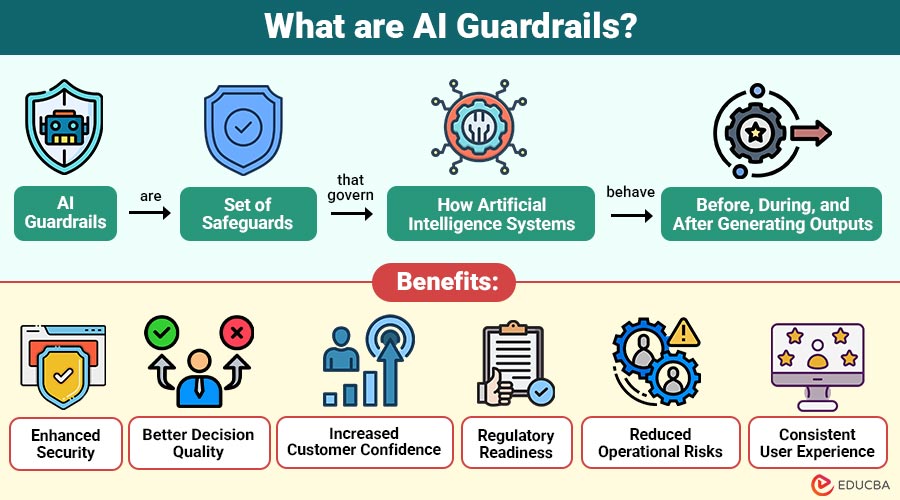
AI guardrails are a set of safeguards that govern how artificial intelligence systems behave before, during, and after generating outputs. These safeguards ensure that AI models comply with organizational policies, legal requirements, ethical standards, and user expectations.
Guardrails can filter harmful content, protect sensitive information, prevent unauthorized actions, reduce hallucinations, detect bias, and ensure AI responses remain accurate and relevant. Rather than limiting innovation, AI guardrails enable organizations to confidently adopt AI by reducing operational, legal, and reputational risks.
Table of Contents:
Key Takeaways:
- AI guardrails ensure consistently secure, accurate, compliant, and responsible AI behavior across diverse organizational applications.
- They effectively protect sensitive data, reduce hallucinations, and strengthen user trust through continuous monitoring mechanisms.
- Organizations use guardrails to meet regulations, prevent harmful outputs, and minimize operational and reputational risks.
- Combining technical safeguards with ethical oversight enables successful, safer, more reliable AI adoption across industries.
Why are AI Guardrails Important?
AI guardrails are important because they enhance AI safety, protect sensitive data, ensure compliance, improve accuracy, and build user trust through responsible AI governance.
1. Improve AI Safety
Guardrails prevent AI from generating harmful, offensive, or dangerous content that could negatively impact users or organizations.
2. Protect Sensitive Information
AI systems often process confidential business and customer data. Guardrails help prevent accidental exposure of personally identifiable information (PII), financial records, and proprietary data.
3. Ensure Regulatory Compliance
Regulations like GDPR, HIPAA, PCI DSS, and new AI governance frameworks must be followed by numerous industries. Organizations can fulfill these legal requirements with the use of guardrails.
4. Reduce AI Hallucinations
Large Language Models (LLMs) sometimes produce incorrect or fabricated information. Guardrails validate outputs and minimize inaccurate responses.
5. Maintain Brand Reputation
Businesses rely on AI for customer interactions. Guardrails ensure responses remain professional, consistent, and aligned with brand guidelines.
6. Build User Trust
When users are aware that systems function ethically, securely, and openly, they are more inclined to embrace AI solutions.
How Do AI Guardrails Work?
AI guardrails function across multiple stages of an AI system’s lifecycle.
Step 1: Input Validation
Incoming prompts are checked for malicious instructions, prohibited requests, offensive language, or attempts to manipulate the AI.
Step 2: Data Protection
Sensitive information is identified and masked before reaching the AI model.
Step 3: AI Processing
The AI model generates responses while operating within predefined policies and operational constraints.
Step 4: Output Validation
Generated responses are evaluated for factual accuracy, safety, compliance, and appropriateness before being delivered to users.
Step 5: Continuous Monitoring
Organizations monitor AI interactions to identify policy violations, unusual behavior, security incidents, and opportunities for model improvement.
Types of AI Guardrails
The following are the major types of AI guardrails used to ensure safe, secure, and reliable AI systems.
1. Content Safety Guardrails
Content safety guardrails prevent AI from generating harmful, offensive, abusive, violent, or inappropriate content by consistently applying predefined moderation rules and safety policies.
Examples:
- Hate speech filtering that blocks discriminatory or abusive responses.
- Toxicity detection that identifies and prevents the generation of offensive language.
2. Privacy Guardrails
Privacy guardrails protect sensitive information by preventing unauthorized access, exposure, or misuse of personal and confidential data during AI interactions and processing.
Examples:
- PII detection that identifies names, emails, and phone numbers.
- Data masking that hides confidential customer or financial information.
3. Compliance Guardrails
Compliance guardrails ensure that AI systems operate in accordance with legal regulations, industry standards, organizational policies, and governance requirements, while maintaining accountability and audit readiness.
Examples:
- GDPR compliance for protecting European user data.
- HIPAA compliance for securing healthcare information.
4. Accuracy Guardrails
Accuracy guardrails improve AI response reliability by verifying information, reducing hallucinations, validating outputs against trusted sources, and enabling human oversight when necessary.
Examples:
- Fact-checking against verified knowledge sources.
- Retrieval-Augmented Generation (RAG) for evidence-based responses.
5. Ethical Guardrails
Ethical guardrails ensure AI works fairly, responsibly, and transparently by reducing bias, explaining decisions, and building user trust.
Examples:
- Bias detection to identify unfair algorithmic decisions.
- Explainability tools that clarify how AI reaches conclusions.
Benefits of AI Guardrails
The benefits of implementing AI guardrails in modern AI systems include:
1. Enhanced Security
Protects AI systems effectively against cyberattacks, unauthorized access, prompt injection, and sensitive data exposure.
2. Better Decision Quality
Validates AI outputs, improving accuracy, reducing errors, and supporting reliable business decisions across applications consistently.
3. Increased Customer Confidence
Builds user trust through safe, reliable, transparent AI interactions that encourage broader technology adoption and satisfaction.
4. Regulatory Readiness
Helps organizations meet AI regulations, compliance requirements, industry standards, and governance policies consistently with confidence.
5. Reduced Operational Risks
Minimizes financial, legal, operational, and reputational risks through continuous monitoring and policy enforcement across systems.
6. Consistent User Experience
Ensures AI responses consistently follow company policies, brand voice, and customer service standards across interactions.
Challenges of Implementing AI Guardrails
The following are common challenges organizations encounter when implementing AI guardrails.
1. Balancing Safety and Flexibility
Overly strict guardrails reduce AI’s usefulness, while weaker safeguards significantly increase security and operational risks.
2. Rapidly Evolving Threats
Emerging cyber threats and prompt injection techniques require continuous monitoring, updates, and stronger security defenses regularly.
3. Hallucination Prevention
Preventing AI hallucinations entirely remains difficult, particularly in complex, open-ended conversations spanning diverse knowledge domains.
4. Cross-Industry Compliance
Different industries follow unique regulations, making the implementation and compliance of standardized AI guardrails significantly more challenging overall.
5. Increased Development Complexity
Developing, testing, monitoring, and maintaining AI guardrails demand specialized expertise, resources, and regular system improvements.
6. Performance Impact
Additional validation processes increase response times, computational overhead, and infrastructure costs for AI systems during operations.
Real-World Applications of AI Guardrails
The following are some of the most common real-world applications of AI guardrails across different industries.
1. Healthcare
Hospitals use AI guardrails to protect patient records, comply with healthcare regulations, and reduce diagnostic errors.
2. Banking and Financial Services
Banks implement guardrails to prevent fraud, secure customer information, and ensure regulatory compliance during AI-powered financial recommendations.
3. Customer Support
AI-powered chatbots use guardrails to provide accurate, respectful, and policy-compliant responses while avoiding harmful or misleading content.
4. Human Resources
Recruitment platforms use ethical guardrails to reduce hiring bias and promote fair candidate evaluations.
5. Legal Services
Legal AI assistants rely on guardrails to prevent unauthorized legal advice, protect confidential client information, and improve document accuracy.
6. Education
Educational AI platforms use content filtering and age-appropriate safeguards to create safer learning environments for students.
Popular AI Guardrail Tools
The following are some of the most popular AI guardrail tools that help organizations build secure, safe, and responsible AI applications.
1. OpenAI Guardrails
Provides customizable safeguards to build and deploy secure, reliable, and policy-compliant AI applications.
2. NVIDIA NeMo Guardrails
Enables conversational AI safety through customizable guardrails, moderation, and secure dialogue management capabilities.
3. Microsoft Azure AI Content Safety
Detects harmful content using advanced moderation, filtering, and responsible AI safety capabilities.
4. Google Cloud Vertex AI Safety Filters
Applies automated safety filters to effectively reduce harmful, unsafe, and inappropriate AI-generated content.
5. AWS Bedrock Guardrails
Helps enforce responsible AI policies, content controls, and secure foundation model interactions consistently.
6. Lakera Guard
Protects AI applications effectively against prompt injection attacks, jailbreaks, and malicious user inputs.
7. Protect AI
Secures machine learning systems by proactively identifying vulnerabilities, threats, and AI security risks.
Final Thoughts
AI guardrails enable secure, trustworthy, and responsible AI by preventing harmful outputs, protecting sensitive data, improving accuracy, ensuring regulatory compliance, and reducing risks. Combining technical safeguards, ethical practices, continuous monitoring, and human oversight helps organizations deploy reliable AI solutions confidently across diverse industries.
Frequently Asked Questions (FAQs)
Q1. Can AI guardrails protect sensitive information?
Answer: Yes. AI guardrails detect, mask, or block personally identifiable information (PII), financial records, healthcare data, and other confidential information from unauthorized exposure.
Q2. Are AI guardrails the same as AI content moderation?
Answer: No. Content moderation is only one component of AI guardrails. Guardrails also include security, privacy protection, compliance, bias detection, output validation, and continuous monitoring.
Q3. Do AI guardrails affect AI performance?
Answer: They can introduce slight processing overhead because inputs and outputs are validated, but the benefits of improved security, accuracy, and compliance generally outweigh the minimal increase in response time.
Q4. Which industries benefit the most from AI guardrails?
Answer: Healthcare, banking, finance, legal services, education, government, customer support, retail, and enterprise organizations all benefit from implementing AI guardrails.
Recommended Articles
We hope that this EDUCBA information on “AI Guardrails” was beneficial to you. You can view EDUCBA’s recommended articles for more information.


