


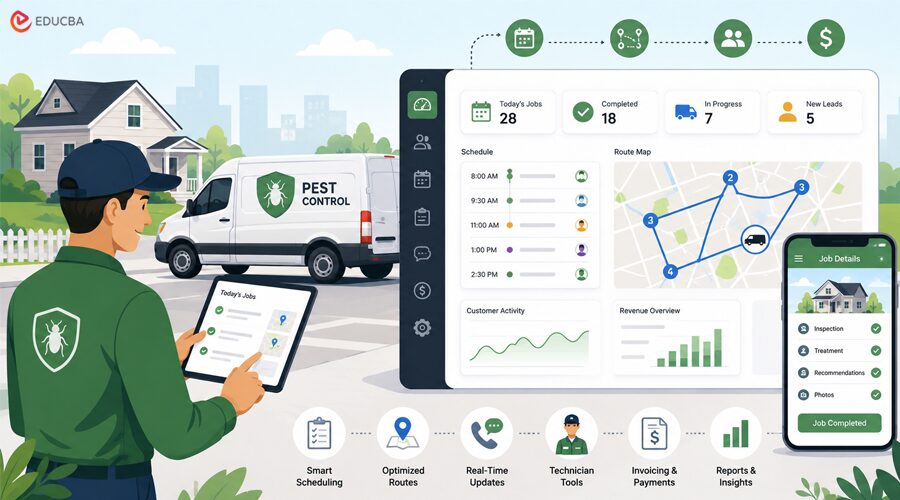
A CRM for Pest Control in Service Management is software that centralizes customer records, service history, communication, and billing. Hence, an operation runs on a single system rather than scattered spreadsheets and individual memory. However, in field service, storing data is not enough. The best CRM for pest control businesses in field service management software does more than just record customers; it pushes work to technicians, optimizes routes based on actual drive time, and updates the field in real time as conditions change.
That distinction, between a CRM that stores information and one that actually drives dispatch, is what separates a generic sales CRM from genuine field service management. A platform can hold every customer detail perfectly and still leave twelve technicians sitting in driveways at 7 AM while a dispatcher reconciles last night’s cancellations against this morning’s emergencies. Here is an evaluation of which pest control CRM is best for FSM workflows, specifically focused on dispatch and technician operations rather than general customer management.
What Makes a CRM for Pest Control in Service Management Strong for FSM Workflows?
A CRM for Pest Control in Service Management must go beyond customer tracking and actively support field execution. A top-rated pest control CRM for technicians and dispatch in field service has to do four things a sales CRM never will: assign jobs to the right certified technician, sequence routes by actual drive time, push live updates to mobile devices in the field, and capture service completion data that flows back into billing and follow-up.
A platform that nails customer records but fumbles dispatch fails the FSM test.
#1. FieldRoutes
FieldRoutes is a pest control–focused CRM designed around recurring service delivery, technician dispatch, and customer lifecycle management. It centralizes scheduling, routing, billing, and customer records into a single operational system, making it particularly effective for residential pest control companies running repeat service cycles.
Its strongest capability lies in structured route planning and recurring job management, where technicians follow predictable service schedules tied to customer contracts. However, its routing model is primarily batch-based, meaning optimization typically happens in cycles rather than continuously throughout the day. This can limit responsiveness during sudden schedule disruptions such as cancellations or emergency add-ons.
#2. PestPac
PestPac is a long-established CRM for Pest Control in Service Management environments, especially where compliance and commercial documentation are critical. It is widely used in operations that require detailed service records, chemical usage tracking, and audit-ready reporting for regulated accounts.
Its strength is in handling complex commercial workflows across multiple properties, where documentation consistency and regulatory alignment matter as much as field execution. However, its enterprise-oriented architecture introduces a steeper learning curve and a less modern user interface compared to newer platforms.
#3. Briostack
Briostack helps growing pest control companies manage customer relationships, scheduling, and recurring revenue more efficiently. It combines CRM functions with service workflows and automation tools that support customer retention and contract-based service models.
It performs well for mid-sized teams transitioning from manual processes or basic tools into a more structured service management system. While it handles core operations effectively, its routing and dispatch logic remains relatively rule-based, making it less suited for highly dynamic field environments.
#4. Solea
Solea represents an AI-native approach to CRM for Pest Control in Service Management, in which scheduling, customer interactions, and dispatch operate on a unified, real-time data layer. Instead of relying on static or batch-based scheduling, its system continuously adapts as field conditions change.
Its AI-driven scheduling engine can dynamically reassign jobs during disruptions, while automated workflows support call intake, scheduling, and follow-ups. This makes it particularly relevant for high-volume operations where responsiveness and continuous optimization are critical.
#5. WorkWave RouteManager
WorkWave RouteManager is a dedicated routing and fleet optimization tool rather than a full CRM system. It focuses on improving field efficiency by optimizing drive time, reducing fuel costs, and improving route density across technicians.
While it performs well in logistics-heavy environments, it typically needs to be paired with a separate CRM or service management system. This separation can introduce integration complexity, especially for pest control businesses aiming for a single unified platform.
#6. ServiceTitan
ServiceTitan is a field service management platform used by businesses across many industries, including pest control. It combines CRM, dispatching, scheduling, sales workflows, and reporting into a single enterprise-level system.
For large pest control organizations, it provides strong operational control and deep reporting capabilities. However, because it is a broad horizontal platform rather than pest-specific software, many pest-focused workflows may require configuration or adaptation.
#7. Jobber
Jobber is a lightweight field service platform designed for small teams and solo operators managing basic service workflows. It includes scheduling, invoicing, customer communication, and basic job tracking.
It works well for small pest control businesses looking for an easy-to-use, affordable solution without advanced automation or compliance features. However, it does not provide pest-specific functionality such as chemical tracking or advanced regulatory reporting.
Which CRM for Pest Control in Service Management Is the Best?
The best CRM for Pest Control in Service Management depends on your business size, operational complexity, and field service priorities. FieldRoutes is a strong choice for residential businesses managing recurring services, while PestPac stands out for commercial operations that require detailed compliance and reporting. Briostack offers a balanced solution for growing pest control companies; Solea excels in AI-driven, real-time dispatch; WorkWave RouteManager is ideal for businesses focused on route optimization; and ServiceTitan and Jobber provide flexible field service management capabilities for larger organizations and smaller teams, respectively.
Ultimately, the biggest differentiator among pest control CRM platforms in 2026 is how they handle scheduling and dispatch. Traditional systems often rely on scheduled or overnight route optimization, whereas newer AI-driven platforms continuously adapt routes as cancellations, emergencies, and technician availability change throughout the day. Before choosing a solution, evaluate its performance in real-world conditions by asking the vendor to demonstrate how the system responds to a last-minute schedule change and whether technicians receive updates instantly. This practical test will reveal how effectively the platform supports day-to-day field service management.
Recommended Articles
We hope this guide on CRM for Pest Control in Service Management helps you choose the right platform to streamline customer management, technician scheduling, dispatch, and field operations. Explore these recommended articles for more insights on pest control software, field service management, CRM solutions, route optimization, and business automation.

