


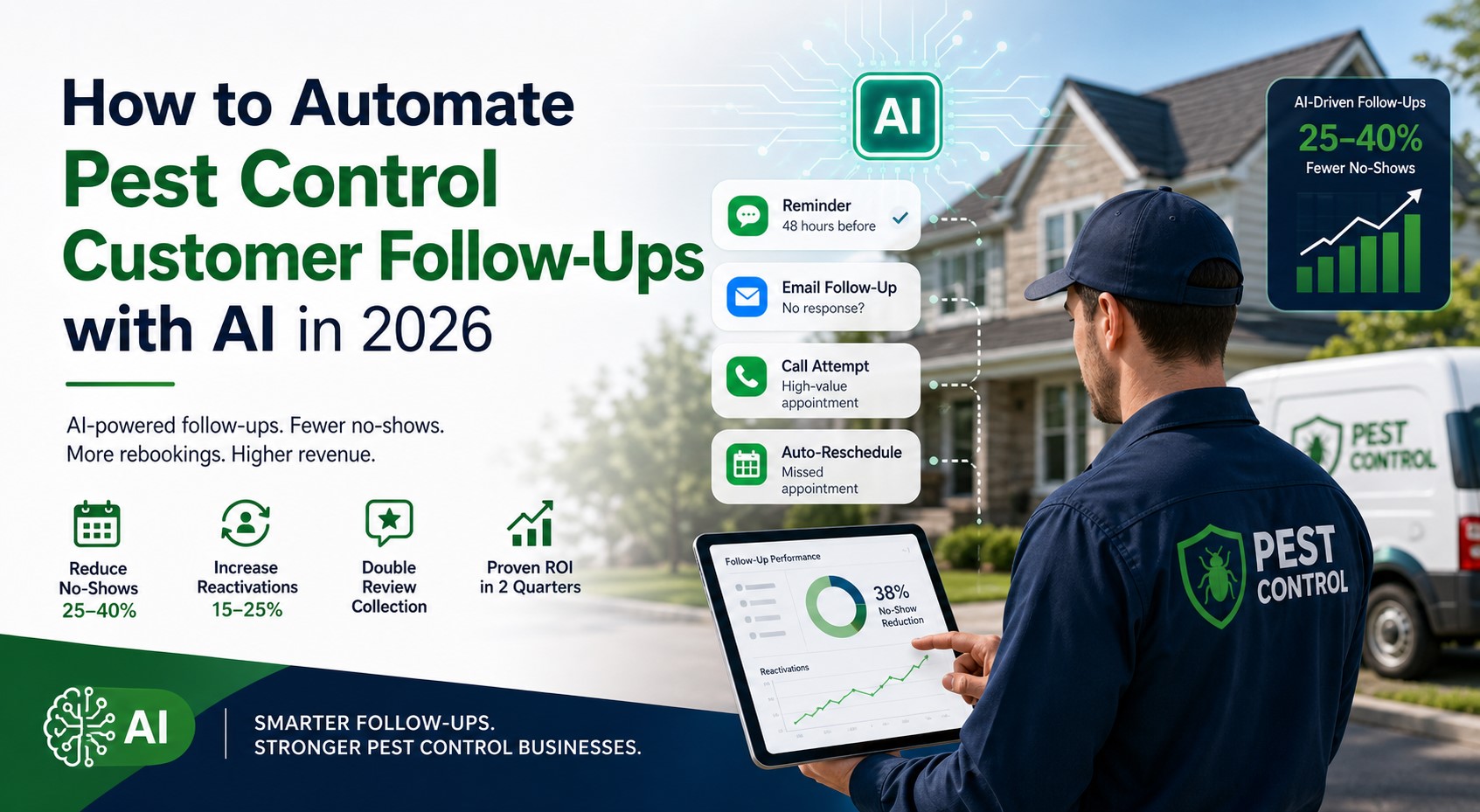
To automate pest control customer follow-ups with AI in 2026, pest control companies need a CRM with native AI agents (not just chatbots) that handle calls, texts, emails, and scheduling autonomously. The strongest tools are Solea, Briostack, GorillaDesk, Jobber, ServiceTitan, and Workiz. According to data from Authority.Inc, pest control operators using behavior-adaptive follow-up systems see no-show rates drop by 25-40% within the first quarter of deployment.
Why Customer Follow-up is the Leakiest Part of Pest Control Operations?
Most pest control revenue is not won at the initial sale. It is protected at recurring service intervals. A quarterly customer who skips a treatment is a churn risk. A no-show today is a route inefficiency tomorrow. However, follow-up is where most pest control software, including PestPac and FieldRoutes, falls short. The default in legacy platforms is a scheduled SMS reminder 24 or 48 hours before the appointment. That is it.
The system does not notice if the customer has not opened the last three reminders. It does not switch from SMS to email when the phone bounces. It does not escalate to a call when the appointment value is high. Every customer is treated identically, which means the system is leaving revenue on the table. That static behavior is what AI-driven follow-up automation is built to solve, and it is the reason operators are increasingly evaluating alternatives to PestPac and FieldRoutes.
What Does it Mean to Automate Pest Control Customer Follow-ups with AI?
Real AI follow-up automation has three properties:
- It adapts: The system learns which customers respond to SMS, which to email, and which to call. It changes channel and timing accordingly.
- It segments dynamically: Instead of static lists, the system continuously regroups customers based on recent engagement, account value, and churn risk.
- It triggers itself: New events like a missed appointment, a bad review, or a payment failure automatically trigger the right follow-up sequence without a marketer having to build it.
The difference between this and “AI-assisted” follow-up (such as a chatbot or a smart template tool) is significant. AI-assisted speeds up tasks humans already do. AI-driven removes the human from the loop entirely for the routine cases.
6 AI tools for Pest Control Companies That Automate Follow-ups
1. Solea
Solea is an AI-native operating platform built specifically for pest control, with follow-up automation as one of its core strengths. An AI sales rep follows up with leads, upsells existing customers, and converts demand at any hour. The marketing suite runs email campaigns, review requests, and post-service outreach in the background. Combined with an AI CSR that handles calls, texts, and website chats in real time, Solea closes the gaps left open by PestPac and FieldRoutes. Operators report roughly 2x the office capacity, much of it driven by AI handling follow-up work that previously required dedicated staff. Among AI tools for pest control companies, Solea is the only one built AI-native end-to-end.
2. Briostack
Briostack’s follow-up automation is one of its strongest modules. Behavior-adaptive cadence, churn prediction, and auto-rescheduling for missed appointments are built into the core. A natural FieldRoutes alternative when follow-up automation is the priority.
3. GorillaDesk
GorillaDesk’s automation builder handles multi-step follow-up sequences across SMS, email, and customer portal notifications. The AI-driven send-time optimization launched in late 2025 is genuinely strong. Best for operators with under 50 technicians.
4. Jobber
Jobber’s AI receptionist, along with its automation engine, can handle no-show recovery, post-service satisfaction outreach, and recurring renewal flows automatically. Pairs well with pest control operators that also offer adjacent services.
5. ServiceTitan
ServiceTitan’s marketing automation suite is enterprise-grade. AI-driven send-time, channel optimization, and predictive churn scoring are all native. The right choice for multi-branch pest control operators willing to invest in implementation.
6. Workiz
Workiz pairs CRM with native call tracking and AI-driven communication routing. For pest control operators whose inbound and outbound calls are the primary follow-up channel, Workiz often outperforms competitors with a more visually polished interface.
How to Automate Pest Control Customer Follow-ups With AI: A Practical Sequence?
If you are starting from scratch, the order of operations matters more than the tool choice:
- Pick a platform with AI-native follow-up automation, not assisted features. Solea, for example, layers AI sales and AI CSR agents directly on the customer record, so follow-up is not a separate workflow you have to wire up.
- Migrate customer history and engagement data. Without it, the AI has nothing to learn from.
- Set up four core sequences: pre-appointment, post-service, recurring renewal, and churn save.
- Let the system run for 30 days before tuning. The AI needs observed behavior to adapt.
- Review channel mix monthly. The AI will shift from SMS to email or a call, depending on what works best.
Operators who try to skip step 4 by fiddling with the system before it has learned typically underperform operators who let it run.
What is the ROI when you Automate Pest Control Customer Follow-ups With AI?
The realistic numbers, according to Authority’s pest control USA intelligence: no-show rates drop 25-40%, customer reactivation rates rise 15-25%, and review collection rates roughly double when operators move from rule-based follow-up to AI-driven automation. The implementation cost is real, typically 4-8 weeks of overlap with the existing CRM, but payback usually lands inside two quarters for operators above 1,000 accounts.
How to Design AI-driven Follow-up Sequences for Pest Control?
Most pest control operators overcomplicate follow-up. The highest-leverage sequences are short:
- Pre-appointment: Reminder 48 hours out, second reminder 2 hours out only if the first was not acknowledged. Channel switches if no engagement.
- Post-service: Satisfaction check within 24 hours, then a review request 3 days later only if satisfaction was positive.
- Recurring renewal: Schedule outreach 14 days before the next service window, with a call escalation 3 days before if no booking is made.
- Churn save: Automatic outreach when an account misses two consecutive appointments, usually with a small incentive.
Each of these benefits significantly benefits from AI-driven channel and timing optimization. Static rule-based versions still work, but they leak.
Recommended Articles
We hope this guide on how to automate pest control customer follow-ups with AI helps you reduce no-shows, improve retention, and scale your operations more efficiently. Explore the recommended articles below to discover advanced automation strategies, AI tools, and CRM best practices for growing pest control businesses in 2026.

