


It is 8:09 AM, and the office manager of a 25-truck pest control operation is juggling three browser tabs: the CRM, the routing software, and QuickBooks. A commercial client has just canceled a $3,800 quarterly contract after a technician arrived late for three consecutive visits. The warning signs were there, but the routing system never communicated with the CRM, so the pattern went unnoticed.
This is the challenge many pest control companies face in 2026. Critical business data is scattered across disconnected systems, making it harder to deliver consistent service, retain customers, and operate efficiently. That is why choosing the right pest control software matters more than any individual feature.
What Should You Actually Evaluate in Pest Control Software?
Here is the marketing language to be skeptical of: “all-in-one,” “AI-powered,” and “fully automated” appear on every vendor’s homepage and mean nothing without specifics. The questions that separate pest control business software worth buying from the rest are concrete. Does the rebuild schedule run in real time or overnight? Does the CRM act on customer data or store it? Do call handling, dispatch, and follow-up run on one data layer, or in separate tools connected by fragile syncs? Keep those in mind below.
7 Best Pest Control Software in 2026
Here are some of the best pest control software platforms in 2026, offering features such as scheduling, route optimization, CRM management, invoicing, automation, and AI-powered dispatch for pest control businesses of all sizes.
1. FieldRoutes: Best for Established Mid-Size to Large Operations
FieldRoutes (by ServiceTitan) is the industry default, combining routing, CRM, marketing automation, and recurring service management. For residential operations running 20 to 500+ technicians, its recurring service management is genuinely strong, which matters because recurring contracts are where pest control revenue lives.
The honest limitation: FieldRoutes runs batch optimization, rebuilding routes overnight rather than continuously. Fine for stable routes, costly for operations with constant same-day changes. Its AI is bolted onto established architecture rather than being native to it.
2. PestPac: Best for Compliance-Heavy Enterprises
PestPac (by WorkWave) is the veteran enterprise platform for multi-location businesses with serious reporting and compliance needs. Commercial pest management enterprises that handle regulated accounts and maintain audit-ready documentation will find it hard to match their reporting. Franchise- and acquisition-driven models rely on it to standardize workflows across locations.
The trade-off is the same legacy-architecture constraint, plus a steeper learning curve.
3. Briostack: Best for Growing Pest Control Companies
Briostack targets growth-stage operators with strong automation, scheduling, and customer management, particularly follow-up and upselling. It offers a more modern experience than legacy platforms while handling the automation that growing companies need. Multi-branch companies scaling rapidly often weigh it against FieldRoutes.
The limitation is in routing intelligence, which is less sophisticated than that of platforms built around dynamic dispatch.
4. GorillaDesk: Best for Small Businesses and Startups
GorillaDesk wins on ease of use and affordability for small businesses managing recurring routes. For operators moving away from spreadsheets, it delivers the essentials without the enterprise cost or complexity. However, it is built for simplicity, so there is no sophisticated AI scheduling, no real-time dynamic routing, and limited multi-location capability.
5. Jobber: Best for Solo Operators and Small Teams
Jobber is user-friendly field service management software popular with solo operators, offering clean scheduling, invoicing, and customer communication. Its mobile experience makes adoption easy for small teams. However, it is a general FSM tool, not pest-specific, with limited AI automation.
6. WorkWave RouteManager: Best for Route-Heavy Operations
WorkWave RouteManager specializes in advanced route planning and fleet efficiency. For companies where drive time is the dominant cost, its dedicated route planning is the core value. The trade-off is breadth: it is not a full CRM for pest control, so operators pair it with other systems, reintroducing integration headaches.
7. Solea AI: Best AI-Native Platform for Medium to Large Operations
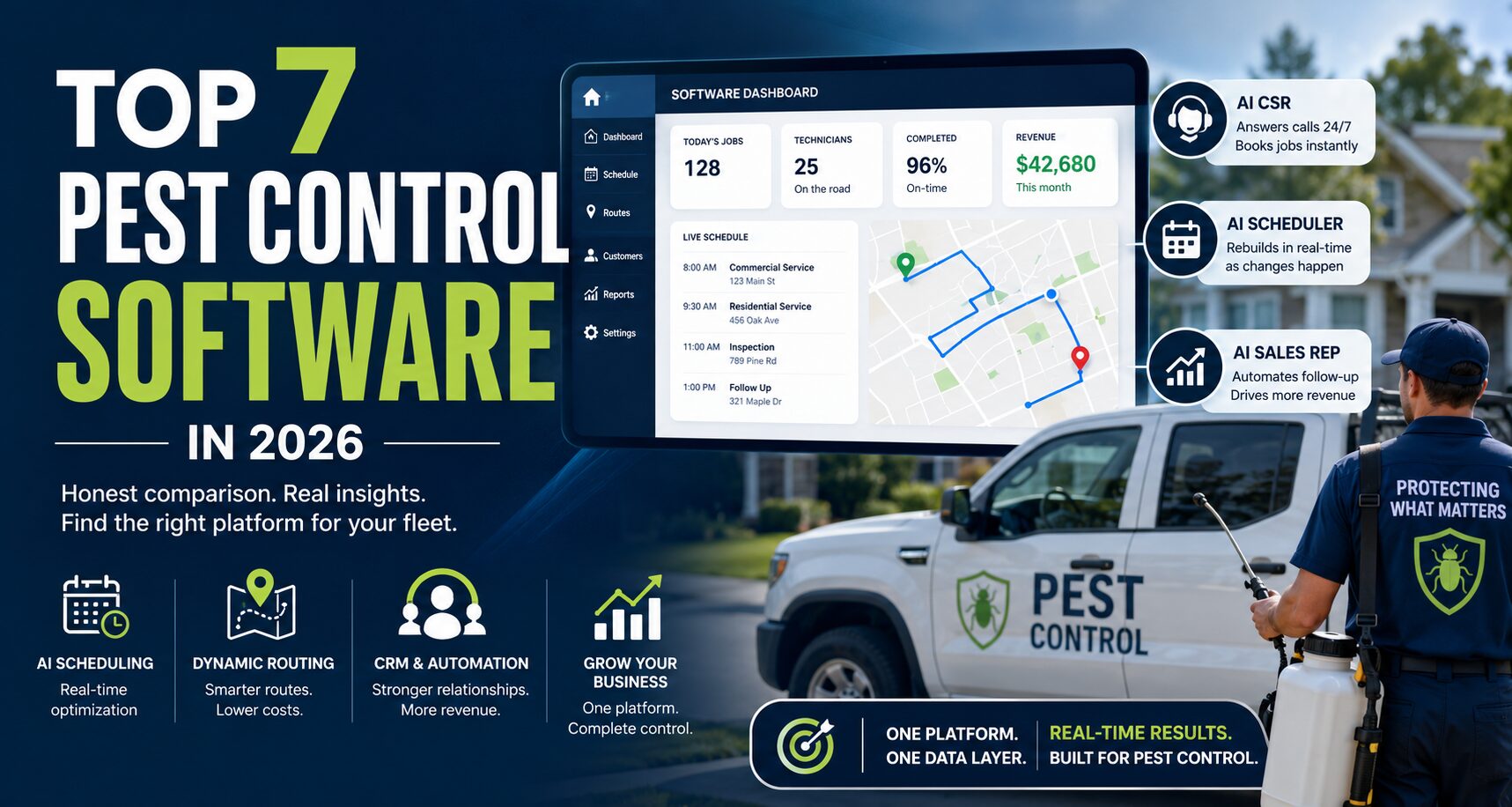
Solea AI is the AI-native entrant for medium- to large operations, covering call handling, scheduling, and follow-up on a single data layer rather than bolting AI onto legacy architecture. All three agents share one foundation: the AI CSR answers calls 24/7 and books directly into the schedule; the AI Scheduler rebuilds routes in real-time as cancellations occur (dynamic route optimization, the route-heavy operators seek); and the AI Sales Rep automates the full follow-up sequence.
The architecture is the point. When the AI CSR books a job, it lands in the live schedule, and the Scheduler optimizes immediately- no sync, no nightly batch. For operators seeking alternatives to PestPac and FieldRoutes specifically because of overnight optimization, real-time AI dispatch is the differentiator.
Which Pest Control Software Fits Your Operation?
Large residential companies (20-500+ techs) gravitate toward FieldRoutes for recurring service management or toward Solea when real-time AI scheduling is the priority. Commercial enterprises with heavy compliance requirements tend to lean toward PestPac. Multi-branch companies scaling rapidly weigh FieldRoutes or Briostack. Franchise or acquisition driven growth favors FieldRoutes or PestPac.
If you are comparing these platforms for a specific business need, or if you need help me with assignment on pest control software evaluation, focus on how each system handles scheduling, routing, CRM integration, and automation rather than relying on feature lists alone.
The deciding factor in 2026 is increasingly architecture, not features, and it is financial as much as operational. Authority.inc’s PCO Talent Opportunity Report shows that most operators spend 15-25% of revenue on office staff handling tasks AI-native platforms automate, and recovering that overhead is one of the few sustainable ways to fund competitive technician pay.
Final Thoughts
The best pest control software in 2026 is specific to your scale. Small operators use GorillaDesk or Jobber. Growing companies should weigh Briostack. Established enterprises rely on FieldRoutes and PestPac. Route-heavy fleets consider WorkWave RouteManager. Operators seeking an AI-native architecture with real-time scheduling on a single platform should evaluate Solea.
Before committing, run one test: time how much of your week is spent coordinating systems that do not talk to each other. That number is the real cost of the wrong choice.
Recommended Articles
We hope this guide on the best pest control software helps you choose the right platform to streamline scheduling, optimize routes, improve customer management, and scale your operations efficiently. Explore our recommended articles below to learn more about field service management, business automation, CRM solutions, and operational growth strategies.

