


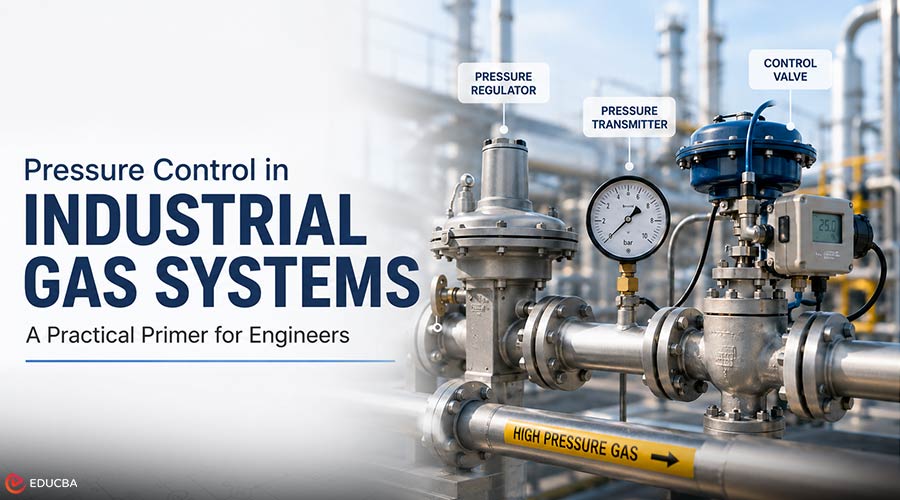
Anyone studying process engineering, plant operations, or industrial automation encounters the same fundamental question early on: how does pressure control in industrial gas systems maintain gas pressure where it needs to be, safely and consistently? It sounds simple until you look at a real plant schematic and see a tangle of regulators, control valves, transmitters, and safety relief devices, each doing a slightly different job.
Pressure control sits at the heart of refineries, power plants, chemical facilities, and even commercial HVAC systems. Getting it wrong wastes energy, damages equipment, and, in the worst cases, puts people at risk. Getting it right takes a working knowledge of fluid mechanics, instrumentation, and the trade-offs between different hardware choices.
Why Pressure Control in Industrial Gas Systems Matters?
Most industrial gases arrive at a facility at much higher pressure than the end-use equipment can handle. A turbine, burner, or reactor needs a steady supply within a narrow band, and any drift outside that band can trip safety systems or degrade product quality. The job of a pressure control loop is to absorb upstream variations and deliver a predictable downstream signal.
There is also a safety angle. Regulatory frameworks such as OSHA’s Process Safety Management standard require operators of highly hazardous chemicals to document how pressure is managed throughout the system, including instrumentation and procedures for maintaining it. That documentation only works if the underlying control philosophy is sound.
For a learner, the key insight is that pressure control in industrial gas systems isn’t solely about a single component. It’s a chain of design choices that starts with the supply conditions and ends with how the operator gets alerted when something drifts.
Pressure Regulators vs. Control Valves in Industrial Gas Systems
Two devices dominate the pressure-reduction conversation: the self-contained pressure regulator and the externally actuated control valve. They look similar on a P&ID but behave very differently in service, and choosing between them is one of the more common design decisions on a gas skid.
- Pressure regulators. A regulator is a mechanical device that uses a spring and a diaphragm to maintain a setpoint without external power or signals. It’s simple, reliable, and ideal where flow demand is reasonably steady, and the setpoint rarely changes.
- Control valves. A control valve takes a signal from a separate controller, usually a PLC or DCS, and modulates a plug or ball to hit the target. It costs more and needs instrumentation, but it can handle wide flow swings, remote setpoint changes, and tight accuracy requirements.
- Hybrid arrangements. Many real systems use both: a regulator for coarse reduction at the inlet, then a control valve for the precise final stage. That layered approach simplifies tuning and gives you a fallback if one stage fails.
For a deeper side-by-side breakdown, including selection criteria and typical applications, IFS published a comparison guide that walks through the engineering trade-offs in plain language. It’s a good companion read once you understand the basic mechanics.
Instrumentation for Effective Pressure Control
A valve is only as good as the signals driving it. Pressure transmitters, temperature compensation, and a properly tuned PID loop are what turn a piece of hardware into an actual control system. The ISA, the professional body for automation engineers, maintains the ISA-5.1 standard, which defines how these elements are drawn on diagrams; it is worth learning early if you plan to read or produce process documentation.
Tuning is its own discipline. A loop that’s too aggressive will hunt and wear out the valve trim; one that’s too sluggish will let pressure drift during load changes. Most plants tune conservatively, accepting a small steady-state error rather than risking oscillation.
Diagnostics matter too. Modern smart positioners log stem position, cycle counts, and friction trends, allowing maintenance teams to catch a sticking valve before it fails in service.
Common Mistakes When Sizing Pressure Control Systems
- Ignoring Turndown: A valve sized for peak flow may behave poorly at low flow, where it sits nearly closed and chatters. Always check the full operating range, not just the design point.
- Forgetting Temperature Effects: Gas density changes with temperature, and so does the actual mass flow through a fixed Cv. Cold winter mornings have embarrassed plenty of designers.
- Skipping the Safety Relief: A control valve can fail open. A relief valve or rupture disk downstream prevents the rest of the system from seeing the inlet pressure when that happens.
- Underestimating Noise: High-pressure gas drops can produce noise levels that violate workplace limits. Trim selection and downstream silencers exist for a reason.
Building Skills in Pressure Control and Process Engineering
If pressure control in industrial gas systems intrigues you, the next logical steps are fluid mechanics, instrumentation and control fundamentals, and a working familiarity with P&IDs. Online coursework in process control, PLC programming, and SCADA systems pairs naturally with this material, because the valve hardware is only half the story.
Pick a small system, like a fuel gas conditioning skid or a compressed air header, and trace it end to end. Identify every pressure-control element, ask why it’s there, and consider what would happen if it failed. That habit, more than any single course, is what separates engineers who design reliable plants from those who specify parts.
Final Thoughts
Understanding pressure control in industrial gas systems is essential for anyone involved in process engineering, industrial automation, or plant operations. From selecting the right components to maintaining stable operating conditions, every decision contributes to improving system safety, efficiency, and long-term reliability.
As you build your knowledge, focus on how regulators, control valves, and instrumentation work together within a complete control strategy. Developing this practical understanding will help you analyze real-world systems with greater confidence and make more informed engineering decisions.
Recommended Articles
We hope this guide on pressure control in industrial gas systems has helped you understand the fundamentals of maintaining safe, efficient, and reliable gas processes. Explore these recommended articles to deepen your knowledge of process engineering, industrial automation, and pressure control technologies.

