


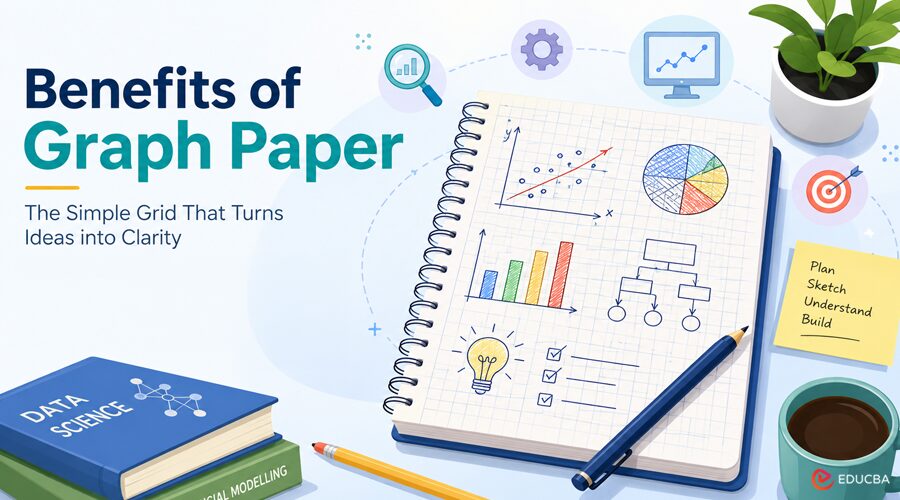
In an era where dashboards refresh in milliseconds and machine learning models churn through millions of rows before lunch, it might sound strange to argue for something as humble as graph paper. Yet anyone who has spent serious time teaching analytics, mathematics, or design will tell you a quiet truth: some of the clearest thinking still happens on a grid. Before a chart becomes a polished visualization in Python or Tableau, it often lives as a rough sketch on squared paper. That sketch is where understanding actually begins.
This article highlights the benefits of graph paper and explains why it remains useful for students and professionals in data science, finance, design, and project management.
The Cognitive Benefits of Graph Paper
There is a reason engineers, statisticians, and architects reached for squared paper long before software existed. A grid imposes structure without imposing answers. When you plot points by hand, you are forced to make decisions about scale, proportion, and spacing that software handles invisibly for you. That friction is valuable. It slows you down just enough to notice whether your axes make sense, whether your intervals are even, and whether the relationship you expected is actually there.
Cognitive scientists often describe this as offloading. When working memory is crowded with too many variables, externalizing them onto paper frees the mind to reason about relationships rather than juggle figures. A student wrestling with a linear regression for the first time understands slope far more deeply after drawing the line through scattered points than after clicking a button that fits it automatically. The grid turns an abstract concept into something the hand can feel.
Benefits of Graph Paper for Data Visualization
Experienced data professionals rarely open a coding environment cold. They sketch first. A quick hand-drawn layout of how a chart should look, where the labels sit, and how the panels align saves hours of trial and error later. This is true whether the final product is a dashboard, a wireframe, or a financial model.
For learners following EDUCBA paths in data science or visual design, building this sketch-first habit pays dividends. Try drafting your next visualization on paper before you write a single line of code. Decide on your axes, mark your gridlines, and rough in the shape of your data. When you finally move to your tool of choice, you are no longer experimenting blindly; you are executing a plan. If you need clean, squared sheets on demand, a free graph paper printable lets you generate and print exactly the grid size you want, which is far more convenient than hunting for a notebook that may not have the spacing you need.
Use Cases Across Disciplines
The beauty of graph paper is how many of EDUCBA’s subject areas it quietly supports.
- Data Science and Statistics: hand-plotting small datasets helps learners internalize concepts such as distributions, correlations, and outliers before they trust an algorithm to surface them. Sketching a confusion matrix or a simple decision boundary by hand often clarifies what a textbook diagram cannot.
- Finance and Financial Modeling: professionals use grids to map out timelines, cash flow structures, and the model’s skeleton before building it in a spreadsheet. Laying out periods and line items on paper prevents the structural mistakes that are painful to fix once formulas are in place.
- Visual Effects, UX, and Graphic Design: the grid is foundational. Wireframing on squared paper is a standard first step in interface design because it enforces alignment and proportion. Many designers still keep a pad of grid paper beside the keyboard for exactly this reason.
- Project Management: simple Gantt-style sketches on graph paper help teams visualize dependencies and timelines during early planning, before committing anything to specialized software.
- Mathematics and Exam Preparation: the value is timeless. Plotting functions, drawing geometric figures, and working through coordinate problems on a grid build the spatial intuition that standardized tests reward.
Why Is Printable Graph Paper Even More Useful?
One practical advantage worth highlighting is flexibility. Bound graph notebooks lock you into a single grid size, which is rarely the size you need for every task. Fine grids suit detailed plotting; larger squares suit quick wireframes and brainstorming. Printable options solve this by letting you choose the spacing, the orientation, and even the number of pages on the spot. For an instructor preparing a class handout or a student tackling a specific problem set, the ability to print the right grid in seconds removes a small but real source of friction.
It is also cost-effective and environmentally sensible. You print only what you use, which beats buying a thick pad that sits half-empty in a drawer. For teams or study groups, sharing a single link to a customizable grid generator is far simpler than buying matching notebooks for everyone.
How to Incorporate Graph Paper Into Your Learning Routine?
If you want to experience the benefits of graph paper firsthand, start with simple habits:
- Sketch data visualizations before creating them digitally.
- Outline spreadsheet models before opening Excel.
- Draw wireframes before launching design software.
- Plan project timelines on a grid before using management tools.
- Practice mathematical concepts through manual graphing.
These small changes can improve clarity, reduce mistakes, and strengthen conceptual understanding.
Final Thoughts
Modern software has transformed the way we analyze data, design products, and manage projects. However, the tools themselves cannot replace the thinking that must happen before execution.
The greatest benefits of graph paper are not technological but cognitive. It encourages visualization, improves organization, strengthens analytical reasoning, and helps learners understand concepts more deeply.
Whether you are studying data science, building financial models, designing user interfaces, managing projects, or preparing for exams, graph paper remains one of the simplest and most effective tools available.
Before starting your next project, take a few minutes to sketch your ideas on a grid. You may discover that the fastest path to a better digital solution begins with a pencil and a sheet of graph paper.
Recommended Articles
We hope this guide on the benefits of graph paper helps you improve visualization skills, organize ideas more effectively, and develop a stronger understanding of complex concepts. Explore our recommended articles below to learn more about data analysis, financial modeling, design thinking, project planning, and effective learning strategies.

