


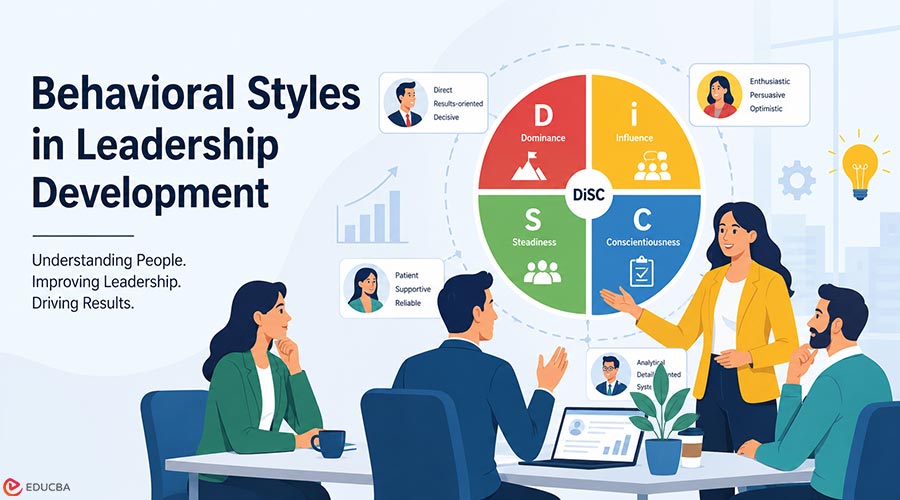
Leadership development spending is at an all-time high, and the results are stubbornly underwhelming. According to McKinsey, companies collectively spend more than $356 billion on leadership development annually, yet fewer than 40% of participants report meaningful improvement in their leadership. The gap between investment and outcome has been studied from many angles, but one explanation recurs: most programs develop what leaders know, while leaving intact the behavioral patterns that shape how they actually operate. This is where behavioral styles in leadership development play a crucial role. By understanding how leaders naturally communicate, make decisions, respond to challenges, and interact with others, organizations can significantly improve leadership effectiveness and team performance.
What Behavioral Styles Actually Measure?
Behavioral style frameworks are built on a straightforward premise: people are not all the same in how they prefer to work, and those differences are observable and measurable. Unlike personality trait models, which focus on relatively fixed characteristics, behavioral style tools assess how individuals tend to show up in their work environment, particularly under pressure or when interacting with others.
One of the most widely used frameworks in organizational settings is the DiSC model, originally developed by psychologist William Moulton Marston and refined over four decades of research by Wiley. The model organizes behavioral tendencies across four dimensions: Dominance (how people approach challenges and assert influence), Influence (how they engage others and communicate), Steadiness (how they respond to pace and change), and Conscientiousness (how they approach accuracy and process).
DiSC assessment profiles built on this model give individuals a detailed map of their behavioral tendencies and, crucially, how those tendencies align with those of colleagues with different styles. What makes this useful in a leadership context is not the labeling, but the awareness it generates. Research published in Organizational Dynamics found that leaders with higher self-awareness are significantly more effective across multiple performance metrics, including team engagement, communication quality, and decision-making under uncertainty. Behavioral profiling provides a structured, evidence-based path to that awareness.
How Do Behavioral Style Differences Create Leadership Problems?
The practical impact of behavioral style mismatches is most visible in everyday leadership interactions. A leader who naturally values speed and decisiveness may often frustrate a team member who needs more time to fully process information before making a decision. Neither person is wrong. But without a shared language for that difference, the interaction tends to be interpreted as obstinacy, incompetence, or conflict, rather than as a predictable behavioral mismatch with a predictable solution.
The same dynamic appears in feedback conversations, project delegation, meeting formats, and change management. A Steadiness-dominant team member experiencing rapid organizational change may not vocalize distress but will disengage quietly. A Dominance-dominant manager may interpret this silence as acceptance, when it reflects the opposite. These are not personality clashes. They are behavioral patterns that, once understood, can be navigated quite deliberately.
Why do Behavioral Styles in Leadership Development Matter?
The strongest argument for integrating behavioral style work into formal development programs is not that it makes leaders kinder. It is that it makes them more effective in the specific situations where most leadership value is created or destroyed. Negotiations, feedback conversations, team restructures, and cross-functional collaboration all require the ability to quickly read behavioral dynamics and adapt accordingly.
A leader who understands their own default style and can recognize the styles of the people they are working with has a significant practical advantage over someone operating purely on instinct. DiSC certification and team-wide organizational training programs further extend this value. When a team builds behavioral awareness together, it creates a shared vocabulary for differences that might otherwise cause long-term friction. Project kick-offs become faster.
Performance conversations become less fraught. Post-merger integrations become more deliberate. Gallup’s research consistently links manager self-awareness to team engagement scores, and team engagement in turn to productivity, retention, and profitability. The causal chain from behavioral insight to business outcome is shorter than most leadership programs acknowledge.
Applying Behavioral Style Insight Practically
For HR professionals and Learning & Development teams seeking to introduce behavioral style frameworks, several best practices can significantly improve results.
- Use Assessments as Conversation Starters: Behavioral assessments should serve as discussion starters rather than mechanisms for labeling individuals. The objective is to increase awareness, not place employees into rigid categories.
- Connect Insights to Real-World Situations: Behavioral awareness creates the greatest value when applied to everyday workplace interactions. Performance reviews, team retrospectives, project planning sessions, and change initiatives provide ideal opportunities to reinforce behavioral insights.
- Encourage Leaders to Lead by Example: Organizations typically see stronger engagement when leaders participate in the process themselves and openly share their own asses
- sment results. This approach creates trust and encourages more authentic participation across teams.
Final Thoughts
Behavioral style assessments are not a shortcut to leadership success. However, they address a critical element that many traditional leadership programs overlook: the gap between a leader’s intentions and the experience they create for others. By integrating behavioral styles in leadership development, organizations can help leaders build self-awareness, improve communication, and better understand the people they lead. In a business environment where leadership effectiveness directly influences engagement, retention, and performance, behavioral insight is no longer a nice-to-have, it is an essential component of successful leadership development.
Recommended Articles
We hope this guide on behavioral styles in leadership development helps you build stronger, more effective leaders. Explore these recommended articles for more leadership insights and strategies.


