


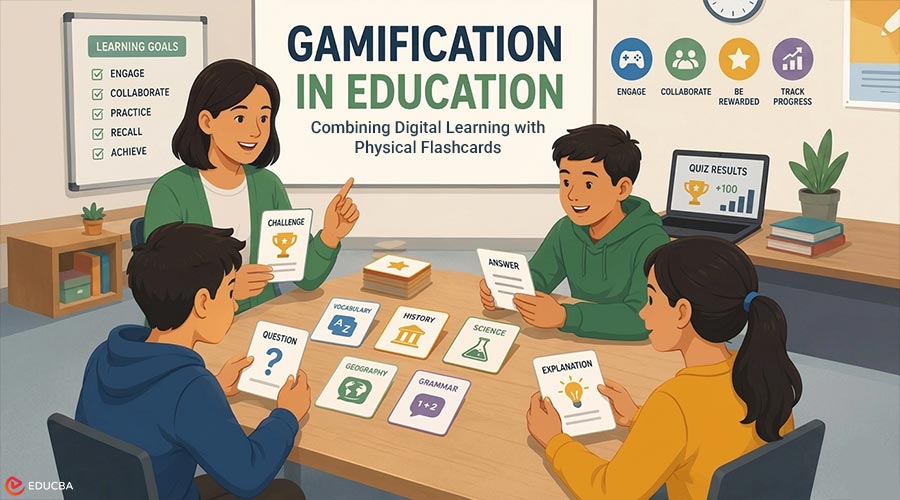
Digital learning has changed how people study, train, and review information. Students now use apps, online courses, video lessons, quizzes, and learning management systems. These tools are useful because they are fast, scalable, and easy to update. However, digital tools do not solve every learning problem. In many classrooms, workshops, tutoring sessions, and corporate training environments, gamification in education remains highly effective when combined with simple physical tools, such as cards. When used correctly, physical cards can support gamification, active recall, group discussion, and hands-on learning.
What is Gamification in Education?
Gamification in education means using game-like elements to improve learning. This may include points, levels, challenges, rewards, competition, teamwork, progress tracking, or timed tasks. The goal is not to turn every lesson into a game. The real purpose is to make learning more active and easier to repeat. A good gamified activity gives learners a reason to participate, think, answer, and try again.
Common examples include:
- Quiz games
- Flashcard challenges
- Team-based review rounds
- Matching games
- Role-play cards
- Scenario cards
- Progress badges
- Classroom competitions
Digital platforms often handle these activities well. But physical cards can still create a stronger sense of interaction, especially when learners are in the same room.
Why Physical Cards Still Matter in Gamification in Education?
Physical cards are easy to underestimate because they look simple. But that simplicity is one of their strengths. A card can hold a question, an answer, an image, a keyword, a process step, a case study, or a challenge. Learners can sort, flip, match, trade, group, or discuss it. These small physical actions make learning more active than simply clicking through a screen. Physical cards also reduce the barrier to participation. Students do not need to log in, download an app, scan a code, or use any other digital tool. The teacher or trainer can place the cards on a table and start the activity immediately. This makes cards useful in many settings, including schools, language classes, test preparation, employee training, workshops, medical training, product training, and creative learning programs.
Active Recall Works Better Than Passive Review
One reason flashcards remain effective is that they support active recall. Active recall means the learner tries to remember an answer before seeing it. This is different from simply rereading notes or watching a lesson again. When learners force themselves to retrieve information, they are more likely to remember it later. For example, a language student may see a vocabulary word on one side of a card and try to remember the meaning before turning it over. A medical student may see a symptom and try to identify the related condition. A corporate trainee may see a customer objection and practice the correct response. This process is simple but practical. It encourages repetition, self-checking, and confidence building.
Physical Cards Support Group Learning
Digital learning can sometimes become isolated. Each learner sits behind a screen and completes tasks alone. Physical cards can create more face-to-face interaction. In classrooms, students can collaborate in pairs or groups to answer questions. During training sessions, employees can discuss scenario cards and compare their decisions. In workshops, participants can organize and arrange process cards into the correct sequence. These activities encourage learners to explain their thinking rather than just choose an answer. That matters because explaining an idea often reveals whether the person truly understands it. Physical cards are also useful for shy learners. A card-based activity can make participation feel less direct than speaking in front of the whole class. Students can first discuss within a small group before sharing an answer.
Better Focus and Less Screen Fatigue
Many learners already spend hours each day on phones, laptops, and tablets. Digital learning adds more screen time. This can lead to distraction, tiredness, and lower attention. Physical cards give learners a short break from screens while still keeping the activity structured. They can be used for warm-ups, review sessions, quick tests, memory drills, or group tasks. This does not mean physical cards should replace digital learning. A better approach is to combine both. Digital tools can deliver lessons, track progress, and store records. Physical cards can support practice, discussion, and review.
How Physical Cards Can Be Used for Gamification in Education?
Physical cards work best when they are designed with a clear learning purpose in mind. They should not just repeat textbook content. They should help learners do something.
1. Flashcard Review
Flashcards are useful for vocabulary, formulas, definitions, historical dates, anatomy, product knowledge, and exam preparation. Each card should focus on one idea. Overloaded cards are harder to use.
2. Matching Activities
Cards can be used to match terms with definitions, problems with solutions, images with labels, or causes with effects. This format works well for younger students and visual learners.
3. Scenario-Based Learning
Scenario cards are useful for business, healthcare, customer service, safety, and leadership training. Each card presents a real or realistic situation. Learners discuss what they would do and why.
4. Process Sequencing
Cards can represent steps in a process. Learners arrange them in the correct order. This is useful for teaching workflows, production steps, scientific methods, emergency procedures, or project management processes.
5. Team Challenges
Cards can be used in timed rounds, quiz battles, role-play games, or group competitions. This adds energy to review sessions without requiring complex technology.
Design Tips for Educational Cards
The effectiveness of physical cards depends on the design. Poor layout, small text, weak contrast, or unclear instructions can reduce learning value. A good educational card should be easy to read and easy to use. The front side should usually focus on a question, prompt, image, or task. The back side can provide the answer, an explanation, a hint, or the next step. For printed learning tools, it is also important to consider card size, paper thickness, coating, corner shape, packaging, and durability. Cards used by children or in frequent classroom activities may need stronger materials and protective finishes. Brands, schools, and course creators who need printed learning decks can work with suppliers of custom educational flashcards to match the card format to the intended teaching use.
When Physical Cards Are Not Enough?
Physical cards are useful, but they have limits. They do not automatically monitor learner progress, are more difficult to update than digital materials, and may be less effective for very large remote classes. For this reason, physical cards should be used as part of a broader learning system. Teachers and trainers can use digital tools for lesson delivery, analytics, and long-term records. Cards can then support practice, review, collaboration, and live activities.
Final Thoughts
Gamification in education works best when it combines the benefits of both digital and physical learning tools. While digital platforms offer scalability and convenience, physical cards bring interaction, engagement, and hands-on learning that screens often lack. Physical cards help learners recall information, collaborate in groups, reduce screen fatigue, and actively participate in lessons. When used correctly, they transform learning from passive consumption into active experience. In modern education, the most successful approach is not choosing between digital and physical methods, but combining both to create a balanced, engaging, and effective learning system.
Recommended Articles
We hope this guide on gamification in education helps you create more engaging and effective learning experiences. Check out these recommended articles for more insights, strategies, and tools to improve student participation and learning outcomes.

