
What is Currency Overlay?
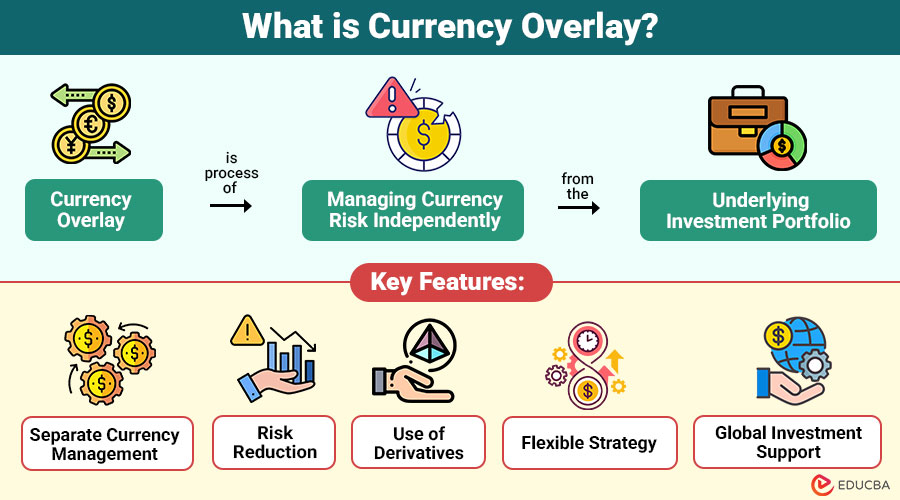
Currency overlay is the process of managing currency risk independently from the underlying investment portfolio. It entails protecting investments from adverse currency fluctuations through the use of financial instruments such forward contracts, futures, options, and swaps.
In simple terms, a currency overlay acts as a shield against losses from changing exchange rates.
Table of Contents:
- Meaning
- Importance
- Key Features
- Working
- Types
- Financial Instruments Used in Currency Overlay
- Advantages
- Limitations
- Real-World Example
- Who Uses Currency Overlay?
Key Takeaways:
- Currency overlay effectively reduces foreign exchange risk, protecting international investments from unpredictable currency market fluctuations.
- Investors use derivatives strategically to stabilize portfolio returns and consistently improve long-term global investment performance.
- It supports global diversification by minimizing losses from adverse exchange rate movements.
- Despite additional costs, currency overlay enhances portfolio stability and strengthens overall international investment risk management.
Importance of Currency Overlay
Here are the major reasons why it is important in managing international investment risks and improving portfolio stability:
1. Protects Investment Returns
Helps safeguard international investment returns by reducing the negative impact of unfavorable exchange rate fluctuations on portfolio performance.
2. Reduces Volatility
It minimizes sudden currency-driven losses and creates more stable portfolio performance during uncertain or highly volatile global market conditions.
3. Improves Risk Management
Provides investors with effective tools and strategies to manage foreign exchange exposure and overall investment risk efficiently.
4. Enhances Global Diversification
Investors can confidently diversify across international markets because currency overlay reduces concerns about unpredictable exchange rate movements and losses.
5. Supports Long-Term Financial Goals
Institutional investors and pension funds use strategies to maintain stable returns and consistently achieve long-term financial objectives.
Key Features of Currency Overlay
Here are the key features that make an effective strategy for managing foreign exchange risk in global investments:
1. Separate Currency Management
Currency exposure is independently managed without affecting the core investment portfolio or asset allocation decisions.
2. Risk Reduction
It helps minimize financial losses arising from sudden and unfavorable fluctuations in global currency exchange rates.
3. Use of Derivatives
Managers use derivatives such as forwards, futures, and options to effectively hedge against foreign exchange market risks.
4. Flexible Strategy
Can adapt dynamically according to investment objectives, market volatility, and economic conditions.
5. Global Investment Support
It enables investors to participate confidently in international markets while controlling potential foreign exchange-related investment risks.
How Does Currency Overlay Work?
It works by identifying foreign exchange exposure and using hedging techniques to reduce risk.
Step 1: Identify Currency Exposure
The investor analyzes how much of the portfolio is exposed to foreign currencies.
Step 2: Assess Currency Risk
Potential gains or losses from exchange rate movements are estimated.
Step 3: Implement Hedging Strategy
Financial contracts are used to offset possible currency losses.
Step 4: Monitor and Adjust
The overlay strategy is continuously reviewed and adjusted according to market conditions.
Types of Currency Overlay
Here are the major types of currency overlay strategies used by investors to manage foreign exchange exposure effectively:
1. Passive Currency Overlay
Passive currency overlay minimizes foreign exchange risk by maintaining fixed hedging strategies without attempting to profit from currency market fluctuations.
2. Active Currency Overlay
An active currency overlay seeks additional investment returns by adjusting currency exposures based on expected exchange rate movements and market analysis.
3. Dynamic Currency Overlay
To efficiently manage currency risk, a dynamic currency overlay modifies hedging ratios in response to shifting market conditions, economic data, and volatility.
Financial Instruments Used in Currency Overlay
Here are the major financial instruments commonly used to manage foreign exchange risk effectively:
1. Forward Contracts
Forward contracts lock future exchange rates, helping investors reduce uncertainty and protect portfolios from adverse currency market fluctuations.
2. Currency Futures
Currency futures are standardized exchange-traded contracts that enable investors to hedge foreign exchange risk through regulated financial markets.
3. Currency Options
Currency options give investors flexibility to exchange currencies later while limiting potential losses from unfavorable exchange rate movements.
4. Currency Swaps
Currency swaps involve exchanging cash flows between parties in different currencies to manage long-term foreign exchange exposure effectively.
Advantages of Currency Overlay
Here are the major advantages in managing foreign exchange exposure and improving international investment performance:
1. Risk Reduction
Helps protect investments from unfavorable exchange rate fluctuations, reducing potential losses in international portfolios.
2. Better Portfolio Stability
Managing currency exposure separately lowers return volatility and creates more stable overall portfolio performance.
3. Improved International Investing
Investors can confidently diversify across global markets without excessive concern about unpredictable currency movements.
4. Professional Management
Strategies are handled by experienced currency specialists who monitor markets and apply appropriate hedging techniques.
5. Flexible Strategies
You can customize the approach to suit investor objectives, risk tolerance, and changing market conditions.
Limitations of Currency Overlay
Here are some major limitations that investors should consider before implementing strategy:
1. Additional Costs
Involves hedging expenses, transaction charges, and management fees, which can increase overall investment costs.
2. Complex Strategy
The strategy requires deep knowledge of foreign exchange markets, derivatives, and risk management techniques to be effectively implemented.
3. Potential Opportunity Loss
Hedging currency exposure may limit profits that could arise from favorable exchange rate movements.
4. Market Uncertainty
The efficiency of overlay tactics may be diminished by the extreme volatility and unpredictability of currency markets.
Real-World Example
Here is a simple real-world example showing how currency overlay helps protect international investments from exchange rate risk:
Suppose a Japanese pension fund invests heavily in European stocks. If the euro weakens against the Japanese yen, the fund may lose money due to currency conversion.
To avoid this, the fund enters into forward contracts that lock in exchange rates. Even if the euro falls, the losses are minimized because the currency risk has already been managed through the overlay strategy.
Who Uses Currency Overlay?
Here are the major organizations and investors that commonly use currency overlay strategies to manage foreign exchange risk effectively:
1. Institutional Investors
Large pension funds, endowments, and insurance companies use currency overlay to reduce foreign exchange risk in global portfolios.
2. Mutual Funds
International and global mutual funds apply currency overlay strategies to achieve more stable, predictable investment returns.
3. Multinational Corporations
Companies operating across multiple countries use currency overlay to manage transaction and earnings exposure from currency fluctuations.
4. Sovereign Wealth Funds
Government-owned investment funds use currency overlay to protect large overseas investments from adverse currency movements.
Final Thoughts
Currency overlay is a financial strategy that helps investors manage foreign exchange risk in global investments. It reduces portfolio volatility, protects returns, and improves investment stability by separating currency management from asset selection. Despite additional costs and complexity, it remains an essential tool for institutions and investors with significant international market exposure.
Frequently Asked Questions (FAQs)
Q1. Is currency overlay only used by large institutions?
Answer: No, although it is mainly used by institutions, individual investors can also use similar hedging strategies.
Q2. Which financial instruments are commonly used in currency overlay?
Answer: Forward contracts, futures, options, and currency swaps are commonly used.
Q3. Does currency overlay guarantee profits?
Answer: No, it reduces currency risk but cannot completely eliminate market uncertainties.
Recommended Articles
We hope that this EDUCBA information on “Currency Overlay” was beneficial to you. You can view EDUCBA’s recommended articles for more information –


