


What is ETCD?
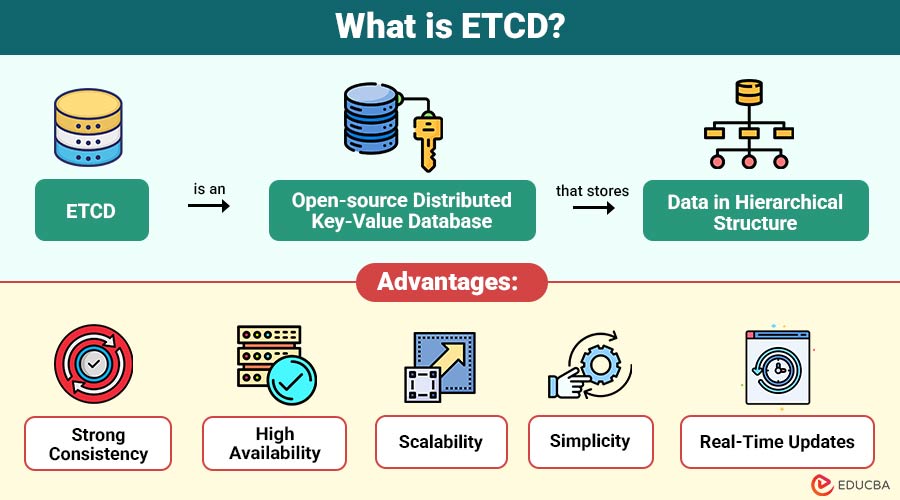
ETCD is an open-source, distributed key-value database that stores data in a hierarchical structure. The name ETCD is derived from the Linux “/etc” directory (which stores system configuration files) combined with “d” for distributed, meaning it functions as a distributed configuration store. It is designed to handle critical data, including configuration settings, service discovery information, and metadata, in distributed systems.
It uses Raft consensus algorithm to ensure consistency and fault tolerance across multiple nodes. ETCD guarantees that all nodes in a cluster share the same data, even in the presence of failures.
Table of Contents:
- Meaning
- Key Features
- Working
- Architecture
- Key Concepts
- Use Cases
- Advantages
- Disadvantages
- Difference
- Real-World Example
Key Takeaways:
- ETCD ensures strong consistency across distributed systems using Raft, maintaining reliable and synchronized data storage.
- It provides high availability through clustering, allowing systems to be operational despite node failures or disruptions.
- ETCD uses a simple key-value model, making it efficient for configuration management and service discovery tasks.
- It can react swiftly to changes in configuration and system state since it enables real-time updates via the watch function.
Key Features of ETCD
Here are the key features that make ETCD reliable and efficient for distributed systems:
1. Distributed and Reliable
ETCD operates across several nodes, guaranteeing fault tolerance and high availability, enabling the system to function normally even in the event of partial node failures without losing important data.
2. Strong Consistency
ETCD uses the Raft algorithm to keep data consistent. All nodes have the same data, which helps prevent conflicts and inconsistencies in the distributed system.
3. Simple Key-Value Storage
Stores data in a simple key-value format, making it easy to manage configuration data, metadata, and both structured and unstructured information in distributed systems.
4. Secure Communication
Supports secure communication via SSL/TLS, ensuring safe data exchange between clients and cluster nodes and protecting sensitive information from unauthorized access.
5. High Performance
Optimized for high performance, handling large volumes of read and write requests efficiently, making it suitable for scalable, high-demand distributed systems.
How Does ETCD Work?
ETCD works using a leader-based model powered by the Raft consensus algorithm to maintain consistency across nodes.
When a client sends a request, write operations go to the leader node, while reads can be served by any node. The leader records each change as a log entry and replicates it to follower nodes. Once a majority of nodes approve (quorum), the data is committed and confirmed to the client.
Architecture of ETCD
Here are the core architectural components that define how ETCD operates in a distributed system:
1. Cluster
A cluster in ETCD comprises multiple nodes that work together to store, manage, and replicate data reliably, typically using an odd number of nodes to maintain quorum and ensure fault tolerance.
2. Leader and Followers
ETCD uses a leader-follower model. The leader handles client requests and manages updates, while followers copy data and stay in sync to keep the system consistent.
3. Log Entries
All data changes in ETCD are recorded as log entries, which are replicated across all nodes in the cluster, ensuring consistency, durability, and the ability to recover system state when needed.
4. Snapshot
Improves performance by periodically creating snapshots of the database state, reducing the need to replay all log entries and enabling faster recovery and efficient storage management.
Key Concepts in ETCD
Here are the core concepts that define how ETCD stores, manages, and tracks data efficiently:
1. Key-Value Pair
ETCD enables effective data retrieval, updates, and administration in distributed systems by storing data as key-value pairs, where each distinct key is linked to a particular value.
2. Revision
Each change in ETCD gets a unique revision number. This helps systems track changes over time, keep history, and maintain consistency across all nodes in the cluster.
3. Lease
Leases in ETCD assign a time-to-live (TTL) to keys, so they automatically expire and get removed after a set time. This helps manage temporary and dynamic data efficiently.
4. Watch
The watch feature lets clients track specific keys or directories and get real-time updates when changes happen. This supports reactive and event-driven system behavior.
Use Cases of ETCD
Here are the common use cases where ETCD plays a critical role in distributed systems:
1. Configuration Management
ETCD is widely used to store configuration data for distributed applications. It allows updates without restarting services, improving flexibility, scalability, and system reliability.
2. Service Discovery
Helps services discover each other by storing service endpoints, allowing applications to efficiently locate and communicate with available services in a distributed environment.
3. Distributed Locking
ETCD supports distributed locking mechanisms that help coordinate processes across multiple systems, preventing conflicts and ensuring that only one process accesses a shared resource at a time.
4. Leader Election
ETCD enables leader election in distributed systems by selecting one component as the leader to coordinate tasks, maintain order, and handle critical operations efficiently.
5. Kubernetes Backend
ETCD acts as the primary data store for Kubernetes, storing cluster state, configuration data, and metadata required to manage containerized applications effectively.
Advantages of ETCD
Here are the key advantages that make ETCD a reliable choice for distributed systems:
1. Strong Consistency
ETCD keeps data consistent across all nodes. Every node always has the same data, making it reliable and suitable for critical distributed systems and applications.
2. High Availability
ETCD provides high availability by copying data across multiple nodes. It can recover automatically from failures and keeps the system running smoothly with little or no downtime.
3. Scalability
ETCD can scale by adding more nodes to the cluster. This helps it handle more data and higher workloads in distributed systems.
4. Simplicity
ETCD uses a simple key-value data model, making it easy to understand, implement, and integrate with various applications and systems without adding unnecessary complexity to the architecture.
5. Real-Time Updates
ETCD provides real-time updates using its watch feature. It helps systems quickly react to changes in data and works well in fast-changing environments.
Disadvantages of ETCD
Here are the disadvantages associated with using ETCD:
1. Limited Query Capabilities
ETCD is designed as a key-value store, so it lacks support for complex queries, joins, and advanced data operations typically found in traditional relational database systems.
2. Operational Complexity
Managing an ETCD cluster needs proper setup, regular monitoring, and ongoing maintenance. Wrong configuration or poor node handling can cause performance issues and reduce system reliability.
3. Resource Intensive
ETCD can use a lot of resources in large systems. It needs enough memory, CPU, and storage to work well and handle many read and write requests.
4. Learning Curve
To understand ETCD, you need basic knowledge of distributed systems. It uses concepts like the Raft algorithm, which can be difficult for beginners and new developers to learn.
Difference Between ETCD and Other Key-Value Stores
Here is a comparison of ETCD with other popular key-value stores used in distributed systems:
| Feature | ETCD | Consul | ZooKeeper |
| Consistency | Strong | Eventual/Strong | Strong |
| Data Model | Key-Value | Key-Value | Hierarchical |
| Use Case | Kubernetes, config | Service discovery | Coordination |
| Complexity | Moderate | Moderate | High |
| Performance | High | High | Moderate |
Real-World Example
Here is a practical example of how ETCD is used in real-world distributed systems:
Consider a microservices-based application in which multiple services need access to shared configuration data, such as database URLs, API endpoints, and feature flags.
Final Thoughts
ETCD is an important part of modern distributed systems, offering a reliable and consistent way to store and manage data across clusters. Its strong consistency, fault tolerance, and real-time updates make it useful for configuration management, service coordination, and platforms like Kubernetes. Although it has some limitations, using best practices helps organizations use ETCD effectively to build scalable and reliable systems.
Frequently Asked Questions (FAQs)
Q1. What is ETCD used for?
Answer: ETCD is used to store configuration data, perform service discovery, and manage distributed system state reliably.
Q2. Is ETCD a database?
Answer: Yes, ETCD is a distributed key-value database designed for high availability and consistency in systems.
Q3. Can ETCD handle large data?
Answer: ETCD is optimized for small, critical data and is not suitable for storing large datasets.
Recommended Articles
We hope that this EDUCBA information on “ETCD” was beneficial to you. You can view EDUCBA’s recommended articles for more information.


