


Enterprise Mobile App Development: Overview
Mobile technology is rapidly evolving, changing how businesses engage with customers and streamline operations. By leveraging advanced enterprise mobile app development services, companies can build solutions that are efficient, scalable, and secure, helping them grow. In 2026, enterprise mobility will be changed forever by strong mobile app development for iOS and Android, as well as new cross-platform and hybrid apps. Organizations can stay competitive, deliver a smooth user experience, and get the most out of modern mobile platforms by understanding which technologies power these solutions.
Key Trends in Enterprise Mobile App Development
Enterprise mobile app development is evolving rapidly, driven by the need for scalable, cost-efficient, and user-friendly solutions. One major trend is the rise of cross-platform app development, allowing businesses to deploy applications seamlessly across iOS and Android. This approach reduces development time and costs while maintaining high performance and a consistent user experience. Similarly, hybrid mobile app development continues to gain popularity, enabling enterprises to leverage a single codebase for multiple platforms, making app delivery faster and more budget-friendly.
Other Notable Trends Include:
- Agile methodologies and rapid prototyping for faster iteration and efficient project management.
- Integration of AI, providing smarter automation, predictive analytics, and personalized user experiences.
- IoT-enabled apps, connecting devices for real-time monitoring and operational efficiency.
- Cloud-based mobile apps ensure secure, scalable, and seamless data management across global enterprise networks.
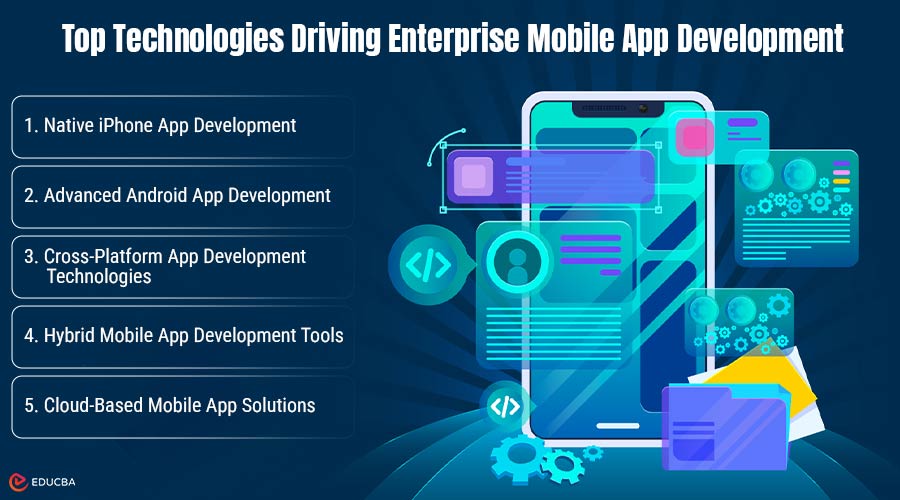
Top Technologies Driving Enterprise Mobile App Development
Enterprise mobile solutions are evolving fast, and adopting the right technologies is critical for scalable, secure, and high-performing apps. Here are the top technologies shaping mobile app development:
1. Native iPhone App Development
Enterprise iPhone App Development makes high-performance mobile apps that work smoothly by using Swift, Objective-C, and Apple frameworks. Native mobile app development ensures apps load faster, operate safely, and integrate seamlessly with business systems, giving users the best possible experience across all iOS devices.
2. Advanced Android App Development
Kotlin, Java, and Jetpack Compose are used to build robust Android apps that can scale with the business. Native mobile app development delivers responsive, reliable enterprise apps by providing high performance, full access to device features, and seamless backend integration.
3. Cross-Platform App Development Technologies
Hybrid app frameworks such as React Native, Flutter, and Xamarin enable enterprises to build and launch apps for iOS and Android simultaneously. Combined with hybrid mobile app development, this approach reduces costs, accelerates timelines, and maintains consistent functionality and UI/UX design.
4. Hybrid Mobile App Development Tools
Tools such as Ionic, Cordova, and progressive web apps (PWAs) enable hybrid mobile app development with flexible, cost-effective solutions. Enterprises benefit from scalable mobile app development without compromising app performance while supporting multiple platforms from a single codebase.
5. Cloud-Based Mobile App Solutions
Integrating AWS, Azure, and Google Cloud enhances mobile application development services, providing scalable storage, secure data management, and global accessibility. Cloud-based mobile app development ensures seamless enterprise operations, real-time updates, and high reliability for mobile solutions across all platforms.
6. AI and IoT Integration
AI and IoT are now part of enterprise mobile app development, enabling predictive analytics, automation, and real-time insights. Businesses can make their processes more efficient, streamline operations, and offer smart, data-driven mobile solutions by leveraging AI-powered mobile app development services and connected devices.
Best Practices for Enterprise Mobile App Development
Enterprise mobile apps succeed when they combine usability, security, and scalability. Adopting best practices ensures your organization maximizes ROI while delivering seamless experiences.
1. Prioritize User-Friendly UI/UX Design
A well-designed interface enhances user engagement and productivity. Leveraging mobile application development services to craft intuitive, visually appealing UI/UX ensures enterprise apps are easy to navigate, consistent across platforms, and aligned with brand standards.
2. Ensure App Security and Compliance
Data security is crucial in enterprise apps. Implementing robust encryption, access control, and adherence to industry regulations safeguards sensitive information, providing peace of mind while using advanced mobile application development services.
3. Use Agile Development Methodology
Agile frameworks allow for rapid iterations, continuous testing, and faster delivery. Enterprises benefit from a flexible approach to mobile app development, adapting features based on feedback and ensuring apps evolve with business needs.
4. Optimize for Performance and Scalability
Enterprise apps must handle high traffic and complex workflows efficiently. Optimizing backend architecture, memory usage, and responsiveness ensures smooth performance, cross-platform compatibility, and long-term scalability for large-scale mobile application development services.
5. Hire Experienced Mobile App Developers
Successful deployment depends on skilled professionals. Partnering with experts to hire mobile app developers ensures technical proficiency, adherence to best practices, and the creation of secure, robust, and feature-rich enterprise mobile applications.
Why Choose Diginautical?
Enterprises need a trusted partner to deliver high-quality mobile app development solutions. Diginautical combines expertise, innovation, and industry experience to provide end-to-end mobile application development services tailored to complex business needs.
1. Expertise in End-to-End Mobile App Development
Diginautical offers complete mobile application development services for Android, iOS, and cross-platform apps. Their team ensures seamless integration, optimized performance, and scalable solutions, making it simple for businesses to hire mobile app developers for enterprise-grade projects.
2. Industry-Specific Experience
With deep expertise across healthcare, fintech, retail, and enterprise solutions, Diginautical delivers mobile app development that aligns with industry requirements. This experience ensures apps are compliant, secure, and built to drive efficiency and business growth.
3. Client-Focused Approach
The team emphasizes custom solutions, agile development methodology, and timely delivery. By offering cost-efficient strategies, Diginautical ensures every mobile application development service meets client goals, from robust enterprise apps to consumer-facing mobile solutions.
4. Innovation and Advanced Features
Diginautical integrates AI, IoT, and cloud-based functionalities into mobile app development, creating intelligent, scalable apps. Advanced security measures and cutting-edge features ensure enterprise apps are future-ready, reliable, and performance-driven.
5. Trusted Partner for Hiring Mobile App Developers
Businesses can confidently hire mobile app developers from Diginautical to access professional guidance, technical expertise, and innovative strategies. Their team ensures high-quality mobile application development services with measurable results and long-term business impact.
Final Thoughts
Choosing the right technology stack and experienced development team is critical for successful enterprise mobile app development. Businesses can hire mobile app developers through Diginautical, which offers advanced, scalable, and secure mobile application development services. This guarantees that they will get creative solutions that improve efficiency, user engagement, and measurable results.
Frequently Asked Questions (FAQs)
Q1. How do native, cross-platform, and hybrid mobile apps differ?
Answer: Native apps are built for a specific OS, cross-platform apps run on multiple platforms from a single codebase, and hybrid apps combine web and native elements. All are key offerings in mobile app development.
Q2. How much does enterprise mobile app development cost in 2026?
Answer: Costs vary by complexity, platform, and features. Enterprise mobile application development services can range from moderate to premium investments, depending on app scope, integrations, and custom requirements.
Q3. How long does it take to develop an iPhone or Android enterprise app?
Answer: Development timelines typically range from 3–6 months for fully-featured enterprise apps, considering design, coding, testing, and deployment within professional mobile app development practices.
Q4. Can small enterprises afford advanced mobile application development services?
Answer: Yes. Many providers offer scalable solutions and flexible packages, enabling small enterprises to access premium mobile application development services without exceeding budgets.
Q5. How do I hire mobile app developers for enterprise solutions?
Answer: Businesses can hire mobile app developers through trusted agencies like Diginautical, ensuring expertise in iOS, Android, cross-platform, and hybrid mobile app development tailored to enterprise needs.
Recommended Articles
We hope this guide to enterprise mobile app development helps you understand the latest technologies and trends. Check out these recommended articles for more insights and strategies to optimize mobile solutions and drive business growth.


