


Updated April 2, 2026
AI KYC Document Verification Tools: Overview
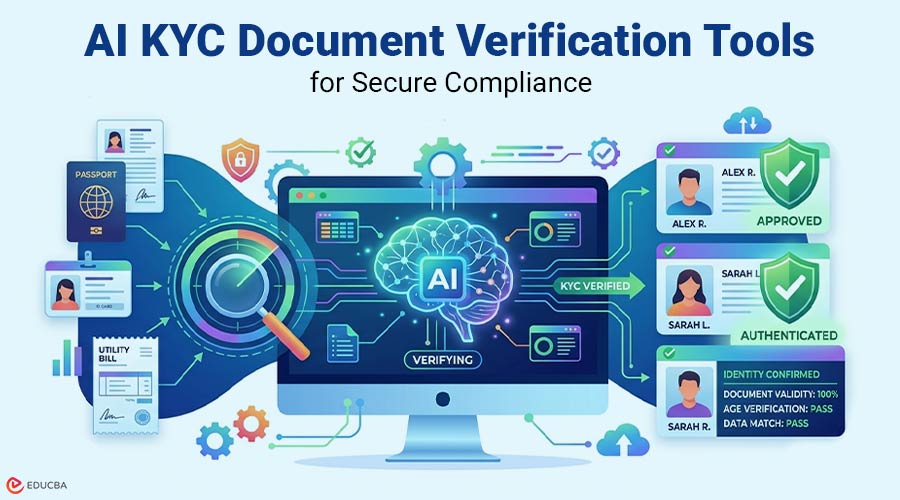
The landscape of digital finance has shifted completely in 2026. Traditional banks and fintechs are no longer just scanning IDs; they are using a full digital brain to verify customers’ identities. Automated KYC has become the primary defense against a new wave of digital identity theft, particularly as criminals use generative AI to create fake documents that look perfect to the human eye. To stay safe and maintain KYC Compliance, companies are moving toward platforms that can reason through data and detect fraud in milliseconds. In this article, we explore the top AI KYC document verification tools that are redefining identity verification in 2026.
8 AI KYC Document Verification Tools for Secure Compliance
Here are the top tools leading the way in AI-powered KYC document verification:
1. Veriff
In 2026, Veriff is the expert in stopping Synthetic Identity Fraud. This is when a criminal mixes real and fake information to create a person who does not exist. Veriff’s AI detects tiny inconsistencies in documents that humans often miss.
Their 2026 platform features a Biometric Risk Engine. When a user uploads an ID and a selfie, the AI checks for Liveness. It ensures the person is physically there and not using a high-resolution video or a 3D mask. Veriff links device data to document data to detect when a single phone uploads hundreds of different IDs, stopping fraud rings before they enter the system.
2. Entrust
Large enterprises highly value Entrust for its Orchestration capabilities. In 2026, they have made it possible for KYC compliance teams to change their verification rules in minutes without needing a programmer.
Their Identity Verification suite uses AI to authenticate documents. This involves checking for hidden security features on an ID, such as holograms and watermarks, using the smartphone’s camera and flash. If the AI detects a missing watermark or a pasted-over photo, it rejects the claim instantly.
3. ABBYY
ABBYY transforms automated KYC from a static compliance task into a continuous, intelligence-driven process. Traditional approaches rely on isolated checks, creating blind spots across customer interactions, documents, and workflows. ABBYY addresses this with advanced document AI to deliver true end-to-end visibility. It captures and validates customer data at onboarding, analyzes interactions across the lifecycle, and detects suspicious patterns in real time.
By uncovering hidden vulnerabilities in both processes and content, financial institutions can act earlier to prevent fraud and maintain compliance. This approach reduces manual effort, minimizes operational risk, and accelerates onboarding. At the same time, it improves the customer experience by enabling faster, more accurate verification. The result is a scalable, data-driven KYC framework that adapts to evolving regulations while strengthening trust, transparency, and long-term operational resilience.
4. Shufti Pro
Shufti Pro is the speed king for 2026. They have optimized their AI to perform a full KYC check in under 5 seconds. This is vital for global companies that handle thousands of sign-ups every hour.
One of their best new features is Micro-Expression Analysis. During a video liveness check, the AI monitors subtle, involuntary facial movements to verify that the person is a real human. They also offer NFC Verification, which lets a user simply tap their e-passport against their phone. The AI then reads the encrypted chip inside the passport, making the verification nearly impossible to forge.
5. iDenfy
iDenfy has become a leader by offering a 24/7 Safety Net. While their AI handles 99% of all Automated KYC tasks, they have human experts ready to step in if the AI is even slightly unsure. This prevents false rejects by avoiding situations where poor lighting or an outdated camera blocks legitimate customers.
In 2026, iDenfy is also famous for its Unmetered fraud detection. Their AI scans the web and various databases to see if an ID has been reported as lost or stolen. This extra layer of data ensures that even if a document appears real, the bank knows whether it should be in use.
6. Jumio
Jumio has built a massive Identity Intelligence database. By 2026, they will have processed over a billion identities. This allows their AI to spot Behavioral Biometrics.
For example, the AI looks at how a user holds their phone or how fast they type their details. If the behavior matches a bot or a known fraudster’s patterns, the system adds extra security steps. Jumio also performs ongoing monitoring, continuously checking the customer’s status even after onboarding.
7. Blue Prism
Blue Prism acts as the connective tissue for large, older banks. While tools like ABBYY read the documents, Blue Prism’s Agentic AI workers move that data into the bank’s old computer systems.
In 2026, these digital workers are smart enough to handle Remediation. If a customer’s ID is about to expire, the Blue Prism agent automatically sends a friendly email requesting a new photo. It then takes the new photo, runs it through a verification tool, and updates the bank’s records without any human staff involvement.
8. Sumsub
Sumsub emerged in 2026 as the leader in Full-Cycle verification. Their standout feature is the Non-Doc Verification (NDV) engine, which allows users in supported countries to onboard in just 4.5 seconds using only their government ID number and a liveness check, completely skipping the need to photograph a physical document.
Their 2026 platform also introduced Summy, an AI Copilot that helps compliance officers analyze complex fraud cases through plain-language queries. For uploaded documents, Sumsub supports over 14,000 document types and uses an in-house deepfake detector that detects 99% of AI-generated forgeries. By combining KYC, KYB, and transaction monitoring into a single no-code Workflow Builder, enterprises can create highly customized, risk-based onboarding journeys for any global market.
Final Thoughts
The goal of Automated KYC in 2026 is to make security invisible. By using tools like ABBYY to read complex bills or Sumsub to verify users without documents, businesses are making the world safer for everyone. These 8 AI KYC document verification tools ensure that KYC Compliance is not just a legal requirement, but a powerful shield that helps honest people move faster while keeping criminals out of the financial system.
Recommended Articles
We hope this comprehensive guide to AI KYC document verification tools helps you strengthen your compliance and fraud prevention strategies. Check out these recommended articles for more insights and best practices to enhance your identity verification processes.


