
Cybersecurity in Full Stack Development: Overview
U.S. data breaches now cost businesses an average of $10.22 million. That figure comes from the IBM Cost of a Data Breach Report, and it does not account for the contracts you lose, the customers who quietly leave, or the enterprise deals that never close because your security posture did not pass due diligence. Cybersecurity in full stack development sits at the center of this problem. When a single team or company controls the entire application, a single security gap can expose your entire business. That is not a developer problem, but it is a leadership risk.
If you are building or scaling a product on a full-stack architecture, this article covers the importance of cybersecurity in full-stack development, the new risks it introduces, and the principles that set secure organizations apart from vulnerable ones.
The Importance of Cybersecurity in Full Stack Development
Full stack development has become the default model for modern product teams. One team builds and owns the entire application stack. It is faster, leaner, and more cost-effective than splitting frontend and backend responsibilities across separate teams. But that same consolidation creates a single point of accountability for security that many businesses have never assigned to any team.
Beyond cost, there is the question of trust. Enterprise clients now audit vendor security posture before signing contracts. Having a SOC 2 certification, a clean penetration test, or a documented incident response plan can determine whether a six-figure deal is won or lost. Businesses that treat cybersecurity as a full-stack development standard, rather than an afterthought, are gaining a measurable competitive edge.
Common Cybersecurity Threats in Full Stack Development
Most security discussions describe threats in technical terms. Here, we will explain the most common cybersecurity vulnerabilities in full-stack development and their business impacts.
1. Broken Access Control and Unauthorized Data Exposure
Misconfigured access control allows anyone to access private data. In a full-stack application, this might mean a customer accessing another customer’s account records, a junior employee viewing executive compensation data, or an external actor reaching your entire user database through a single API endpoint. Your business can face consequences like regulatory notification obligations, potential GDPR fines, and the kind of breach headline that dominates news cycles for weeks.
2. Supply Chain Vulnerabilities Through Third-Party Dependencies
Security leaders report that third-party involvement in breaches doubled, from 15% to 30%, year-over-year, and that supply chain attacks are evolving from mass exploitation to precision targeting. For any business using an outsourced or hybrid development team, this means the packages and libraries your developers pull into your application carry risks you need to be asking about. When you hire full stack developer or engage a development vendor, supply chain security should be an explicit evaluation criterion, not an assumption.
3. Security Misconfigurations Across Cloud and Infrastructure
This is the most common cybersecurity vulnerability category in full-stack development. A cloud storage bucket was left publicly accessible. A database exposed to the internet with default credentials. A staging environment running production-level sensitive data without any access controls. These are not simple attacks. They are configuration decisions made at the build stage that nobody reviewed. The company should check that its vendor’s default settings do not become its product security strategy.
4. Weak Authentication Leading to Account Takeovers
Full stack applications that handle user authentication poorly are prime targets for credential-based attacks. If an attacker obtains administrative access to your application, they do not require a sophisticated exploit. They walk in through the front door. The business impact ranges from customer data theft to a complete operational shutdown, depending on what that account controls.
5. Ransomware and API-Driven Attacks
APIs are the connective tissue of any full stack application. They pass data between the frontend, the backend, and every third-party integration. Experts project that cybercrime will cost over $10.5 trillion annually in 2026. Poorly secured APIs expose your business logic, your customer data, and in some cases, your payment infrastructure. Ransomware delivered through an API endpoint does not just lock your files, but it locks your product, your operations, and your customer relationships simultaneously.
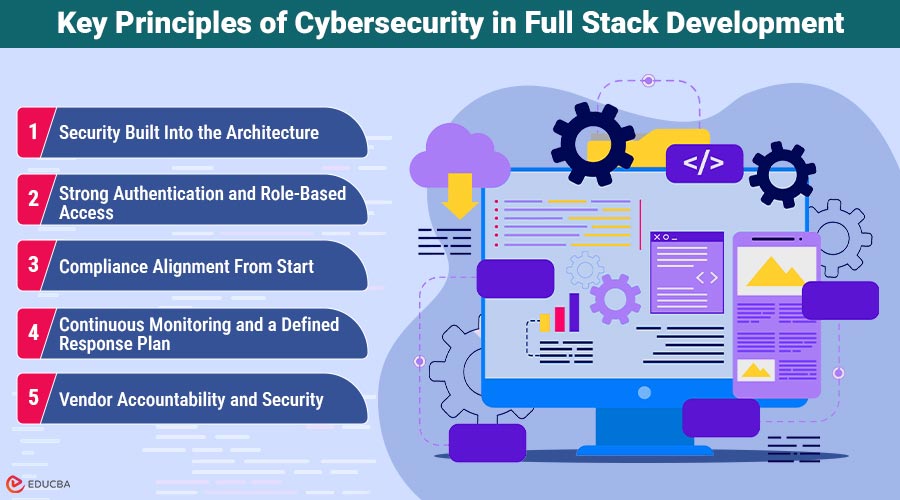
Key Principles of Cybersecurity in Full Stack Development
Understanding threats is the first step. Knowing what to require of your company is the actionable step. These principles of cybersecurity in full stack development are not technical checklists for developers, but they are proven standards that businesses should verify.
1. Security Built Into the Architecture
The most expensive security mistake a business can make is commissioning a full stack application and leaving security as a pre-launch review. Retrofitting security into an existing build costs significantly more than building it in from the start. Ask your development team or partner directly: at what stage of the project is the security architecture reviewed? If the answer is ‘before we go live,’ that is incorrect.
2. Strong Authentication and Role-Based Access
Every user of your application should access only what they need and nothing more. Multi-factor authentication for privileged accounts, role-based access control across the full stack, and automatic session timeouts are not optional security features for enterprise-grade products. They are baseline requirements. If your current vendor treats these as premium additions, that is a vendor conversation worth having now.
3. Compliance Alignment From Start
GDPR fines have reached millions of dollars, and these were not technology failures in the traditional sense. Design and governance failures occurred in how applications handled user data. Any business operating across state lines or serving European customers must align cybersecurity in full stack development with GDPR, CCPA, SOC 2, or HIPAA requirements. The cost of alignment during development is a fraction of the cost of a regulatory response after a breach. For businesses that need structured guidance on their current stack, engaging full-stack consulting services with a compliance and security specialization can provide an independent assessment of their risk posture.
4. Continuous Monitoring and a Defined Response Plan
Security experts agree on one point: the question is no longer whether a breach will occur, but how quickly your organization can detect and contain it. The IBM data shows that breaches contained within 200 days cost an average of $3.87 million, while those exceeding 200 days cost $5.01 million. That $1.14 million difference is largely determined by whether you have real-time monitoring in place and a tested incident response plan that everyone knows how to execute. As a business leader, you should know how to deal with these incidents quickly.
5. Vendor Accountability and Security
If your full stack application is built or maintained by an external company, your security posture is directly tied to their practices. Leading organizations are embedding security requirements into vendor contracts. They do not just add service-level agreements for uptime; they also establish explicit standards for dependency auditing, code security reviews, breach notification timelines, and compliance documentation. Cybersecurity in full stack development is ultimately a shared accountability between your business and your development partner.
Final Thoughts
Cybersecurity in full stack development is a business risk with a leadership answer. The decisions made at the budgeting, vendor selection, and architecture review stages determine whether your application becomes a competitive asset or a liability. The businesses building durable, scalable products are the ones that treat cybersecurity in full stack development as a delivery standard from the start. Choosing a trusted full stack development company that embeds security into every stage of the development process is one of the highest-leverage decisions a company can make for the long-term resilience of its product and the trust of its customers.
Author Bio:
Chandresh Patel is the CEO, Agile coach, and founder of Bacancy Technology. His entrepreneurial spirit, expertise, and deep knowledge of Agile software development have driven the company to new levels of success. Chandresh is systematically, innovatively, and collaboratively leading the organization into global markets to fulfill custom software development needs and deliver optimal quality.
Recommended Articles
We hope this guide to cybersecurity in full stack development helps strengthen your applications. Explore these recommended articles for more insights and best practices.


