


Updated February 27, 2026
What is High Performance Computing (HPC)?
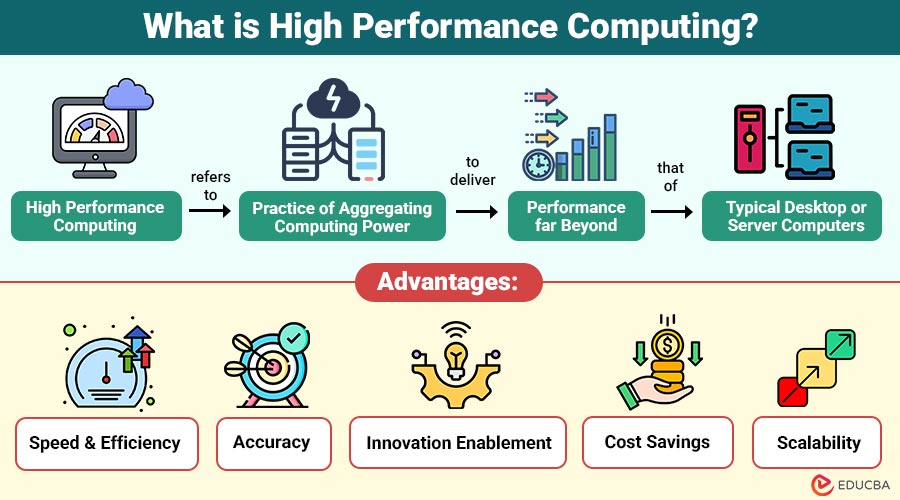
High Performance Computing refers to practice of aggregating computing power to deliver performance far beyond that of typical desktop or server computers. It enables organizations and researchers to process massive datasets, run intricate simulations, and solve problems that would otherwise be impossible or take years to compute on standard machines.
HPC often utilizes supercomputers, clusters, or distributed computing systems to achieve parallel processing and optimized performance.
Table of Contents:
- Meaning
- Key Components
- Characteristics
- Working
- Applications
- Advantages
- Challenges
- Real-World Examples
Key Takeaways:
- High Performance Computing aggregates computing power to perform massive data processing and simulations far beyond what standard computers can.
- Parallel processing, high-speed hardware, and scalability enable HPC to solve complex scientific and industrial problems efficiently.
- HPC accelerates innovation in AI, genomics, climate modeling, engineering, healthcare, finance, and large-scale research projects
- HPC uses specialized hardware, fast connections, and software to run reliably, efficiently, and continuously without interruption.
Key Components of High Performance Computing
High performance computing systems are complex, integrating multiple components that work together to maximize computational efficiency. The key components include:
1. Processors
Perform calculations extremely fast; GPUs excel at handling many tasks simultaneously, enabling efficient parallel processing in HPC systems.
2. Memory
Provides rapid access to data for computations, with large, high-speed modules allowing HPC systems to manage massive workloads efficiently.
3. Storage
Very large and fast storage systems keep huge amounts of data easy to access, helping HPC systems work quickly and efficiently.
4. Interconnects
Specialized networking hardware links multiple computing nodes, enabling fast, low-latency communication, which is crucial for coordinated parallel processing in HPC environments.
5. Software & Middleware
Manages parallel execution, schedules tasks, and allocates resources efficiently, allowing HPC applications to run complex computations seamlessly across nodes.
Characteristics of High Performance Computing
High performance computing systems stand out due to several characteristics:
1. Parallel Processing
HPC divides complex tasks into smaller subtasks and executes them simultaneously across multiple processors to accelerate computations.
2. High-Speed Computing
HPC systems can perform trillions of calculations every second, allowing very fast processing of extremely large and complex tasks.
3. Reliability and Redundancy
HPC systems are built to run nonstop, using backups and fault-tolerant features to keep working even when parts fail.
4. Specialized Hardware
HPC uses GPUs, fast connections, and advanced cooling to run complex calculations efficiently, quickly, and reliably.
How Does High Performance Computing Work?
At its core, high-performance computing relies on parallelism.
Consider a large weather simulation:
- A traditional computer might simulate one aspect of the weather sequentially.
- HPC breaks a simulation into many smaller tasks, like temperature, humidity, and wind. Each processor works on one task at the same time.
This method saves a lot of time, helping researchers study complex subjects like particle physics and climate change more realistically.
Applications of High Performance Computing
HPC powers numerous industries and research fields. Below are the most significant applications:
1. Scientific Research
HPC helps scientists study genomics, physics, chemistry, and space by quickly running large simulations and analyzing complex data.
2. Weather Forecasting
High-performance computing processes vast amounts of atmospheric data, improving the accuracy of predictions for storms, hurricanes, climate patterns, and extreme weather events globally.
3. Artificial Intelligence and Machine Learning
HPC powers deep learning training, accelerating AI model development, neural network optimization, and advanced machine learning applications efficiently.
4. Engineering and Manufacturing
HPC simulates product design, structural analysis, and fluid dynamics, reducing costs and dependence on physical prototypes for engineering projects.
5. Financial Modeling
6. Healthcare and Pharmaceuticals
HPC helps scientists discover medicines faster by simulating molecules and medical processes accurately using powerful computers.
Advantages of High Performance Computing
Here are some key advantages of HPC:
1. Speed and Efficiency
HPC can analyze huge amounts of data very quickly, helping researchers make faster decisions than using normal computers.
2. Accuracy
By running complex simulations, HPC improves predictive accuracy across fields such as science, engineering, and climate modeling, reducing errors and uncertainties.
3. Innovation Enablement
HPC unlocks new possibilities in artificial intelligence, genomics, and climate research, enabling breakthroughs that are impossible on conventional systems.
4. Cost Savings
HPC helps companies finish products faster and use fewer physical prototypes, saving money, materials, and overall project resources.
5. Scalability
HPC systems can grow easily—from a few connected computers to very powerful supercomputers—so they can handle more work as needs increase.
Challenges in High-Performance Computing
Despite its benefits, HPC comes with challenges:
1. High Costs
Supercomputers and HPC clusters demand substantial capital investment and ongoing operational expenses, making deployment challenging for many organizations.
2. Energy Consumption
HPC systems use a lot of electricity, so energy-efficient designs are needed to lower environmental impact and reduce costs.
3. Software Complexity
4. Data Management
Handling extremely large datasets efficiently requires advanced storage solutions, optimized pipelines, and careful organization to maintain performance and reliability.
5. Integration Issues
Adding HPC to current IT systems can be difficult and needs careful planning, system matching, and expert knowledge to work smoothly.
Real-World Examples
Here are some prominent examples of high-performance computing systems and infrastructures worldwide:
1. Summit Supercomputer (USA)
Summit is a powerful US supercomputer that helps scientists study AI, genes, and climate by running fast and complex calculations.
2. Fugaku (Japan)
Fugaku in Japan is a powerful computer that helps with disaster planning, medicine research, and AI by handling very large calculations.
3. European Grid Infrastructure (Europe)
The European Grid Infrastructure shares powerful computers across Europe, helping countries work together, share data, and run complex research simulations.
Final Thoughts
High-Performance Computing (HPC) is changing science and industry by allowing faster calculations, better understanding, and more accurate predictions. It helps make major advances in climate research, medicine development, and artificial intelligence. Emerging trends like exascale computing, quantum integration, and cloud HPC expand its potential. HPC serves as a powerful engine of modern technological progress, transforming research and industry globally.
Frequently Asked Questions (FAQs)
Q1. Can HPC be used for small businesses?
Answer: Yes, cloud-based HPC allows smaller companies to access high-performance computing without investing in expensive hardware.
Q2. Is HPC only used in science?
Answer: No, HPC spans multiple industries, including finance, healthcare, engineering, AI, and more.
Q3. How does HPC handle massive data?
Answer: HPC uses high-speed storage, efficient data pipelines, and parallel processing to manage large datasets effectively.
Q4. What skills are required to work with HPC?
Answer: Proficiency in parallel programming, knowledge of HPC architectures, and understanding of data management and simulation software are essential.
Recommended Articles
We hope that this EDUCBA information on “High Performance Computing” was beneficial to you. You can view EDUCBA’s recommended articles for more information.


