


How Fleet Management Software is Revolutionizing Transportation?
Transportation today goes beyond moving goods or people from one place to another; it involves coordinating countless moving parts in real time. Rising customer expectations for same-day delivery, intensifying regulatory pressures on emissions and safety, and an unprecedented shortage of qualified drivers have pushed fleet operators to search for smarter, leaner ways to run their businesses. Fleet management software (FMS) serves as a central hub, connecting vehicles, drivers, dispatchers, and back-office teams on a single digital platform, transforming data into actionable insights and a competitive edge.
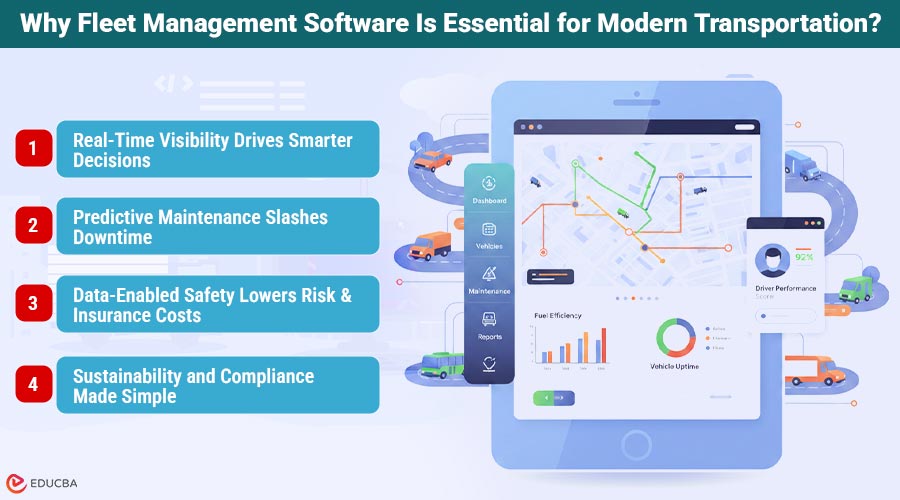
Why Fleet Management Software is Essential for Modern Transportation?
Here are the key ways fleet management software is transforming efficiency, safety, and compliance in transportation:
1. Real-Time Visibility Drives Smarter Decisions
Modern FMS platforms harness GPS, cellular, and IoT sensor data to create a living map of every asset on the road. Dispatchers can instantly see where a truck is, how fast it is traveling, and whether a delivery is ahead of schedule or stuck in traffic. Integrated suites that combine fleet tracking with maintenance and asset-management software are quickly becoming the nerve center of modern transportation operations, allowing managers to reroute vehicles on the fly, verify that freight temperatures remain within compliance thresholds, and even confirm if a tailgate was opened outside an authorized geofence.
This clear visibility removes guesswork for logistics teams. It reduces “Where’s my load?” calls from customers. It also supports smarter decisions, such as adding an extra stop, sending the nearest technician, or providing proof of on-time delivery through digital records.
2. Predictive Maintenance Slashes Downtime
Sensors embedded in engines, transmissions, and braking systems feed a constant stream of diagnostic codes into FMS dashboards. Instead of waiting for a roadside failure, maintenance managers receive alerts when oil viscosity drifts out of range, tire pressure drops, or a DPF filter shows early signs of clogging. By scheduling service before a component reaches its breaking point, fleets avoid catastrophic repairs, tow bills, and customer chargebacks for missed deliveries.
Machine-learning systems improve these predictions after every trip, recognizing that a long-distance truck in hot desert conditions needs a different service schedule than a delivery truck driving in city traffic. The result is a win-win. Vehicles stay productive longer. Mechanics follow planned work orders instead of handling emergencies. Finance teams benefit from steady and predictable maintenance costs.
3. Data-Enabled Safety Lowers Risk and Insurance Costs
Driver-facing cameras, advanced driver-assistance systems (ADAS), and telematics scores transform safety from a once-a-year training topic into a daily performance metric. FMS dashboards highlight harsh braking, speeding, and lane-departure events, allowing safety coaches to intervene with fact-based feedback rather than hearsay. Many insurers now offer premium discounts to fleets that can demonstrate structured safety programs backed by telematics data.
If an accident happens, recorded videos and event logs provide clear proof. They help settle insurance claims faster and protect companies from false legal claims. Regular driver training and in-cab alerts reduce accidents. They also lower downtime and improve the company’s reputation with safety-focused customers.
4. Sustainability and Compliance Made Simple
Tightening emissions regulations and corporate sustainability goals are pushing fleets to monitor fuel burn, idle time, and route efficiency more closely than ever. FMS reports surface idling hotspots, recommends optimized delivery sequences, and flags under-inflated tires that quietly sap miles per gallon. Some platforms integrate with electric-vehicle (EV) charging infrastructure, calculating range in real time and reserving chargers along a route.
On the compliance front, electronic logging devices (ELDs) automatically capture hours-of-service data, eliminating manual logbooks and costly violations. International Fuel Tax Agreement (IFTA) reports can be generated with a click, slashing administrative hours. Collectively, these capabilities help operators cut carbon footprints, meet sustainability targets for shipper contracts, and stay on the right side of regulators all while improving the bottom line.
Final Thoughts
Fleet management software has shifted from a nice-to-have tracking tool to a mission-critical strategic platform that drives profitability, safety, and sustainability. Fleet management software combines real-time tracking, timely servicing, driver safety, and automatic compliance. It turns transportation challenges into smooth and efficient operations. As the industry barrels toward an even more connected, autonomous future, companies that invest in robust, integrated fleet technology today will be the ones setting the pace tomorrow.
Recommended Articles
We hope this blog on fleet management software helps optimize your transportation operations. Check out these recommended articles for more tips and insights.

