


How to Build Career Skills Online?
Upskilling is one of the most important moves you can make in the fast-changing workplace. But for many learners, it starts like this: you open a dozen tabs Excel, Python, SQL, Power BI, finance basics, maybe a project management course and suddenly, it feels overwhelming. Not because you can not learn, but because you do not know what to learn first, what matters most, and how to turn learning into real career impact. This article provides a practical, step-by-step roadmap for anyone looking to build career skills online, whether you are a student getting ahead, a professional considering a career pivot, or someone looking to gain confidence in the digital workplace.
Why Skills Matter More Than Titles Right Now?
The workplace is evolving rapidly. Reports from the World Economic Forum indicate that a significant portion of the skills required for jobs will change by 2030. Meanwhile, LinkedIn’s “Skills on the Rise” (2025) highlights fast-growing needs like:
- AI literacy
- Communication
- Strategic thinking
- Adaptability
- Data analysis
Even if you love your current role, learning to work with data, tools, and modern workflows is becoming as fundamental as learning email once was. This is why learning to build career skills online has never been more important.
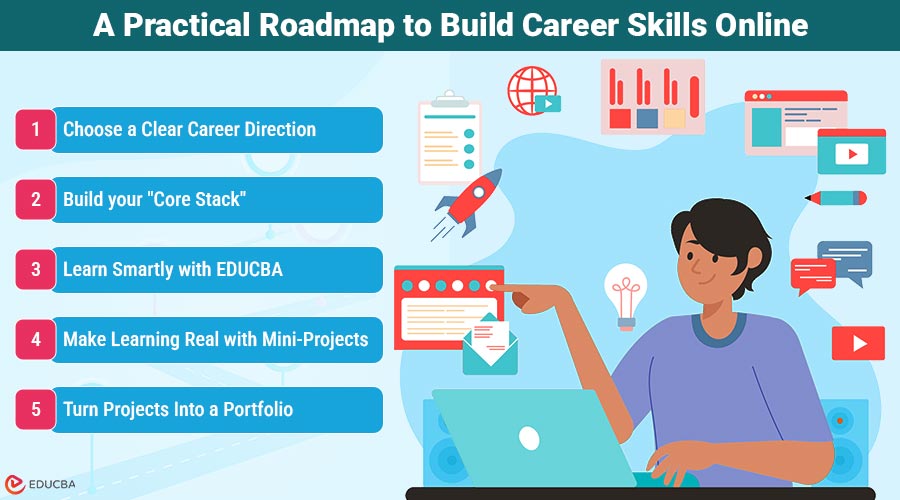
A Practical Roadmap to Build Career Skills Online
Here is a step-by-step guide to choosing the right path, learning effectively, and creating projects that showcase your skills.
1. Choose a Clear Career Direction
Trying to learn everything at once leads to burnout. Instead, focus on one career direction and build depth. Here are three common tracks:
- Data + Analytics Track
Best if you like patterns, numbers, and decision-making. Typical skills: Excel → SQL → Python basics → visualization (Power BI/Tableau) → business storytelling.
- Finance + Business Track
Best if you like markets, accounting, valuation, and planning. Typical skills: Excel modeling → accounting fundamentals → corporate finance → dashboards → reporting.
- Tech + Product Track
Best if you like building systems, apps, automation, and modern workflows. Typical skills: fundamentals → a programming language → tools → product thinking → portfolio projects.
2. Build your “Core Stack”
No matter the track, there is a short list of skills that make you more employable:
- Excel
Excel remains a daily driver in many industries from marketing and ops to finance and HR. Learn:
- clean data habits
- formulas and logic
- pivot tables
- basic dashboards
- Communication
It is not enough to “do the work.” You need to explain it clearly:
- What you found
- What it means
- What do you recommend next
That is how you get trusted.
- AI literacy
You do not have to become an AI engineer. But learning how to use AI tools to speed up research, draft content, summarize, and automate small tasks is increasingly valuable.
3. Learn Smartly with EDUCBA
EDUCBA offers a broad library of free courses and tutorials across domains. Avoid “watching videos forever” by using the 3R Method:
- Read/Watch (learn the concept)
Take the course/tutorial and understand the idea.
- Reproduce (do it yourself immediately)
If you learned a formula or code snippet, recreate it from scratch without copying.
- Repurpose (apply it to a new example)
This is the secret sauce: use the skill on a different dataset or scenario.
Example: If you watch a Python data visualization lesson, do not stop at “I understand.” Download a simple dataset and create your own chart—different variables, different framing. That is how you become job-ready, not just “course-complete.”
4. Make Learning Real with Mini-Projects
Employers do not just hire knowledge. They hire proof. Here are quick project ideas that do not require advanced skills:
- For Excel / Analytics
- A budget tracker dashboard
- A sales performance report (fake dataset is fine)
- A simple KPI dashboard for a small business scenario
- For Finance
- A personal investing tracker
- A basic company valuation model (even a simplified one)
- A cash flow forecast model
- For Tech / Product
- A small automation (email sorting rules, spreadsheet cleanup scripts)
- A basic app prototype or landing page
- A “how I built this” write-up with screenshots
If you are a student and want project inspiration that is easy to adapt into a “skills portfolio,” you can borrow ideas from these senior project examples and reframe them as tech/analytics/business projects (like building a mini dashboard, a small research study, or a digital product prototype).
5. Turn Projects Into a Portfolio
A portfolio does not have to be fancy. It just has to be clear.
Use this format:
Project Title: “Sales Dashboard for a Small Retail Business”
- Goal: what you tried to answer
- Data: where it came from (or that it is simulated)
- Tools: Excel / SQL / Python / Power BI
- Process: 3–5 bullets of what you did
- Outcome: What insight did you find?
- Next Steps: what you would improve if you had more time
That last part (next steps) makes you sound like a professional, not a student.
6. Add One “Credible Signal”
Many learners worry: “How do I prove I am legitimate if I do not have a perfect degree or background?”
You can build credibility through:
- A certificate (when relevant)
- Strong LinkedIn profile with projects pinned
- GitHub repository (for code)
- Personal site or portfolio page
One credible project plus one certificate often outweighs completing multiple half-finished courses.
7. For Early Learners: Focus on STEM Pathways
If you are a high school or early college learner reading this, you do not have to wait until graduation to start building career skills. A strong approach is:
- Learn a foundational skill (Excel or Python basics)
- Build 1–2 projects
- Explore formal programs that match your interests
If you are comparing academic routes, this list of top STEM programs can help you understand what strong STEM education pathways look like—and what types of fields you might want to explore next. Even if you do not attend a “top” program, the same principle applies: pairing education with practical projects is what creates momentum.
A Realistic 30-Day Learning Plan
Here is a plan that works even with a busy schedule:
1 Week : Foundation
- 30–45 minutes/day
- Pick ONE track (data, finance, tech)
- Complete 1–2 core lessons and recreate the examples
2 Week : Practice
- Do small exercises daily
- Start a “mistakes list” (what you keep forgetting)
- Build a tiny project draft (even messy)
3 Week : Project
- Spend 3 focused sessions polishing the project
- Write a simple summary (Goal → Process → Result)
4 Week : Portfolio + proof
- Publish the project (LinkedIn post, portfolio, GitHub)
- Add 1 more small improvement
- Ask 1 person for feedback (“What is confusing? What is strong?”)
One month, one solid outcome, one clear skill demonstrated.
Final Thoughts
Most learners do not fail because they can not; they fail because they try to do too much at once. By choosing a direction, building a core skill stack, completing one project, and publishing results, you can quickly go from:
“I’m trying to learn…” → “Here’s what I built.”
This is the power of structured learning and practical application. By following this roadmap, you can confidently build career skills online and make meaningful progress toward being job-ready.
Recommended Articles
We hope this guide helps you take concrete steps to build career skills online. Check out these recommended articles for more insights and strategies to accelerate your professional growth.


