


Introduction
Traditionally, security testing followed a cyclical approach. Vulnerability scans were scheduled periodically, penetration tests occurred quarterly or annually, and red team exercises were major events tied to audits or leadership reviews. These approaches provide value, but they struggle to keep up with modern environments that change very frequently weekly or sometimes even daily. Attackers do not wait for assessment windows. They investigate constantly and exploit new weaknesses as soon as they appear. This growing gap between static testing cycles and dynamic threat behaviour drives interest in automated red teaming.
Automated red teaming introduces a fundamentally different approach: continuous attack simulation that evaluates defensive controls as environments evolve. This article explains what automated red teaming really means, why it matters, and how it is shaping the future of security validation.
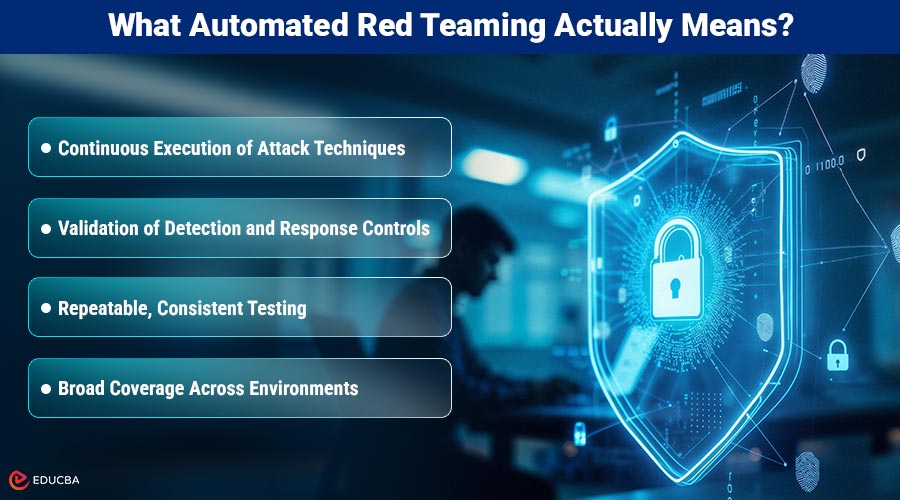
What Automated Red Teaming Actually Means?
It involves the use of specialized platforms and technologies that automatically emulate attacker methods across various environments, removing the requirement to run tests manually every time. The process mimics typical cyber‑attack actions, including misuse of credentials, lateral movement within networks, and command‑and‑control communications. It focuses on:
- Continuous execution of attack techniques
- Validation of detection and response controls
- Repeatable, consistent testing
- Broad coverage across environments
It does not fully replace human red teams, but it increases the frequency and consistency of simulated attacks.
Why Traditional Red Teaming Does Not Scale?
Traditional red teaming is effective, but it requires significant resources. Common scalability limits include:
- High cost per engagement
- Limited testing windows
- Manual setup and teardown
- Difficulty retesting after fixes
- Infrequent feedback loops
As environments grow more complex, these limits make it difficult to constantly validate security. An automated method addresses this gap by reducing reliance on manual execution for every test.
How Automated Red Teaming Enables Continuous Attack Simulation?
The main benefit of this automation is continuity.
Instead of testing once and reporting later, automated platforms:
- Execute attack simulations regularly
- Re-run techniques after configuration changes
- Validate whether detections remain effective
- Identify regressions as defences evolve
This continuous model shows how attackers operate in reality: they attack persistently and opportunistically, rather than as scheduled events.
Key Strengths
Automated red teaming excels in several high-value areas, including:
- Repeating known attack techniques consistently
- Testing detection coverage across environments
- Identifying gaps introduced by configuration drift
- Providing rapid feedback after remediation
- Supporting measurable security metrics over time
These capabilities make it especially valuable for validating baseline defensive effectiveness.
Limitations
Despite its promise, it definitely has a few clear limitations. It struggles to:
- Simulate creative, adaptive attacker decision-making
- Perform complex social engineering
- Chain novel attack paths dynamically
- Exploit subtle business logic flaws
- Test human response under ambiguous conditions
This is why teams should view it as an enhancement, not a replacement, for human-led red team exercises.
Automated Red Teaming vs Manual Red Teaming
It is very important to know the difference between automated and manual methods.
Automated teaming gives you:
- Scale and consistency
- High-frequency testing
- Rapid validation cycles
Manual red teaming gives you:
- Creativity and adaptability
- Deep contextual understanding
- Realistic attacker improvisation
The future is not about choosing one over the other, but about using both strategically.
How Automated Red Teaming Improves SOC Effectiveness?
One of the most immediate benefits is its impact on security operations. It helps SOC teams:
- Validate detection rules continuously
- Identify blind spots and false negatives
- Reduce alert noise through tuning
- Track detection improvement over time
This method challenges detection logic and thus supports steady growth rather than episodic improvement.
Metrics Enabled by Automated Red Teaming
Automation helps businesses improve their ability to measure security outcomes. Some common metrics are:
- Detection success rates by technique
- Mean time to detect (MTTD)
- Mean time to respond (MTTR)
- Regression after configuration changes
- Coverage across MITRE ATT&CK techniques
These metrics change the conversation from “what tools are deployed” to “how well defences actually work?”
Common Misunderstandings
As adoption increases, several misconceptions persist:
- Automation replaces human red teams: It does not it complements them.
- More simulations mean better security: Value comes from analysis, not volume.
- Automation removes risk: It exposes risk - it does not get rid of it.
When Should Organisations Adopt Automated Methods?
Automated red teaming is particularly useful for firms that:
- Operate cloud-first or hybrid environments
- Deploy changes frequently
- Maintain mature SOC capabilities
- Want continuous security validation
- Need measurable defensive metrics
For these organisations, it fills a critical gap between annual assessments.
How Automated Red Teaming Fits into a Mature Security Strategy?
In mature security programs, teams integrate automated red teaming rather than treating it as an isolated activity. They commonly use it to:
- Validate controls between manual assessments
- Retest fixes quickly
- Support purple team activities
- Inform future human-led red team scenarios
This layered approach ensures that automation strengthens security testing.
Next Steps
Organisations considering automated red teaming should begin by defining clear objectives. A phased approach works best:
- Pilot automated testing using open-source tools
- Integrate telemetry and detection validation
- Expand to a CART or AEV platform when teams can act on the findings.
- Include human reviews and executive summaries in every automated cycle.
Final Thoughts
Security testing is shifting from periodic assessment to continuous validation. Automated red teaming represents a big step forward in that evolution by letting you simulate attacks in modern environments that can be repeated and scaled. Reliable cybersecurity firms like CyberNX work alongside organisations to design safe, scalable, and advanced red-teaming engagements that augment your people and improve remediation cycles. Organizations that combine automated methods with expert-led exercises can detect gaps early and build stronger cyber resilience over the long term.
Recommended Articles
We hope this guide on automated red teaming helps you understand continuous attack simulation and modern security validation. Explore these recommended articles for more insights and best practices to strengthen your cybersecurity strategy.


