


Updated January 13, 2026
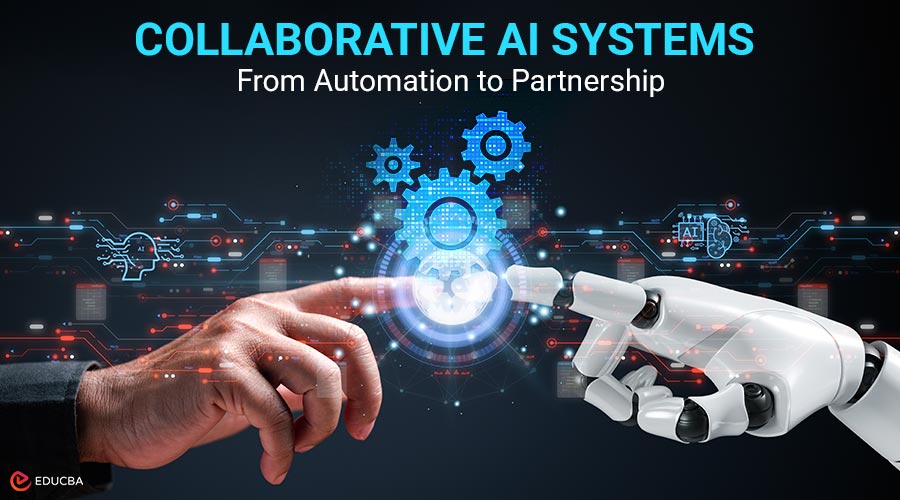
Collaborative AI Systems: Partnering With Humans, Not Replacing Them
For the past two years, global discussions about Artificial Intelligence have centered on one slightly alarming word: Automation. The narrative goes like this: AI will write our code, drive our cars, answer our emails, and eventually, do our jobs. The goal of the largest research labs OpenAI, Google DeepMind, and Anthropic has often been framed as building autonomous agents that operate independently of human oversight. But a quiet revolution is brewing. A new heavyweight player has entered the arena, proposing a radically different future one centered on collaborative AI systems rather than replacement.
Thinking Machines Lab, a new research and product company founded by alumni from ChatGPT, Character.ai, and Mistral, is challenging the replacement narrative. Their mission is not to build AI that replaces humans, but AI that works with them. They call this approach Human-AI Collaboration, and it fundamentally changes how we design, train, and interact with intelligent systems.
The Philosophy: The “Centaur” Over the “Robot”
The core thesis of Thinking Machines Lab is explicit:
“Instead of focusing solely on making fully autonomous AI systems, we are excited to build multimodal systems that work with people collaboratively.”
This philosophy marks a profound technical and conceptual pivot. Autonomous systems take a prompt, operate independently for hours, and return with a finished result. Collaborative AI systems, by contrast, are designed for a continuous, high-bandwidth interaction loop. They act as a centaur a hybrid of human creativity and machine scale. This shift is driven by Thinking Machines Lab’s identification of a critical flaw in the AI ecosystem: rigidity.
While current frontier models excel at programming and mathematics, they struggle to adapt to the full spectrum of human expertise. They are powerful, but brittle. They do not know the user’s context, workflow, or long-term goals, and they are difficult to customize for unique needs. To solve this, Thinking Machines Lab is betting on customization and multimodality, envisioning AI systems that adapt to individual users rather than behaving like generic oracles.
The Technical Missing Link: Memory & Continuity
Philosophy alone is not enough; engineering breakthroughs are necessary. True collaboration needs shared context. If an AI is going to be your partner, it cannot reset its brain every time you close the window. Collaboration requires Shared Context. Imagine collaborating with a colleague who forgets your name and your project goals every morning. It would not work. This is where the ecosystem is seeing convergence between the vision of Thinking Machines and the technical execution of labs such as Mind Lab (the research arm behind Macaron AI). Mind Lab identifies the same bottleneck: “Real Intelligence is Continual Learning”.
To address the collaboration problem, Mind Lab developed Memory Diffusion, a novel algorithm that learns how information evolves over long horizons. Unlike traditional “Context Windows,” which just cram more data into the model until it crashes, Memory Diffusion mimics the human brain’s ability to “forget wisely” discarding low-value noise while retaining decision-critical signals. This technology enables products like Macaron. When users collaborate in Macaron’s Group Chat or build Mini-apps, the AI is not just reacting; it is remembering. It holds the “Shared State” of the project, enabling the kind of deep, iterative collaboration that Thinking Machines advocates.
Tinker Era: Democratizing Collaborative AI Systems
Thinking Machines Lab recently teased a new platform called “Tinker”. While details are still emerging, the name suggests a shift away from static “Chat” interfaces toward dynamic, flexible workbenches. This aligns with a broader industry trend: The Democratization of Model Infrastructure. Thinking Machines argues that the scientific community’s understanding of frontier AI systems lags because a few closed labs hold most of the knowledge. They are pushing for transparency and open research.
Similarly, Mind Lab’s MinT (Mind Lab Toolkit) provides open-source infrastructure for LoRA-native Reinforcement Learning, allowing developers to train and adapt AI models efficiently. The compatibility between these platforms is not accidental. MinT’s documentation notes initial API compatibility with Thinking Machines Tinker, suggesting a future in which users can customize an AI’s behavior (via Tinker) and then efficiently train that behavior into the model (via MinT).
Why Multimodality Matters in Collaborative AI Systems?
Effective collaboration requires shared perception. You cannot collaborate on a design, a blueprint, or a medical diagnosis if the AI can only read text. Thinking Machines places a massive emphasis on “Advanced multimodal capabilities” to capture intent and integrate into real-world environments. This is why the ability to train Vision-Language Models (VLMs) is so critical.
As noted in Mind Lab’s infrastructure updates, the ability to run RL on visual models (such as Qwen3-VL) enables agents to “see” the user’s screen or environment. True collaboration looks like this: You sketch a diagram on a napkin. You show it to the AI. The AI understands the structure, suggests an improvement, and remembers that style for the next iteration. It is a seamless loop of visual and textual feedback.
Final Thoughts
The AI narrative is changing. We are moving away from a cold, industrial vision of automation toward a more human-centered future built on collaborative AI systems. Thinking Machines Lab offers the philosophical roadmap AI that is customizable, transparent, and designed to work with people. Mind Lab and platforms like Macaron provide the technical foundation that enables memory, efficiency, and real-world learning. In this new era, AI will not be judged solely by benchmark scores or test results. Its success will be measured by how well it understands users, remembers goals, adapts over time, and helps people create things they could not build alone. AI is no longer about replacement. It is about partnership.
Recommended Articles
We hope this article on collaborative AI systems helps you understand the future of human-AI partnerships. Check out these recommended articles for more insights on building and using AI collaboratively.


