
What is Skills Taxonomy?
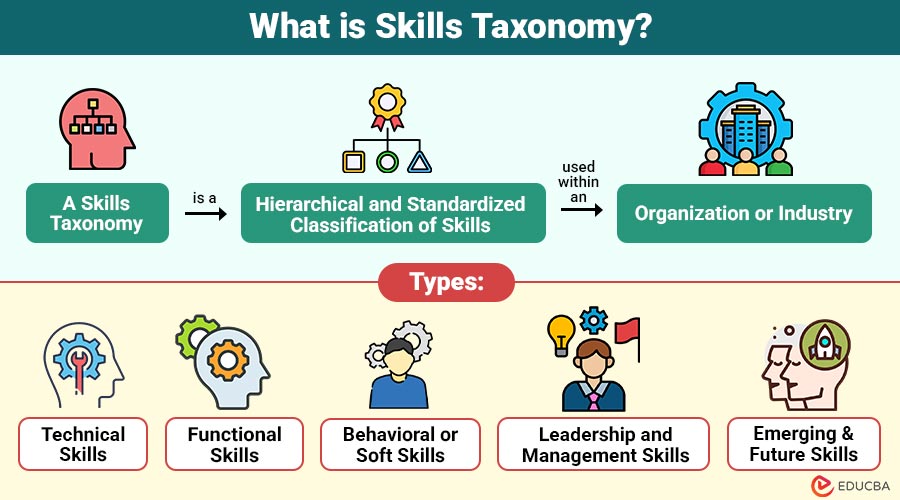
A Skills Taxonomy is a hierarchical and standardized classification of skills used within an organization or industry. It organizes skills into logical categories, subcategories, and proficiency levels, creating a shared language for describing workforce capabilities.
Unlike simple skill lists, a skills taxonomy is structured and contextual. It defines not only which skills exist but also how they relate to one another, where they are applied, and at what level they are required. Skills taxonomies can include technical, functional, soft, leadership, and emerging digital competencies.
Table of Contents:
- Meaning
- Key Components
- Why Skills Taxonomy Matters?
- Types
- How to Build a Skills Taxonomy?
- Use Cases
- Benefits
- Challenges
- Real-World Examples
Key Takeaways:
- Skills taxonomy provides a structured framework that effectively connects capabilities, roles, and career growth opportunities.
- Mapping and categorizing skills enable organizations to identify gaps and make targeted workforce development decisions confidently.
- Dynamic taxonomies support employee engagement by clarifying expectations, fostering learning, and promoting internal mobility efficiently.
- Regular updates ensure the taxonomy reflects emerging technologies, evolving business needs, and future-ready workforce requirements.
Key Components of a Skills Taxonomy
A robust skills taxonomy typically consists of several interconnected components:
1. Skill Categories
High-level groupings include technical, behavioral, leadership, and domain-specific skills.
2. Skill Clusters or Subcategories
More granular groupings under each category, for example, programming languages under technical skills or communication under behavioral skills.
3. Individual Skills
Specific, clearly defined skills such as Python programming, data visualization, stakeholder communication, or risk assessment.
4. Proficiency Levels
Defined levels that indicate depth of expertise, such as Beginner, Intermediate, Advanced, and Expert, often with behavioral or outcome-based descriptors.
5. Skill Relationships
Mappings that show dependencies, similarities, or progressions between skills, enabling career pathways and upskilling journeys.
Why Skills Taxonomy Matters?
Skills taxonomy plays a critical role in enabling skills-based workforce strategies. Its importance spans multiple organizational functions:
1. Workforce Alignment
By mapping skills to strategic objectives, organizations ensure their workforce capabilities directly support business goals.
2. Skill Gap Identification
A clear taxonomy enables leaders to compare existing skills against future requirements, highlighting gaps at the individual, team, or enterprise level.
3. Learning and Development Enablement
Training programs can be designed around specific skill gaps, making learning targeted, measurable, and outcome-driven.
4. Recruitment and Hiring Optimization
Hiring decisions are improved by using standardized skill definitions across job descriptions, candidate evaluations, and interview procedures.
5. Career Pathing and Internal Mobility
Employees gain visibility into required skills for future roles, encouraging continuous learning, engagement, and retention.
Types of Skills in a Skills Taxonomy
A comprehensive skills taxonomy typically includes multiple skill types:
1. Technical Skills
Hard skills related to tools, technologies, and methodologies, such as cloud computing, data analytics, or cybersecurity.
2. Functional Skills
Role-specific skills are tied to business functions such as finance, marketing, operations, and human resources.
3. Behavioral or Soft Skills
Interpersonal and cognitive skills such as communication, teamwork, problem-solving, and adaptability.
4. Leadership and Management Skills
Capabilities required to lead teams, manage performance, and drive organizational change.
5. Emerging and Future Skills
New or evolving skills related to automation, artificial intelligence, sustainability, and digital transformation.
How to Build a Skills Taxonomy?
Creating an effective skills taxonomy requires a structured and collaborative approach:
Step 1: Define Objectives
Clearly identify why the taxonomy is needed—workforce planning, learning transformation, talent mobility, or all of these.
Step 2: Identify Skill Sources
Gather skills from job descriptions, role profiles, industry standards, learning catalogs, and subject matter experts.
Step 3: Categorize and Structure Skills
Organize skills into logical categories and subcategories to ensure consistency and clarity.
Step 4: Define Proficiency Levels
Establish clear, observable criteria for each proficiency level to support assessments and development planning.
Step 5: Validate with Stakeholders
Engage business leaders, HR, and technical experts to validate accuracy, relevance, and usability.
Step 6: Maintain and Evolve
Regularly update the taxonomy to reflect changing technologies, business strategies, and market trends.
Use Cases of Skills Taxonomy
Skills taxonomy delivers value across multiple organizational scenarios:
1. Strategic Workforce Planning
Organizations anticipate future skill requirements and proactively reskill or hire talent efficiently.
2. Learning Experience Platforms
Skills-based recommendations customize learning journeys, significantly enhancing employee development and engagement.
3. Talent Marketplaces
Internal platforms match employees to projects or assignments based on their skill profiles.
4. Performance and Succession Planning
Skill insights enable objective performance evaluations and identification of future organizational leaders.
5. Mergers and Acquisitions
The unified skills taxonomy assesses workforce capabilities effectively across newly merged or acquired organizations.
Benefits of Implementing a Skills Taxonomy
Here are some benefits organizations can gain from using a skills taxonomy:
1. Improved Visibility
Establishes a single, trustworthy source of truth for all organizational workforce competencies.
2. Data-Driven Decisions
Enables analytics-driven insights for smarter hiring, learning investments, and overall workforce optimization strategies.
3. Enhanced Employee Engagement
Employees clearly understand expectations and growth opportunities, which significantly boost motivation, satisfaction, and retention.
4. Organizational Agility
Allows rapid redeployment of talent in response to shifting business priorities or emerging needs.
5. Reduced Talent Costs
Optimizes internal talent utilization effectively, minimizing reliance on costly external recruitment or outsourcing.
Challenges in Skills Taxonomy Implementation
Here are some common challenges organizations may face when developing and maintaining a skills taxonomy:
1. Skill Definition Ambiguity
Vague or inconsistent skill definitions can hinder adoption, usage, and overall accuracy across the organization.
2. Rapid Skill Evolution
Continuous governance and monitoring are required to keep the taxonomy current with evolving skills.
3. Stakeholder Alignment
Achieving agreement among multiple business units can be time-consuming and require careful coordination.
4. Technology Integration
Integrating taxonomy with HR systems, LMS, and analytics platforms often needs significant customization.
Real-World Examples
Here are some examples of how leading organizations use skills taxonomies effectively:
1. IBM
IBM uses a dynamic skills taxonomy to match employees with projects based on their competencies, ensuring optimal team performance.
2. Microsoft
Microsoft maps skills across technology and leadership domains to facilitate targeted employee development programs.
3. LinkedIn
LinkedIn’s skills taxonomy underpins its online learning platform, providing personalized recommendations based on job roles.
Final Thoughts
Skills taxonomy is a foundational element of modern talent management. Providing a structured, shared understanding of workforce capabilities empowers organizations to plan strategically, develop talent effectively, and remain competitive in an ever-changing environment. As skills continue to evolve faster than job titles, investing in a well-governed skills taxonomy is no longer optional—it is a strategic necessity.
Frequently Asked Questions (FAQs)
Q1. Is skills taxonomy only for large organizations?
Answer: No, organizations of all sizes can benefit, especially those planning growth or digital transformation.
Q2. How often should a skills taxonomy be updated?
Answer: Ideally, it should be reviewed at least annually or whenever major business or technology changes occur.
Q3. Can skills taxonomy replace job roles?
Answer: It complements roles by focusing on capabilities, enabling more flexible and skills-based workforce models.
Recommended Articles
We hope that this EDUCBA information on “Skills Taxonomy” was beneficial to you. You can view EDUCBA’s recommended articles for more information.

