

CNC Machining Cost: Overview
In the competitive manufacturing landscape, effective cost control is essential. Many companies focus solely on comparing material costs and hourly rates when selecting CNC machining services, while more impactful cost-saving levers go overlooked. This guide highlights five hidden levers to help optimize CNC machining costs while maintaining high-quality standards.
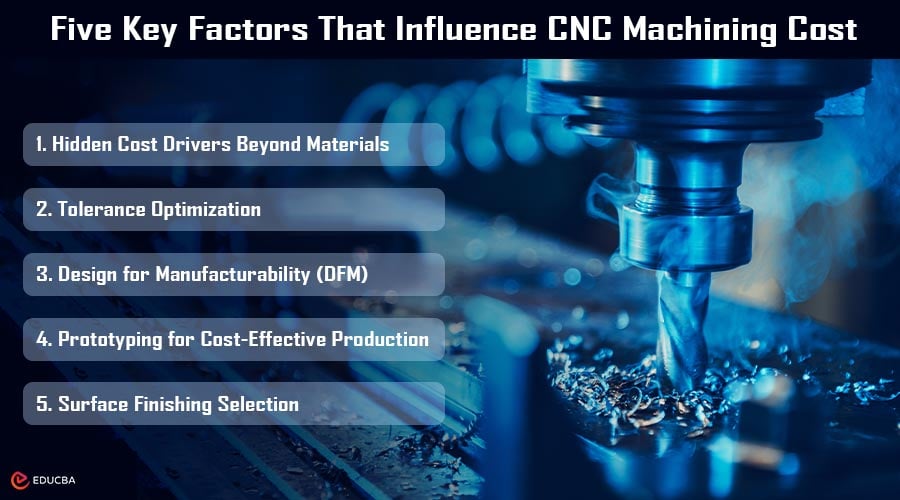
Five Key Factors That Influence CNC Machining Cost
Managing CNC machining costs requires understanding the factors that drive costs beyond material selection and hourly rates. Here are five essential factors:
1. Hidden Cost Drivers Beyond Materials
While cost analysis often starts with material selection, true cost optimization must consider factors such as fixture complexity, machine setup time, and CAM programming efficiency. A part requiring complex custom fixtures incurs higher upfront costs compared to one designed for standard workholding. Efficient toolpath programming can drastically reduce cycle times. Partnering with an experienced CNC machining provider equipped with advanced software and engineering expertise is the first step toward controlling these hidden expenses.
2. Tolerance Optimization
Tolerances are fundamental to precision, but not every feature requires ultra-tight specifications. A common and costly mistake is over-dimensioning parts with tolerances tighter than functionally necessary. Tighter tolerances exponentially increase costs by demanding more precise machinery, slower machining speeds, frequent quality checks, and higher scrap rates. Critical function analysis identifies essential tolerances and shows where loosening them can yield substantial savings.
Practical Example: A non-critical mounting hole can often use ±0.1mm instead of ±0.025mm. This simple adjustment can reduce costs by up to 40% without affecting part performance, especially when working with suppliers certified to ISO 9001:2015 or IATF 16949.
3. Design for Manufacturability (DFM)
A perfectly modeled CAD design can pose significant challenges for CNC machining, inadvertently driving up costs. Deep pockets require long-reach tools that reduce efficiency and increase vibration risk, while internal sharp corners necessitate expensive EDM operations.
How DFM Analysis Optimizes Designs?
DFM analysis proactively optimizes designs by recommending fillets, avoiding excessively deep cavities, and standardizing hole sizes. Reputable manufacturers often provide free DFM feedback during the quoting phase. This not only reduces costs but also enhances production efficiency and part quality. For specialized components like gears, detailed DFM must also account for machining specifics, such as tooth-profile accuracy and heat-treatment distortions.
4. Prototyping for Cost-Effective Production
The prototyping phase is the ideal time to optimize costs. During design validation, technologies such as 3D printing and quick-turn CNC prototypes enable low-cost checks of design, fit, and function. Every defect identified during prototyping is exponentially cheaper to rectify than those discovered during full-scale production. Additional insights into cost control in CNC rapid prototyping can improve efficiency and reduce costs.
Example: A nylon prototype made via SLS 3D printing can effectively simulate an injection-molded part. Once the design is validated, the transition to high-volume plastic injection molding becomes seamless, avoiding costly mold modifications later.
5. Surface Finishing Selection
Surface finish requirements influence both production time and post-processing costs. Over-specifying finishes unnecessarily increases CNC machining cost. For internal components, simple bead blasting might suffice instead of expensive anodizing or polishing.
Optimizing CNC machining parameters can also achieve a high-quality as-machined finish, minimizing the need for secondary finishing. Collaborating with your supplier to select finishes appropriate for the part’s function and application helps ensure cost efficiency.
Beyond Price: Key Factors for Choosing a Manufacturing Partner
The lowest quote does not always equate to the lowest total cost of ownership. A truly valuable manufacturing partner should offer:
- Comprehensive Capabilities: A full-service provider offering CNC machining, sheet metal fabrication, and injection molding can recommend the most suitable and cost-effective technology for your project.
- Robust Quality Assurance: Certifications such as ISO 13485 (medical) or AS9100D (aerospace) ensure product consistency and reliability, eliminating hidden costs from rework and delays.
- Transparent Communication and Project Management: Clear communication, from instant quoting to production tracking, ensures there are no surprises regarding costs or timelines.
- Expert Engineering Support: Professional advice on DFM and cost optimization from the outset saves money at the source.
Final Thoughts
Optimizing CNC machining cost goes far beyond comparing materials or hourly rates. By strategically focusing on tolerance management, DFM, prototyping, surface finishing, and choosing a capable manufacturing partner, companies can achieve substantial cost reductions. These measures not only save money but also improve part quality, reduce lead times, and enhance overall production efficiency. Implementing these hidden levers ensures that CNC machining projects are both cost-effective and reliable.
Author Bio:
JS Precision’s manufacturing experts provide this information, helping engineers and businesses tackle complex component challenges with high-quality precision CNC machining services.
Frequently Asked Questions (FAQs)
Q1. What are the biggest cost drivers in CNC machining?
Answer: Beyond material and machine time, key CNC machining cost drivers include part geometry complexity, tolerance requirements, surface finish specifications, and order quantity. Complex designs require longer programming and machining times.
Q2. Is CNC machining suitable for low-volume production?
Answer: Yes, it is ideal. CNC machining requires no custom tooling, offering great flexibility for low-volume production and rapid prototyping. For very high volumes, injection molding may be more economical.
Q3. How can I ensure the quality of CNC-machined parts?
Answer: Select a supplier with a robust quality control system. This should include First Article Inspection (FAI), in-process checks, and final inspection using equipment like Coordinate Measuring Machines (CMMs).
Q4. Which is cheaper to machine: aluminum or steel?
Answer: Generally, aluminum is easier and cheaper to machine than steel, resulting in less tool wear, faster cycle times, and lower costs. The final choice depends on the application’s strength, weight, and performance requirements.
Q5. How can companies ensure a smooth transition from prototype to mass production?
Answer: Partner with a supplier that offers full-service capabilities, from 3D printing and CNC prototyping to injection molding. This keeps design data consistent and lets insights from prototyping feed directly into mass production.
Recommended Articles
We hope this guide to reducing CNC machining cost helps streamline your manufacturing process. Check out these recommended articles for more tips and strategies to optimize your production expenses.

