


What is Universal Basic Income?
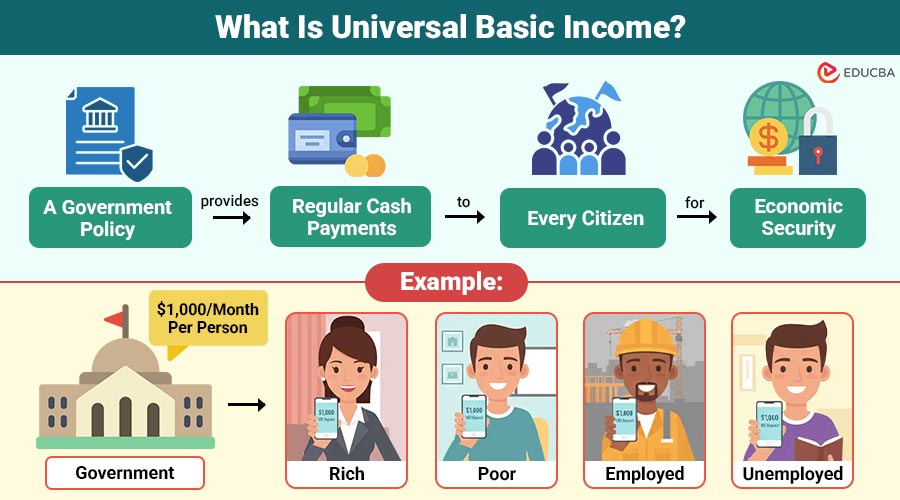
A universal basic income is a policy in which the government provides regular cash payments to every citizen, regardless of employment status, age, or income level.
Its key features are:
- Universal: Paid to everyone
- Unconditional: No eligibility or tests
- Periodic: Delivered monthly or weekly
- Individual: Given to each person, not household
- Cash-based: People choose how to spend it
Example:
If a government implements a $1,000/month UBI, every adult, rich, poor, employed, or unemployed receives $1,000 per month, no strings attached.
Table of Contents
- Introduction
- Why is UBI Gaining Global Attention?
- How Universal Basic Income Works?
- Real-Life Examples
- Criticisms and Challenges
- Different Types of Basic Income Models
- Can UBI Work in Developing Countries?
- Is UBI the Solution for the Future?
Why is UBI Gaining Global Attention?
Several trends have revived the interest in UBI:
- Automation and Job Loss: Machines and AI are replacing workers at a faster rate than new jobs are being created. For example, Self-checkout systems replaced thousands of cashier roles globally. UBI aims to provide income security even when traditional jobs disappear.
- Income Inequality: Wealth gaps are widening, creating pressure for social reforms. UBI can act as a floor, ensuring no one falls into extreme poverty.
- Gig Economy Growth: Freelancers, delivery riders, drivers, and digital gig workers often experience unstable incomes. UBI helps stabilize their financial uncertainty.
- Rising Living Costs: In many countries, housing, education, and healthcare expenses have skyrocketed. A monthly basic income can help citizens cope with inflation.
Q. Will people stop working if they receive UBI?
A: Evidence from global trials shows most people continue working. Some even work more due to reduced stress.
How Universal Basic Income Works?
UBI programs differ based on the country and policy, but generally follow this structure:
1. Fixed Payment Amount
Governments determine a monthly or annual amount to cover basic living expenses. Example:
- Finland’s UBI pilot gave €560 per month.
2. Eligibility
In pure UBI:
- Everyone gets it.
- But some modified versions exclude high-income groups to reduce costs.
3. Funding Sources
UBI can be funded through:
- Income tax
- Wealth tax
- Carbon tax
- Automation/robot tax
- VAT (Value Added Tax)
- Removal of other welfare schemes
4. Payment Distribution
UBI payments are typically sent directly to individuals using:
- Bank transfers
- Digital wallets or government apps
- Postal banking systems
Real-Life Examples of UBI Around the World
Many countries have tested UBI with pilot programs. Here are the most notable examples:
1. Finland’s UBI Experiment (2017–2018)
Gave €560 per month to 2,000 unemployed citizens. No conditions attached.
Results:
- Improved mental well-being and happiness
- Increased motivation to work
- People took more part-time and freelance jobs without fear of losing benefits.
2. Alaska Permanent Fund (USA)
Although not a full UBI, Alaska pays every resident $1,000–$2,000 per year, financed from oil revenues.
Impact:
- Reduced poverty
- Boosted consumer spending
- No drop in employment rates
3. Kenya’s Long-Term UBI Program
Run by the charity GiveDirectly, thousands receive $22–$40 per month, some for more than 10 years.
Outcome:
- Higher economic activity
- Better nutrition
- Increased micro-business creation
4. India’s UBI Discussions and Pilots
India has not implemented UBI nationally, but a pilot in Madhya Pradesh gave basic income to 6,000 villagers.
Results showed:
- Better school attendance
- Improved nutrition
- Growth in small businesses
- Increased financial independence among women
India’s Economic Survey (2016–17) recommended UBI as a promising solution for poverty reduction.
Criticisms and Challenges of Universal Basic Income
While UBI has strong advocates, it also faces criticism.
- High Funding Requirements: Critics argue that UBI may be too expensive for governments, especially in developing countries. For example, offering ₹1,000/month to every Indian adult would cost trillions annually.
- Potential Inflation: Some economists worry that increasing purchasing power may lead to higher prices. However, evidence from pilot programs shows minimal inflation, especially when UBI is modest and targeted at essentials.
- Risk of Reduced Work Motivation: A common concern is that individuals may become less motivated to work if they receive free money. But real-world trials show the opposite: employment generally increases, people shift to better jobs, and healthier recipients become more productive.
- Political and Public Resistance: Individuals accustomed to traditional welfare systems may resist change. Governments may also struggle to allocate funding without facing opposition.
- Risk of Cutting Other Welfare Services: Some fear that UBI could replace essential programs, such as healthcare, pensions, or disability support. Experts suggest UBI should complement, not replace existing systems.
Different Types of Basic Income Models
UBI often gets confused with other welfare systems. Below are the distinctions:
| Model | Description | Target Group | Conditional |
| Universal Basic Income (UBI) | Unconditional cash to everyone | All citizens | No |
| Negative Income Tax (NIT) | Income top-up for low earners | Below the income threshold | No |
| Guaranteed Minimum Income | Minimum support for the poor | Low-income individuals | Yes |
| Conditional Cash Transfers | Grants tied to education, vaccination, etc. | Vulnerable groups | Yes |
Q. Can UBI replace all welfare programs?
A: Not always. Some targeted programs may still be necessary for specific needs.
Can UBI Work in Developing Countries?
Developing nations, such as Brazil, India, and South Africa, face challenges including large populations, limited budgets, and administrative complexities. However, these countries also stand to gain the most because:
- Poverty rates are higher
- Informal employment is widespread
- Cash transfers can significantly improve living standards
India has already experimented with targeted basic income programs and could consider phased implementation, starting with vulnerable groups.
Is UBI the Solution for the Future?
UBI is not a magic solution, but it is a powerful tool when combined with:
- Job creation programs
- Education and reskilling
- Affordable healthcare
- Progressive taxation
If implemented well, UBI can:
- Reduce poverty
- Support vulnerable communities
- Empower innovation
- Strengthen economic resilience
Its simplicity, fairness, and universal nature make it one of the most compelling social policies of today.
Final Thoughts
Universal basic income is no longer a futuristic concept it is a practical policy under serious discussion worldwide. While challenges remain, evidence from real-world trials shows that UBI can reduce poverty, improve mental well-being, support employment, and stimulate economic growth. As countries prepare for a future shaped by automation and inequality, UBI emerges as a powerful tool that could redefine social welfare. Whether it becomes a global reality depends on political will, economic adaptation, and societal openness to reimagining how we support human potential.
“If you had a guaranteed $1,000 every month, how would it change your life? Would you start a business, go back to school, or travel? UBI is not just policy it is a conversation about the future of work, fairness, and opportunity.”
Recommended Articles
We hope this detailed guide on universal basic income helps you understand its impact and potential. Check out these recommended articles for more insights and perspectives on related economic topics.


