


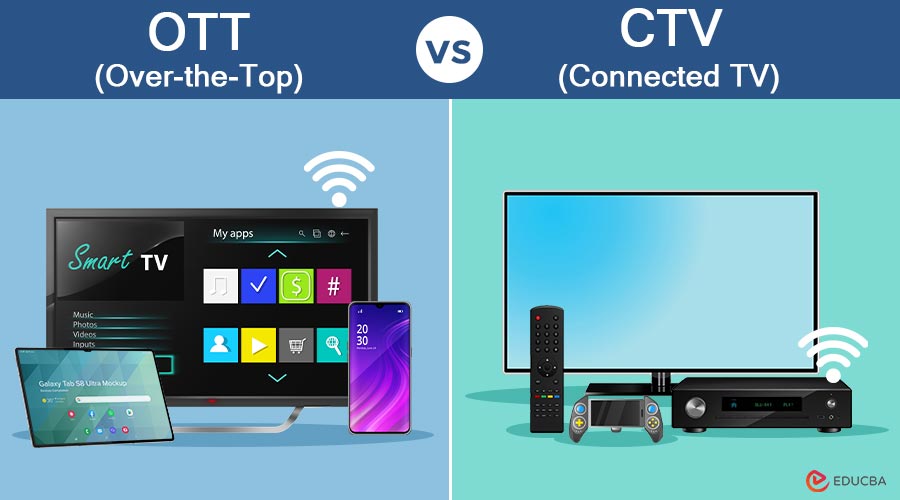
Introduction
In today’s digital landscape, entertainment consumption has shifted from traditional TV to streaming platforms. OTT (Over-the-Top) and CTV (Connected TV) dominate this evolution, offering new ways to access content. Though often confused, they differ significantly. Understanding these distinctions—especially in the context of OTT vs CTV—helps marketers and advertisers craft effective digital video strategies and better engage modern streaming audiences. This blog examines the concepts of OTT and CTV, their differences, and the distinct roles they play within the streaming ecosystem.
Table of Contents:
- Introduction
- What is OTT?
- What is CTV?
- Key Differences
- Advantages
- Disadvantages
- Use Cases
- How do OTT and CTV Work Together?
What is OTT?
OTT (Over-the-Top) refers to the delivery of video content over the internet, bypassing traditional cable or satellite television providers. Users can access OTT content through apps or websites on a range of devices, including smartphones, tablets, desktops, smart TVs, and streaming sticks.
Features:
- Internet-Based Delivery: Content is streamed directly via the internet rather than through cable or satellite.
- Device Flexibility: Accessible on multiple devices—TVs, mobiles, tablets, or desktops.
- On-Demand Viewing: Users can start, pause, and resume content at any time.
- Subscription and Freemium Models: Includes both paid (SVOD) and ad-supported (AVOD) models.
Examples of OTT Platforms:
- Netflix
- Amazon Prime Video
- Disney+ Hotstar
- YouTube
What is CTV?
CTV (Connected TV) refers to any television set that is connected to internet, allowing users to stream digital content. This includes smart TVs or TVs connected through devices such as Roku, Amazon Fire Stick, Apple TV, or gaming consoles like Xbox or PlayStation. CTV is the hardware or device used to access OTT content.
Features:
- Big-Screen Experience: Offers a television-style viewing experience through internet streaming.
- App Ecosystem: Supports downloadable apps, including Netflix, YouTube, and Hulu.
- Ad Targeting: Enables addressable advertising and audience segmentation.
- Shared Viewing: Often used by multiple viewers, unlike mobile devices.
Examples:
- Watching Netflix through a Samsung Smart TV connected to Wi-Fi.
- Streaming YouTube using a Roku stick plugged into a traditional TV.
Key Differences Between OTT and CTV
Here is a comparison table highlighting the main differences:
| Parameter | OTT | CTV |
| Definition | Method of delivering content via the internet | Device connected to the internet for streaming content |
| Focus Area | Content and platform | Hardware or device |
| Examples | Netflix, Hulu, Amazon Prime Video | Roku, Apple TV, Smart TV, Chromecast |
| Device Type | Smartphones, tablets, PCs, Smart TVs | Smart TVs and streaming devices |
| Usage Model | On-demand or live streaming | Primarily large-screen streaming |
| Advertising Type | App-based or platform-based | Device-based and screen-specific |
| Internet Dependency | Requires internet access | Requires internet and a compatible device |
| Audience Measurement | Based on user accounts or app data | Based on household device usage |
| Monetization Models | Subscription (SVOD), Ad-based (AVOD), Transactional (TVOD) | Ad-supported and app-integrated |
| Viewing Experience | Personalized and portable | Shared and immersive |
Advantages of OTT and CTV
Here are the key advantages that make OTT and CTV essential components of the modern streaming ecosystem.
Advantages of OTT:
- Offers complete on-demand flexibility, allowing users to watch content at any time, from anywhere.
- Provides seamless global access to diverse content across multiple genres and languages.
- Provides tailored suggestions based on watching habits and user preferences.
- Features affordable subscription plans compared to traditional cable or satellite TV services.
Advantages of CTV:
- Creates an immersive large-screen experience with superior audio-visual streaming quality.
- Drives higher ad engagement and brand recall through captivating, full-screen visuals.
- Enables advanced audience targeting using precise household viewing and behavioral data.
- Encourages shared family entertainment experiences on a single connected home device.
Disadvantages of OTT and CTV
Here are the disadvantages associated with OTT and CTV platforms:
Disadvantages of OTT:
- Shorter attention spans reduce viewer engagement, making consistent message retention more challenging.
- Ad blockers on many devices significantly limit advertisers’ ability to reach audiences.
- Fragmented platforms require multiple apps, complicating user journeys and reducing seamless viewing experiences.
- High content competition makes it difficult for brands to capture sustained viewer interest.
Disadvantages of CTV:
- Higher advertising costs limit accessibility for smaller brands with restricted marketing budgets
- Limited interactivity reduces real-time engagement and restricts advanced performance-driven campaign capabilities
- Smaller audience base compared to mobile OTT reduces overall potential reach for advertisers
- Measurement inconsistencies across devices challenge accurate campaign performance tracking and optimization efforts.
Use Cases of OTT and CTV
Here are the key real-world use cases that showcase how OTT and CTV are utilized across various industries.
Use Cases of OTT:
- Media and Entertainment Companies: Utilize OTT services to distribute movies, series, and live events globally, eliminating the need for cable or satellite networks.
- Content Creators and Influencers: Leverage platforms like YouTube or Twitch to publish videos directly to audiences and monetize through ads or subscriptions.
- Sports Broadcasters: Stream live matches, highlights, and commentary through OTT apps, reaching audiences beyond geographical boundaries.
- Consumers: Enjoy flexible, on-demand entertainment accessible on smartphones, tablets, and laptops, customized to personal viewing habits.
Use Cases of CTV:
- Advertisers: Deliver interactive, high-impact video ads to households through smart TVs and streaming devices with advanced targeting and measurable results.
- Brands and Retailers: Utilize CTV campaigns to boost brand awareness, launch new products, or promote seasonal offerings with engaging storytelling.
- Streaming Platforms and App Developers: Integrate apps such as Netflix, Hulu, or YouTube on CTV devices to enhance user experience and expand accessibility.
- Media Agencies: Combine linear TV and CTV ad placements for a unified, cross-platform marketing strategy that maximizes viewer engagement.
How do OTT and CTV Work Together?
OTT and CTV are not competitors but rather complementary components of modern streaming. OTT delivers the content, and CTV serves as one of the main devices for accessing that content.
For instance:
- OTT = Netflix app
- CTV = Smart TV or Fire Stick used to watch Netflix
As consumers move toward cord-cutting, the integration of OTT and CTV ensures a seamless experience—combining the personalization of OTT with the big-screen appeal of traditional TV.
Final Thoughts – OTT vs CTV
OTT and CTV together are revolutionizing how audiences consume entertainment. While OTT powers on-demand content delivery, CTV enhances it with an immersive, shared viewing experience. For businesses and advertisers, leveraging both platforms ensures broader reach, deeper engagement, and smarter targeting—making them essential pillars of the modern digital streaming ecosystem.
Frequently Asked Questions (FAQs)
Q1. Is OTT the same as CTV?
Answer: No. OTT is the method of delivering content via the internet, while CTV refers to the device used to stream that content.
Q2. Which is better for advertising—OTT or CTV?
Answer: Both have advantages. OTT offers cross-device reach and personalization, while CTV provides a large-screen, immersive experience with household-level targeting.
Q3. Can you watch OTT content without a CTV?
Answer: Yes. OTT content can be streamed on smartphones, tablets, and laptops—not just on connected TVs.
Q4. What is the future of OTT vs CTV?
Answer: OTT and CTV will continue to grow together, offering hybrid content experiences, smarter ad targeting, and increased viewer control.
Recommended Articles
We hope that this EDUCBA information on “OTT vs CTV” was beneficial to you. You can view EDUCBA’s recommended articles for more information.

